{"url":"https://www.zooplus.co.uk/magazine/dog/dog-health-and-care/skin-cancer-in-dogs-symptoms-treatment-life-expectancy","title":"Skin Cancer in Dogs: Symptoms, Treatment & Life Expectancy","mag_id":414303,"is_single":true,"cat_name":"Dog","sub_cat_id":143,"sub_cat_name":"Dog Health and Care","cat_id":3410}
Have you just been cuddling your four-legged friend and suddenly noticed scabs on the skin beneath their coat, a thickening or a small lump? If so, your vet should definitely take a look at these skin changes. After all, skin cancer in dogs is quite common.
Symptoms: What Does Skin Cancer in Dogs Look Like?
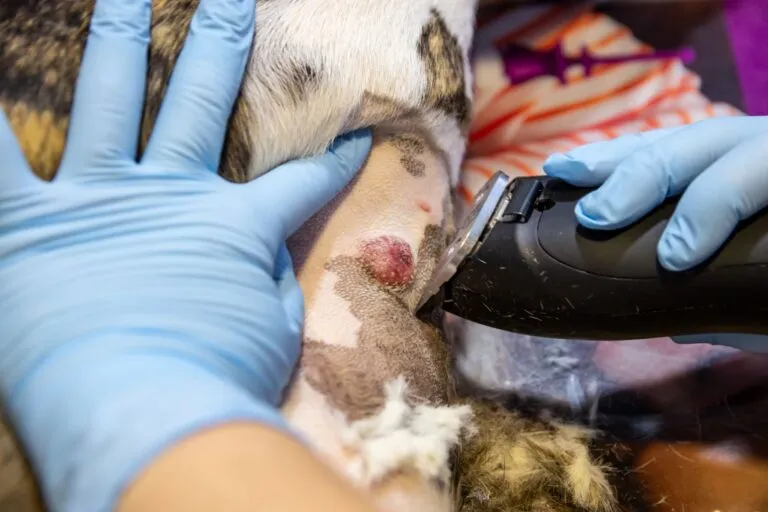
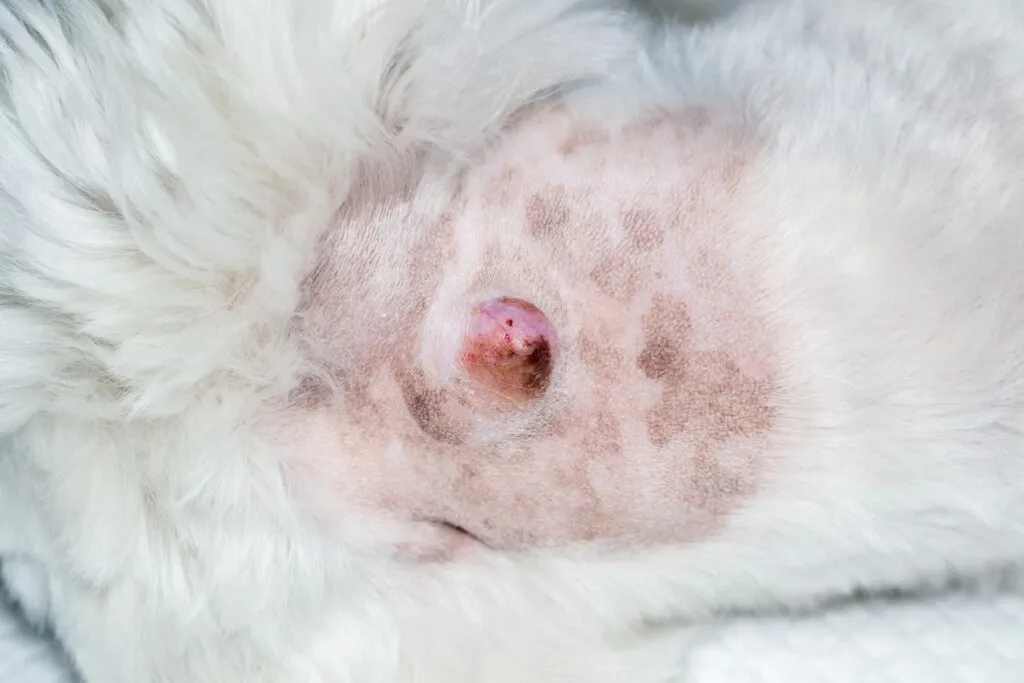
Skin cancer in dogs can take various forms. Depending on the tissue of origin, the tumour may be attached to the surrounding tissue or moveable within the skin. Some skin tumours also tend to become inflamed, form cauliflower-like growths or cause bleeding.
Typical Signs: How to Recognise Skin Cancer in Dogs
If you have a short-haired dog, you’re more likely to spot skin cancer early. However, tumours can easily go unnoticed in the long coat of long-haired breeds, unless they grow on the head or on the toes.
These tumours are often only noticed once they have reached a certain size or if the dog starts to limp due to reduced mobility. In addition, dogs with skin cancer may show general symptoms such as itching, frequent licking or increased tiredness.
Skin cancer in dogs can occur on various parts of the body.
Diagnosis: How Is Skin Cancer in Dogs Identified?
The first step in diagnosis is for the vet to feel the tumour and the surrounding tissue. They will assess the consistency, size, possible inflammation and whether the tumour can be moved.
What Does Skin Cancer Look Like in the Early Stages?
Skin tumours are not uncommon in veterinary practices. If you’ve noticed a swelling on your pet’s skin, you should have it examined by your vet as soon as possible.
To determine the type of tumour, the vet will then perform a fine needle aspiration. This involves taking a small sample of tumour cells from your dog using a very fine needle. The cells are placed on a slide so they can be examined for abnormalities under a microscope.
Has the Tumour Spread?
If your vet wants the tissue analysed by a specialised laboratory, they may also carry out a biopsy. This involves taking a larger tissue sample from your dog using a biopsy punch.
Your vet will also feel your dog’s lymph nodes to rule out metastases. If they are significantly enlarged, imaging techniques such as X-rays can be used to assess the structure of internal organs such as the lungs or liver.
Treatment: How Is Skin Cancer in Dogs Treated?
Treatment for a skin tumour in dogs depends on several factors, including the type, severity and location, and whether the tumour is growing invasively or has formed metastases.
The following therapeutic measures may be used individually or in combination to treat skin tumours:
surgical excision (removal of the tumour)
chemotherapy
radiotherapy
immunotherapy
dendritic cell therapy
Supportive Therapy
If the tumour has metastasised to the nearby lymph nodes, the vet may remove these as well. In addition to treating the underlying cause, supportive measures can help to relieve your dog’s discomfort.
These include, for example, acid blockers (e.g. omeprazole), which protect the stomach from inflammation of the stomach lining (gastritis) and stomach ulcers.
Causes: What Leads to Skin Cancer in Dogs?
The skin is the dog’s largest organ and protects the body from external influences such as UV rays and toxic substances.
These environmental factors can damage skin cells and trigger skin cancer. In addition, breed-related and genetic factors often play a role in the development of cancer.
Which Dog Breeds Are Prone to Skin Cancer?
Skin cancer is observed more frequently in some dog breeds, including:
Skin cancer in dogs can have different appearances. There are various types of tumours, which differ in their characteristics and can therefore be benign or malignant.
Benign Tumours
Basal cell tumour (basalioma): Middle-aged dogs, as well as Poodles and Cocker Spaniels, have an increased risk of developing benign basal cell tumours. These button-like growths can usually be removed surgically without difficulty.
Cutaneous histiocytoma: This type is one of the most common benign skin tumours in dogs. It often disappears on its own. Typically, this tumour has a button-like shape. The skin on the legs and head is particularly commonly affected.
Lipoma: Older dogs in particular are prone to developing benign tumours of fatty tissue (lipomas). They appear as soft, moveable swellings beneath the skin. As a rule, lipomas do not affect a dog’s health, but as they grow larger they can restrict your dog’s mobility.
Papilloma (warts): Papillomas are benign skin tumours. They occur in two different forms: in young dogs as part of viral papillomatosis, which leads to stalk-like to cauliflower-shaped growths, and more rarely in older dogs.
Malignant Tumours
Mast cell tumour: Malignant mast cell tumours are very common in dogs, particularly in Boxers. They usually develop on the limbs, head, around the anus and in the genital area and tend to form metastases within the body. Because they also grow invasively, mast cell tumours require extensive surgical removal.
Melanoma: Melanomas are predominantly malignant when found in the oral mucosa and on the toes. Such malignant melanomas (also known as black skin cancer) often spread to nearby lymph nodes, the lungs and organs in the abdominal cavity. However, melanomas can also develop on haired areas of skin, where they are more likely to be benign skin tumours.
Squamous cell carcinoma: This form is a malignant skin tumour that occurs particularly in lightly pigmented dogs. It most commonly appears in the mouth, on the toes or on the abdomen along the mammary line. In these areas, the carcinoma can form flat or cauliflower-like skin changes, and the tumour often develops ulcers.
Sarcoma: Sarcomas are malignant skin tumours that arise, for example, from connective tissue (fibrosarcoma), muscle (rhabdomyosarcoma) or the lining cells of blood vessels (haemangiosarcoma). Due to this variety, soft tissue sarcomas can occur anywhere in the dog’s body and tend to grow invasively and metastasise.
Prognosis: How Long Can a Dog Live with Skin Cancer?
Not all skin cancer is the same. Unfortunately, it’s not possible to generalise about this skin condition in terms of chances of recovery and life expectancy.
While benign skin tumours usually have a good prognosis if treated early, some skin tumours are unfortunately not treatable.
Prevention: How Can I Protect My Dog from Skin Cancer?
Unfortunately, you cannot completely protect your dog from skin cancer. However, you can avoid factors that contribute to its development.
Sun Protection and Cancer Screening at the Vet
Make sure you protect your dog from strong sunlight. Also prevent them from having access to chemicals and other toxic substances. In addition, you should check your dog regularly for skin changes so they can be assessed and treated at an early stage.
In general, it’s advisable to arrange an annual health check for your four-legged friend, including cancer screening at the vet.
Conclusion: Suspect Skin Cancer? Head to the Vet
Harmless wart or malignant tumour? It’s not always easy to tell the difference between these skin changes. A visit to the vet will provide clarity: only a thorough examination of the affected tissue can determine whether your dog has skin cancer. Depending on the type and location of the tumour, your vet will choose the most appropriate treatment for your pet.
Important Note: The content provided for informational purposes only and is not intended to replace professional veterinary advice, diagnosis or treatment. If you have any questions or concerns about your pet's health, please always consult a licensed veterinarian.
This article was translated using Artificial Intelligence from the original German zooplus Magazine. While the original content was authored by industry experts and reviewed by our editorial team, this automated translation has not been human-edited and is provided for informational purposes.
At the Justus-Liebig-University of Giessen I was extensively trained as a veterinarian and was able to gain experience in various fields such as small animal, large animal and exotic animal medicine as well as pharmacology, pathology and food hygiene.
Since then, I have been working not only as a veterinary author, but also on my scientifically driven dissertation. My goal is to better protect animals from pathogenic bacterial organisms in the future.
Besides my veterinary knowledge, I also share my own experiences as a happy dog owner and can thus understand and enlighten fears and problems as well as other important questions about animal health.
When does a female dog’s first season begin? How often and for how long is a female dog in season? And what symptoms does a female dog in season show? Find out everything you need to know about these “hot days” and how you and your dog can get through the season calmly and stress-free in the following article.
16 February 2024 |Leishmaniasis is an infectious disease transmitted by sandflies and can often prove fatal for dogs. Find out how you can protect your dog and how to recognise and treat the disease should it emerge.
Neutering has traditionally been a standard veterinary practice, but is it universally recommended? What distinguishes neutering from sterilisation and what expenses should a dog owner anticipate? Here, you can discover all the essential information concerning the advantages and disadvantages of neutering your dog.