{"url":"https://www.zooplus.co.uk/magazine/dog/dog-health-and-care/dog-faeces-what-colour-and-consistency-reveal","title":"Dog Faeces: What Colour and Consistency Reveal","mag_id":416053,"is_single":true,"cat_name":"Dog","sub_cat_id":143,"sub_cat_name":"Dog Health and Care","cat_id":3410}
Your dog's intestines play a central role in their overall health. If the digestive system is disrupted, your dog's poo can change. Have you noticed that your dog's poo is slimy, yellow, black or red? If you also spot worms or blood in your dog's poo, you should take action. Find out more about other warning signs, as well as the ideal consistency and colour of healthy dog poo.
Dogs sometimes eat spoiled food while out on walks or drink from stagnant water. It’s not unusual for them to develop diarrhoea or vomit comes from.
However, if your dog’s poo does not return to normal after one or two days or if your dog shows other signs of illness, you should take them to your vet as a precaution. This is important so that serious illnesses can be ruled out or treated at an early stage.
Take Extra Care with Puppies
In these cases, you should also not wait too long, as an early visit to the vet can be life-saving in an emergency. This is particularly important for puppies or small dogs, as severe diarrhoea at this age can lead even more quickly to significant fluid and electrolyte loss and consequently to dehydration in dogs.
You should also consult your vet if your dog’s poo looks different than usual, has a noticeably unusual colour or even contains blood.
A Reflection of Your Dog’s Health
The consistency, contents and colour of your dog’s poo can provide clues about their health. The following points will help you understand what your four-legged friend’s poo says about their wellbeing.
Note: Choosing a suitable dietary dog food or dog food supplement can support your dog’s natural bodily functions. Please note, however, that dietary foods cannot cure or prevent illnesses. You should also always discuss the right diet for your dog with your vet.
Dog Poo Consistency: Not Too Hard and Not Too Soft
The condition of your dog’s poo says a lot about their current state of health. The consistency may be either too hard or too runny:
1. Diarrhoea
If your dog’s poo is too soft, this is diarrhoea. If it occurs suddenly and lasts for less than a week, it is considered acute diarrhoea.
If your dog suffers from diarrhoea for at least three weeks or repeatedly experiences it, it is classed as chronic diarrhoea.
This distinction is important because these factors provide clues about the cause and largely determine the treatment. While acute diarrhoea usually disappears quickly with symptomatic treatment such as infusions, dogs with chronic diarrhoea often require additional medication such as antibiotics, antiparasitic treatments or immunosuppressants.
Infectious diseases: Viruses such as parvovirus or coronavirus, bacteria such as Campylobacter spp. or Salmonella spp., parasites such as roundworms or giardia
Cancer: lymphoblastic intestinal lymphoma or mast cell tumour
Medication: antibiotics or non-steroidal anti-inflammatory drugs
2. Hard Dog Poo
The large intestine has the important job of removing water from the stool. However, if the intestinal contents remain in the large intestine for too long, the stool becomes increasingly dry and compact – resulting in hard dog poo.
Hard stools are therefore an indication that the large intestine is mechanically or functionally impaired. A functional disorder can occur, for example, following surgery or poisoning.
A mechanical disorder, on the other hand, occurs when the intestine is blocked by foreign objects or narrowed by a tumour, for example.
However, feeding too many bones can also make your dog’s poo very hard.
Additions: What Do Strands or Mucus in Dog Poo Mean?
Sometimes you may notice additions such as blood, strands or mucus in your dog’s poo. These are also important signs that you should mention to your vet.
Strands: If you find white, narrow strands in your dog’s poo, they could be hairs or worms. If you suspect a worm infestation, you should definitely have a stool sample tested so your dog can receive targeted worming treatment. Too much fur in the stool can be a sign of an allergy or significant stress. You should also discuss this with your vet.
Mucus: Sometimes dog poo is coated with mucus. This is mainly caused by inflammation of the lining of the large intestine.
This dog faeces is noticeably yellow in colour and indicates an intestinal illness.
Dog Poo Colours: Be Cautious of Changes
In healthy dogs, the gallbladder releases bile, which contains the yellow pigment bilirubin – this is why dog poo is normally brown.
The colour of your dog’s poo can vary slightly if their diet or water intake changes. Colourings in food, such as carotene from carrots, can also cause changes in stool colour.
This type of change is usually nothing to worry about. However, colour changes can also occur that may indicate health problems. These include:
Yellow Dog Poo
Yellow dog poo may indicate problems with the pancreas, gallbladder or liver.
Red Dog Poo / Blood in Dog Poo
Red dog poo points to bleeding in the lower digestive tract.
Black Dog Poo
Black dog poo is caused by bleeding in the upper digestive tract (melaena) comes from.
White Dog Poo: Beware of “Bone Poo”!
White dog poo can have various causes. For example, it may be a sign of impaired fat digestion.
Your dog’s poo can also turn white if they have, for example, eaten too many bones and therefore consumed a large amount of calcium. This also makes the stool dry and usually “rock hard” – which is where the term “bone poo”comes from.
Warning: Bone poo can be dangerous for your dog, as it may injure the intestinal wall or even cause an intestinal blockage.
Make sure you do not feed your dog too many bones, as hard bone poo can cause your pet severe problems and even pain when passing stools.
To spot changes in your dog’s poo early on, you should know what the ideal conditions look like:
The Poo Scale: What Should Dog Poo Ideally Look Like?
When assessing dog poo, vets sometimes use a numerical system from 1 to 7 – similar to the Bristol Stool Chart used in human medicine.
This system mainly evaluates the consistency of dog poo, where 1 stands for “very hard” and 7 for “liquid”.
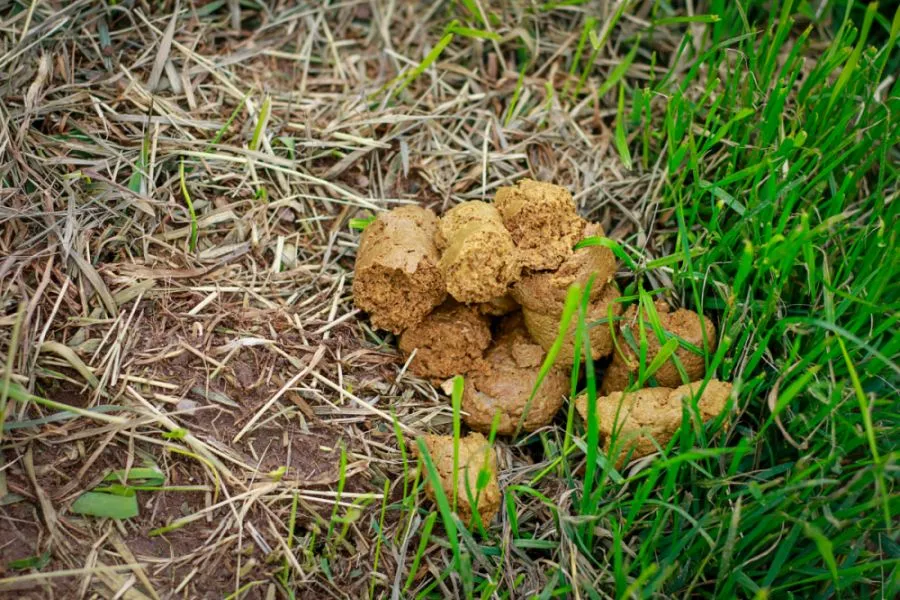
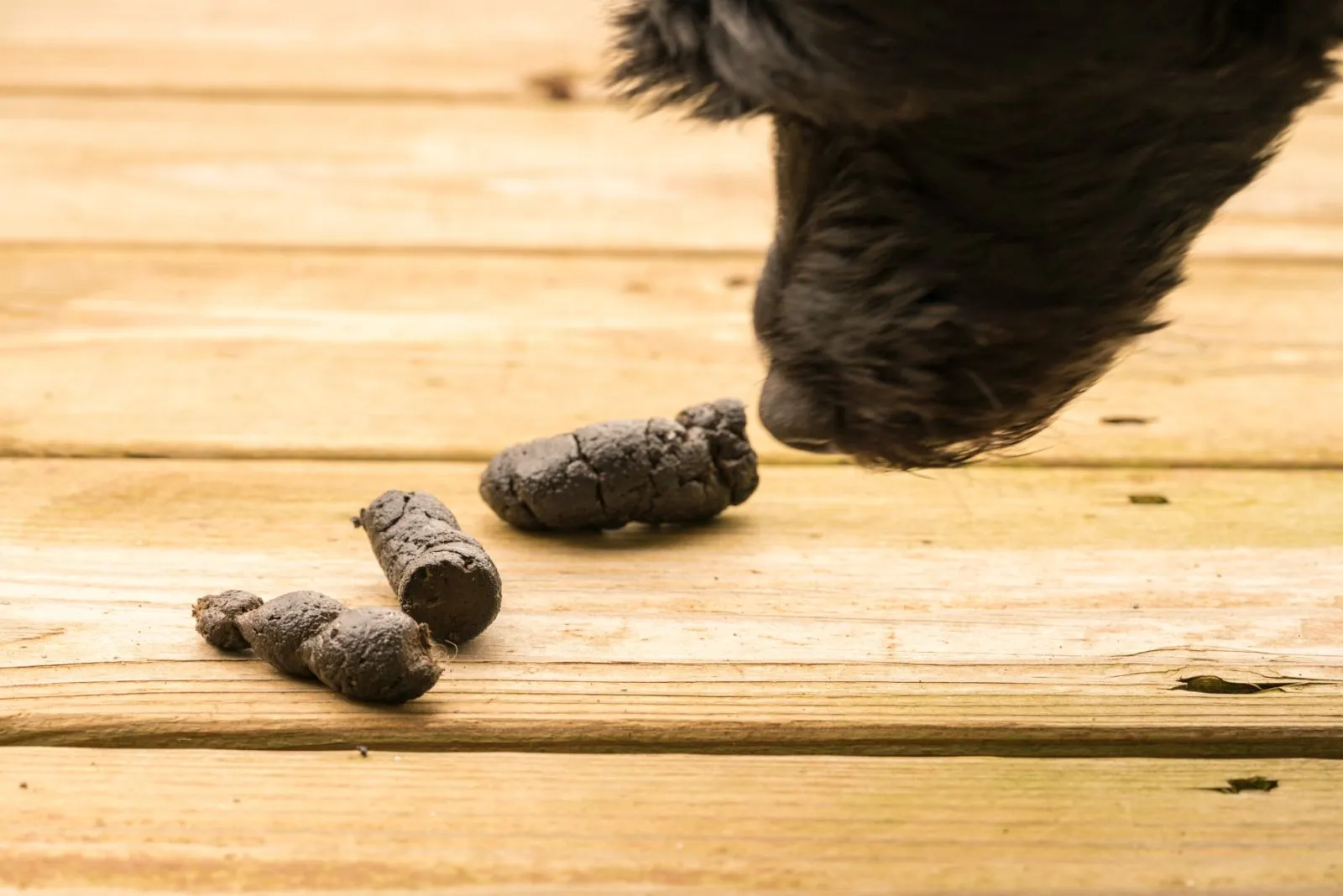
The perfect dog poo scores a 2 or 3: It should be chocolate brown and compact. It should be easy to pick up and feel like modelling clay. It should also be moist but not watery.
How often Should Dogs Pass Stools?
On average, dogs pass stools around once or twice a day. However, the amount depends on various factors and can therefore vary from dog to dog. Factors include the dog breed, the type of food and the quantity fed.
What Is Dog Poo Made Of?
What your dog’s poo consists of depends on individual factors such as their diet. However, a significant proportion is made up of water – more than 75%.
The rest is dry matter, 80% of which consists of organic compounds. These include:
Microorganisms such as bacteria,
indigestible food components such as fibre,
shed epithelial cells from the intestine and
secretions from the gastrointestinal tract such as bile pigments and bile acids.
What Causes the Unpleasant Smell of Dog Poo?
Every dog owner knows just how bad dog poo can smell. However, this is a completely normal characteristic of faeces, caused by putrefaction gases and fermentation products.
However, if the smell becomes overwhelming and other changes in the stool occur, it is definitely time to consult your vet.
Important Note: The content provided for informational purposes only and is not intended to replace professional veterinary advice, diagnosis or treatment. If you have any questions or concerns about your pet's health, please always consult a licensed veterinarian.
This article was translated using Artificial Intelligence from the original German zooplus Magazine. While the original content was authored by industry experts and reviewed by our editorial team, this automated translation has not been human-edited and is provided for informational purposes.
At the Justus-Liebig-University of Giessen I was extensively trained as a veterinarian and was able to gain experience in various fields such as small animal, large animal and exotic animal medicine as well as pharmacology, pathology and food hygiene.
Since then, I have been working not only as a veterinary author, but also on my scientifically driven dissertation. My goal is to better protect animals from pathogenic bacterial organisms in the future.
Besides my veterinary knowledge, I also share my own experiences as a happy dog owner and can thus understand and enlighten fears and problems as well as other important questions about animal health.
When does a female dog’s first season begin? How often and for how long is a female dog in season? And what symptoms does a female dog in season show? Find out everything you need to know about these “hot days” and how you and your dog can get through the season calmly and stress-free in the following article.
16 February 2024 |Leishmaniasis is an infectious disease transmitted by sandflies and can often prove fatal for dogs. Find out how you can protect your dog and how to recognise and treat the disease should it emerge.
Neutering has traditionally been a standard veterinary practice, but is it universally recommended? What distinguishes neutering from sterilisation and what expenses should a dog owner anticipate? Here, you can discover all the essential information concerning the advantages and disadvantages of neutering your dog.