{"url":"https://www.zooplus.co.uk/magazine/dog/dog-health-and-care/distemper-in-dogs-causes-symptoms-and-treatment","title":"Distemper in Dogs: Causes, Symptoms and Treatment","mag_id":417041,"is_single":true,"cat_name":"Dog","sub_cat_id":143,"sub_cat_name":"Dog Health and Care","cat_id":3410}
A few days ago, a puppy moved into your home. Suddenly, they seem lethargic and are showing signs of illness such as diarrhoea or nasal discharge? In the worst-case scenario, your dog’s symptoms could be caused by distemper. Read on to find out everything you need to know about this dangerous viral infection.
Distemper is a highly contagious viral disease. Young and unvaccinated dogs in particular often become seriously ill and may die within just a few days. Even if the dog survives the infection, they often suffer from the long-term effects of the disease for the rest of their life.
Can Humans Catch Distemper?
Although the virus that causes canine distemper is closely related to the measles virus, it appears to be harmless to humans. There are no known cases of transmission to humans.
Causes: How Does the Disease Develop?
Distemper in dogs is caused by the canine distemper virus. Medical professionals also refer to it as Carré’s disease or canine distemper. Unvaccinated dogs with a weakened immune system due to illness, stress or age are particularly at risk. However, dogs most commonly contract distemper between three and six months of age.
The canine distemper virus belongs to the Paramyxoviridae family and spreads quickly. Transmission occurs through contact with secretions and excretions such as saliva, urine and faeces from infected animals.
Infection in the Womb
Other dogs become infected when they inhale or ingest the virus. The placenta of the mother dog can also transmit the virus to the puppies. In this case, the disease only breaks out once the puppy has been weaned off its mother’s milk and is no longer receiving maternal protective proteins (maternal antibodies).
The canine distemper virus occurs worldwide, including in Germany. Alongside dogs, foxes, bears, martens, seals and hyenas can also become infected. Cats do not become infected.
What Does the Distemper Virus Do in a Dog’s Body?
If the distemper virus is inhaled through the air, its first point of attack is the surface of the respiratory tract (respiratory epithelium). There, the viruses infect certain cells of the innate immune system in the dog, known as scavenger cells (macrophages).
Normally, scavenger cells recognise pathogens such as bacteria and viruses and eliminate them. However, distemper viruses survive inside the scavenger cells and also multiply rapidly within them.
Various Organs Affected
After just a few hours, the viruses spread via the lymphatic system to the lymph nodes and other lymphatic organs such as the spleen and liver. Later, the viruses are then distributed through the bloodstream throughout the dog’s entire body within a very short time. The main targets are the urinary, reproductive and respiratory tracts as well as the nervous system.
Symptoms: What Are the Signs of Distemper?
In healthy dogs with an unaffected immune system, distemper usually progresses without any symptoms. However, if the immune system is already severely weakened, the disease often becomes apparent after around two weeks with severe symptoms. These are accompanied by various signs of illness.
Typical Signs of Distemper
High fever and poor general condition
Gastrointestinal complaints: vomiting, diarrhoea, dehydration, loss of appetite, weight loss
Respiratory complaints: sneezing and coughing, eye discharge, nasal discharge, tonsillitis and pneumonia with breathing difficulties
Central nervous system complaints: head tilt, lameness, seizures, blindness and regular muscle twitching (distemper tic), encephalitis (old dog encephalitis)
Skin complaints: excessive skin formation on the nose and paw pads (hyperkeratosis, hard pad disease) as well as skin inflammation
Dental problems: If a puppy becomes infected before teething, the formation of tooth enamel is impaired. As a result, the dog develops what is known as distemper teeth.
Distemper Can Be Fatal
There are different strains of the distemper virus. These differ both in terms of infectivity (virulence) and the symptoms that occur. This means that not every dog shows every symptom. However, the disease is definitely potentially fatal.
Puppies are usually particularly severely affected by distemper.
Diagnosis: How Can Distemper in Dogs Be Detected?
If you suspect distemper, you should consult a vet immediately. If the owner interview (medical history) and general examination indicate a possible distemper infection, the vet will carry out further tests.
Depending on the organ system affected, the vet will take blood, urine or cerebrospinal fluid samples. Other options include an eye swab or a lung lavage sample (bronchoalveolar lavage). The virus can then either be detected directly or indirectly.
Difficult Diagnosis
In direct detection methods, specialised laboratories detect the virus itself. This is done using polymerase chain reaction (PCR), immunofluorescence or electron microscopy. Indirect detection, on the other hand, looks for protective proteins (antibodies) against the virus.
Overall, diagnosing distemper in dogs is unfortunately often difficult. Vets usually make the diagnosis based on the combination of clinical signs and laboratory results. This is because the viruses are not directly detectable in every stage of the disease. Dogs that have been insufficiently vaccinated may possess antibodies against the virus. In these cases, it is not possible to determine whether the antibodies are due to an infection or vaccination.
Treatment: Can Distemper Be Cured?
Successful treatment always consists of a combination of different therapeutic measures.
Symptomatic Treatment
To improve the dog’s general condition, the vet may use the following measures:
Infusions
Cough suppressants and mucus-loosening medication
Medication for nausea, vomiting and diarrhoea
Vitamin supplements (especially vitamins E, B1 and B12)
However, all of these measures naturally only treat the symptoms and not the underlying cause of the disease.
Antibiotics
Since the immune system of a dog suffering from distemper is severely weakened, there is a high risk of secondary bacterial infections. If these occur as well, the course of the disease usually worsens significantly. In such cases, the vet will therefore use prophylactic broad-spectrum antibiotics.
Antibody Concentrates
Antibodies (immunoglobulins) are protective proteins that are produced by white blood cells (leukocytes). Their role is to find pathogens and bind to them. This marks the pathogens for other cells in the immune system. These then destroy the invaders.
Prognosis: What Are the Chances of Recovery from Distemper in Dogs?
Unfortunately, the chances of recovery from distemper in dogs are rather poor in most cases. The milder the course of the disease, the higher the likelihood of successful treatment. However, if neurological symptoms are already present, the prognosis worsens considerably.
How Long Can a Dog Live with Distemper?
Depending on the type and severity of the disease, the mortality rate is between 30 and 80 percent. Without treatment, many dogs die within days to a few weeks from the infection.
For some dogs, the disease is fatal despite treatment. If the dog survives the infection, long-term complications such as so-called old dog encephalitis (ODE), epileptic seizures, ataxia or involuntary muscle twitching may occur.
Prevention: How Can I Prevent Distemper in Dogs?
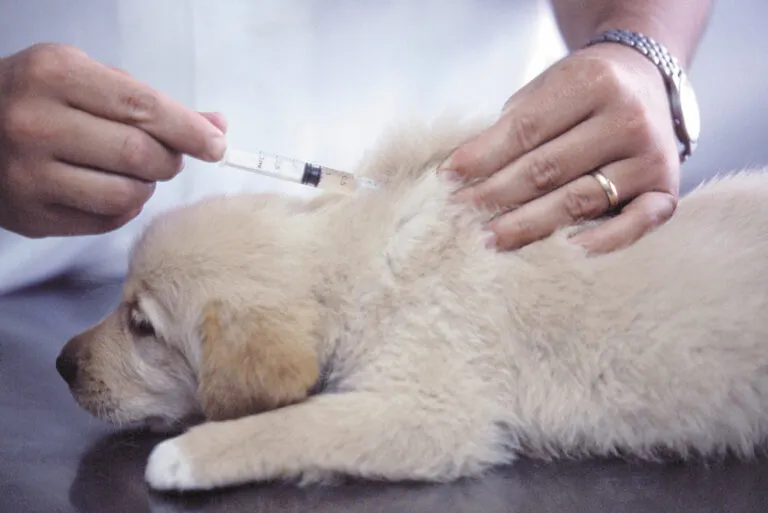
Fortunately, you can effectively prevent distemper infection in your dog with a vaccination. To do this, the dog receives one vaccination each at the eighth, twelfth and sixteenth week of life and then again at 15 to 16 months old. After that, the primary vaccination course is complete and the vaccination must be repeated every three years.
If there is an increased number of distemper cases in dogs within a particular area, preventive hygiene measures are especially important. In such cases, regularly clean and disinfect surfaces and objects. Of course, contact between infected and healthy animals must be strictly avoided.
Conclusion: Highly Contagious and Potentially Fatal
Distemper is also known as canine plague. Alongside rabies, the disease is one of the most dangerous viral infections in dogs. Infection occurs, among other things, through mutual licking or droplet infection. In unvaccinated or weakened dogs, the disease can trigger severe symptoms. In many cases, the infection is fatal.
Table: Important Facts about Distemper in Dogs at a Glance
Description:
Distemper is a highly contagious viral disease that is life-threatening for your dog (especially puppies).
Course of disease:
Progressive
Symptoms:
Healthy dogs usually show no symptoms. Weakened dogs show fever, weakness and symptoms affecting various organ systems (e.g. gastrointestinal tract, respiratory tract, nervous system, eyes, skin)
Occurrence:
Unvaccinated dogs with weakened immune systems are particularly affected
Causes:
Infection with the canine distemper virus through contact with contaminated secretions (e.g. faeces, urine, saliva)
Important Note: The content provided for informational purposes only and is not intended to replace professional veterinary advice, diagnosis or treatment. If you have any questions or concerns about your pet's health, please always consult a licensed veterinarian.
This article was translated using Artificial Intelligence from the original German zooplus Magazine. While the original content was authored by industry experts and reviewed by our editorial team, this automated translation has not been human-edited and is provided for informational purposes.
At the Justus-Liebig-University of Giessen I was extensively trained as a veterinarian and was able to gain experience in various fields such as small animal, large animal and exotic animal medicine as well as pharmacology, pathology and food hygiene.
Since then, I have been working not only as a veterinary author, but also on my scientifically driven dissertation. My goal is to better protect animals from pathogenic bacterial organisms in the future.
Besides my veterinary knowledge, I also share my own experiences as a happy dog owner and can thus understand and enlighten fears and problems as well as other important questions about animal health.
When does a female dog’s first season begin? How often and for how long is a female dog in season? And what symptoms does a female dog in season show? Find out everything you need to know about these “hot days” and how you and your dog can get through the season calmly and stress-free in the following article.
16 February 2024 |Leishmaniasis is an infectious disease transmitted by sandflies and can often prove fatal for dogs. Find out how you can protect your dog and how to recognise and treat the disease should it emerge.
Neutering has traditionally been a standard veterinary practice, but is it universally recommended? What distinguishes neutering from sterilisation and what expenses should a dog owner anticipate? Here, you can discover all the essential information concerning the advantages and disadvantages of neutering your dog.