{"url":"https://www.zooplus.co.uk/magazine/dog/dog-health-and-care/hair-loss-in-dogs","title":"Hair Loss in Dogs ","mag_id":402387,"is_single":true,"cat_name":"Dog","sub_cat_id":143,"sub_cat_name":"Dog Health and Care","cat_id":3410}
Have you noticed more hair than usual in your brush after grooming your beloved dog? Or perhaps you’re seeing bald patches? Hair loss in dogs, although not uncommon, is not always harmless. You’ll find the most important information in the following article.
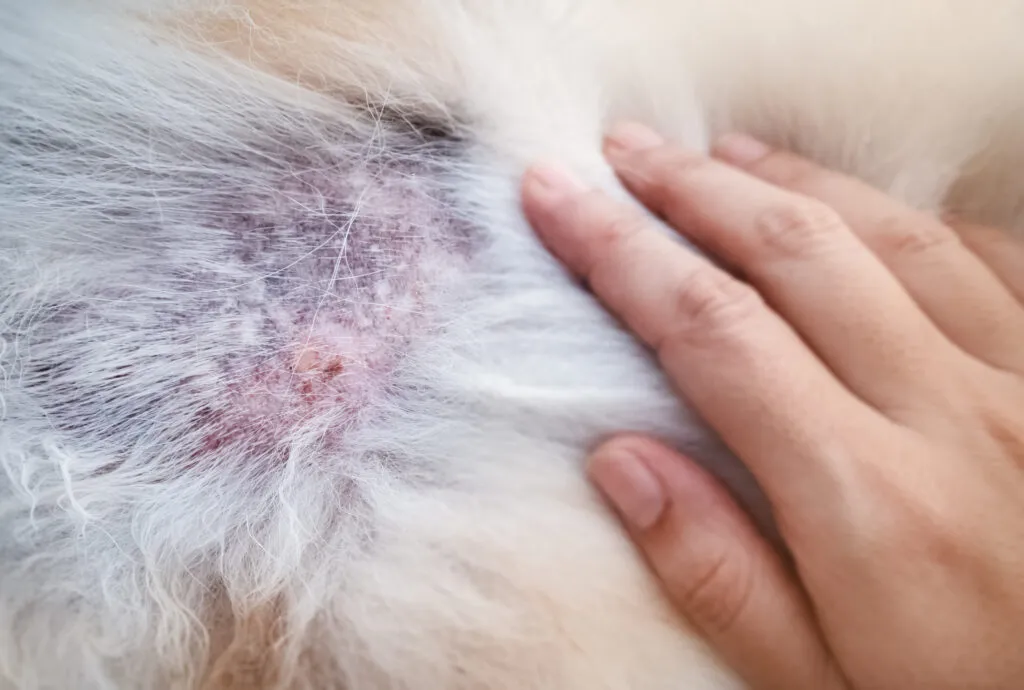
Hair loss in dogs, scientifically called alopecia, is an abnormal, significant loss of hair from typically hairy body areas. It must be strictly distinguished from physiological hair loss, which occurs, for example, during the transition from puppy fur to adult fur.
Although hair loss might initially sound harmless, the underlying causes can be quite severe. If a new collar is the culprit, the problem is likely quickly solved. Unfortunately, hair loss sometimes indicates a serious underlying condition, which is why you should never take this symptom lightly.
Causes: What Conditions Cause Hair Loss in Dogs?
Hair grows following a specific cycle, divided into a growth phase (anagen), a transitional phase (catagen), and a resting phase (telogen). Growth hormones, produced in the thyroid or adrenal glands, regulate these phases. This is why hormonal disorders can lead to hair loss in dogs.
However, hair loss might also result from many other conditions and stimuli. Therefore, categorising the causes into different types helps in understanding them.
We distinguish between itching-related and non-itching-related causes of hair loss in dogs:
Itching-Related Causes
Itching, triggered by various stimuli or conditions, often causes hair loss that appears more severe than it actually is. Scratching and itching can break the hair, leading to hair that falls out but is not completely lost.
These include allergic reactions, ectoparasites, and bacterial or fungal infections. Rubbing from accessories like collars or harnesses can also cause increased scratching. However, the most common causes are parasites like ear mites, fleas, or hair follicle mites.
A bacterial infection, also known as pyoderma, can quickly develop from micro-injuries followed by scratching and licking. The most common pus-causing bacteria are staphylococci and streptococci, while the most frequent fungi include Malassezia and dermatophytes.
Non-Itching-Related Causes
Veterinarians further divide this category into non-inflammatory and inflammatory causes of hair loss:
Non-inflammatory causes include functional or structural disorders of the hair follicles. There are also various genetic conditions. One example is follicular dysplasia, where hair follicle formation is impaired.
Hormonal disorders, such as Cushing’s syndrome (hyperadrenocorticism, adrenal overactivity) or hypothyroidism (thyroid underactivity), often play a significant role. Tumorous changes, like Sertoli cell tumours, can also lead to increased hair loss in dogs.
Although deep bacterial skin infections (pyoderma) and fungal infections often cause itching, they can also occur without it. The inflammation alone can lead to increased hair loss in affected dogs. Additionally, demodicosis, caused by the hair follicle mite, sometimes starts without itching.
The severity and location of hair loss in dogs vary depending on the cause. Sometimes dogs show severe itching, increased licking, and scratching in affected skin areas.
Symmetrical bald spots on both flanks, the neck, or the bridge of the nose often indicate hormonal disorders. Hypothyroidism, one of the most common hormonal disorders, frequently accompanies hair loss with weakness, weight gain, and additional neurological and dermatological issues.
Hyperadrenocorticism (Cushing’s syndrome) often observed in older dogs, presents with hair loss, alongside weakness, increased drinking, urination, and obesity.
If the affected skin areas show wounds with purulent secretion, bacterial involvement is likely. In severe cases, increased scratching and licking can also cause pain, deep skin infections, and fever. Additionally, lethargy and lack of interest might occur.
Diagnosis: How is the Cause of Hair Loss in Dogs Found?
To determine the underlying cause of hair loss in dogs, a vet may need to investigate meticulously. It is crucial to provide your vet with information about behavioural and feeding changes and other potential clues. This helps the vet identify whether a hormonal disorder or allergy might be the cause. An allergy can be identified with an allergy test through blood or skin tests.
For suspected hormonal disorders causing hair loss, the vet uses specific hormone tests. For example, for suspected hyperadrenocorticism, an ACTH stimulation test is conducted.
After a thorough consultation, the vet examines the dog’s bald spots closely. They might already recognize signs of inflammation such as swelling and redness, or even ectoparasites like fleas. They also determine whether the hair is falling out completely or merely breaking due to dullness.
If the cause of hair loss isn’t apparent externally, further lab diagnostic methods are employed. For example, the vet uses a trichogram to evaluate the hair cycle. Here, hairs are placed on a slide and examined under a microscope to identify specific hair anatomy characteristics.
Sometimes, a biopsy involving the removal of several skin samples with hair using a biopsy punch is necessary. This allows the examination of not only the hair but also the surrounding skin layers for possible inflammatory cells and pathogens like bacteria and parasites.
Treatment: What Treatment Options Are Available?
Treatment greatly depends on the underlying cause of the hair loss in your dog. For allergic reactions, corticosteroid preparations are often used, while hypothyroidism is treated with lifelong administration of thyroid hormones. Hyperadrenocorticism is managed with steroid preparations.
If a bacterial infection causes hair loss, regular wound hygiene using disinfectant solutions and anti-inflammatory shampoos is essential. If there is no improvement, a resistance test is advisable. This test allows the targeted administration of effective antibiotics, preventing antibiotic resistance.
For tumorous conditions, the treatment depends on the tumour type. Radiation therapy, chemotherapy, or surgery might be options, depending on the tumour.
Prognosis: What Are the Chances of Recovery?
Similar to treatment, the prognosis of hair loss in dogs depends on the cause and severity. Whether the next hair cycle proceeds normally depends on the extent of hair follicle damage and the success of the treatment for the underlying conditions.
Prophylaxis: How to Prevent Hair Loss in Dogs?
You can prevent hair loss in dogs due to ectoparasite infestation by using special collars or spot-ons as prophylaxis. These contain pyrethroids and prevent not only flea bites but also tick and mite infestations.
Regular coat care with the right coat care products also helps maintain healthy skin flora and prevents hair loss.
There are few prophylaxis options for tumorous and hormonal conditions. However, in some cases, risks can be reduced through conscious feeding and exercise.
Important Note: The content provided for informational purposes only and is not intended to replace professional veterinary advice, diagnosis or treatment. If you have any questions or concerns about your pet's health, please always consult a licensed veterinarian.
At the Justus-Liebig-University of Giessen I was extensively trained as a veterinarian and was able to gain experience in various fields such as small animal, large animal and exotic animal medicine as well as pharmacology, pathology and food hygiene.
Since then, I have been working not only as a veterinary author, but also on my scientifically driven dissertation. My goal is to better protect animals from pathogenic bacterial organisms in the future.
Besides my veterinary knowledge, I also share my own experiences as a happy dog owner and can thus understand and enlighten fears and problems as well as other important questions about animal health.
When does a female dog’s first season begin? How often and for how long is a female dog in season? And what symptoms does a female dog in season show? Find out everything you need to know about these “hot days” and how you and your dog can get through the season calmly and stress-free in the following article.
16 February 2024 |Leishmaniasis is an infectious disease transmitted by sandflies and can often prove fatal for dogs. Find out how you can protect your dog and how to recognise and treat the disease should it emerge.
Neutering has traditionally been a standard veterinary practice, but is it universally recommended? What distinguishes neutering from sterilisation and what expenses should a dog owner anticipate? Here, you can discover all the essential information concerning the advantages and disadvantages of neutering your dog.