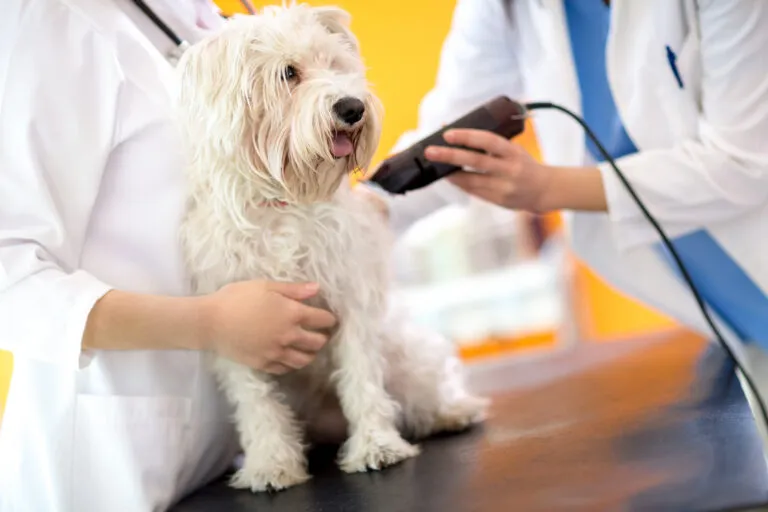
A small white dog being clipped by a professional groomer.
How is a dog’s coat structured?
In some dog breeds, the coat consists of topcoat and undercoat. Some breeds, such as the Maltese and Yorkshire Terrier, however, have a single-layer coat structure, meaning no undercoat.
Function of topcoat and undercoat
The topcoat protects against external influences such as sun, rain, or dirt and is longer than the undercoat. The undercoat, on the other hand, is shorter and primarily protects against cold.
During the spring moulting period, a large part of the undercoat falls out. For the coat to fulfil its function, proper coat care is essential.
Clipping your dog in summer – is it really necessary?
As dogs have hardly any sweat glands on their bodies, regulation of body temperature takes place largely through panting. The evaporation of moisture in the mouth and nasal area has a similar effect to sweating in humans.
A short haircut for summer?
In dogs, sweat glands are mainly found on the pads of the paws, which serve for territory marking. So don’t be surprised if your furry friend pants a little more heavily in summer: this is how they provide cooling.
Clipping a dog’s coat to help them cool down in summer is therefore not always necessary. However, you can certainly help them cope with the summer heat through other measures, such as setting up a dog pool.
Which dogs should not be clipped?
Dogs with an undercoat should not get clipped. Clipping removes the topcoat and therefore its protective function as well. What usually remains is only the undercoat, which can lead to excessive growth of the undercoat and thus to matting .
With non-professional clipping, it can also lead to post-clipping alopecia, meaning the appearance of bald patches or tufts of topcoat growth in certain areas.
Does your dog have an undercoat? Then it’s better to brush
So reach for the brush instead if your pet belongs to a breed with an undercoat. Thorough brushing of the coat removes dead undercoat, stimulates blood circulation and ensures that air can get between the hairs.
When does it make sense to clip a dog?
Dogs with a single-layer coat can generally be clipped. Make sure never to clip your dog’s coat completely, as without fur they are not protected against UV radiation and parasites.
For old or ill animals that have problems with moulting, a trim can be beneficial. Before deciding to clip, you should therefore always be aware of your dog’s coat type and their state of health. Seek advice from a dog groomer or your trusted vet.
These breeds need to be clipped
In addition, there are dog breeds that need to be clipped regularly because their hair does not shed naturally. These include Poodles and other dogs with curly coats, such as various Poodle mixes. Schnauzers and wire-haired terriers should also be clipped or trimmed from time to time.
In these breeds, the hair grows continuously without thinning naturally. This has the advantage that these dogs hardly shed. The disadvantage is that coat care is a little more demanding in order to avoid matting and skin problems.
You can find the right clippers for your dog in our zooplus dog shop.
Guide: How can I clip my dog myself?
To make clipping as smooth and stress-free as possible for your dog, just a few basic rules can help. Have an experienced dog owner or dog groomer show you how to use the clippers in advance at your dog salon – many groomers offer courses for this. However, with well-trained dogs, a clear set of instructions, some dog sense, and plenty of patience are often enough.
If you want to clip your dog, you should get it used to stand still. Teach your dog to remain calm for longer periods on a table or on the floor – even when mum or dad approaches with a buzzing machine. With the right training, you build trust and a solid foundation!
Which length is the right one?
Now it’s time to choose the right clipper comb . This depends on your dog’s hair length. Many complete clipper sets include several combs that you can try out and use as needed. If in doubt, choose the larger comb to leave the hair longer at first – you can always clip again later.
It is advisable to brush out matted areas before clipping . This ensures that the clippers can glide smoothly through the coat without problems.
In which direction should you clip?
To make clipping as painless as possible, you should always clip with the grain! Guide the clippers carefully and without pressure from your dog’s head towards the rear – depending on need, only on defined areas of skin or over the whole body.
Which hairs should you not cut on a dog?
The whiskers of the dog should not be cut; these are also known as tactile hairs or vibrissae. These thick, wiry hairs are found on the muzzle as well as on the eyebrows of the dog and help with sensory perception. Thus, they must not be shortened.
Clipping your dog: tips and tricks
With these small tricks, clipping your dog becomes easier:
- If your dog is afraid from clippers, suitable calming remedies can have a stress-reducing effect.
- Wet or dry clipping? Clear answer: dry! Wet dog hair is harder to cut.
- Use a special clipper for animals, not a hair clipper for humans. The latter is not suitable for thick, long dog hair.
- Be especially careful around sensitive areas such as the head, ears and paws. Instead of clippers, you should use a special pair of scissors here.
- Reward your brave dog after clipping with cuddles or a treat.