{"url":"https://www.zooplus.co.uk/magazine/dog/dog-sport-and-game/flyball-fast-paced-dog-sport-for-ball-enthusiasts","title":"Flyball: Fast-Paced Dog Sport for Ball Enthusiasts","mag_id":415373,"is_single":true,"cat_name":"Dog","sub_cat_id":146,"sub_cat_name":"Dog sports and games","cat_id":3410}
Running, jumping, catching and retrieving: that’s Flyball. This relatively young dog sport is suitable for energetic dogs of all sizes. Alongside fitness and sociability, it also strengthens the bond between dog and owner. Find out exactly how Flyball works and how you and your dog can become the perfect Flyball team here.
Red, yellow, green: as soon as the traffic light on the electronic judging system turns green, it’s time to go. The dog sprints over the start line. It jumps over four hurdles and catches the ball from the Flyball box. It then races back over the obstacles to its owner.
As soon as it crosses the finish line, the next dog in the team immediately sets off. It too races down the course to loud cheers and commands from its owner and the excited barking of the other dogs. By the end of a Flyball tournament, the four-legged competitors are out of breath and the two-legged ones are usually hoarse – but both are happy.
That’s Flyball in a nutshell. But what exactly makes this fast-paced dog sport so fascinating? What rules apply in Flyball and which dogs are best suited to this sport?
The Rules of Flyball
The first official Flyball rulebook in the USA was initially just a single page long. Today, the rulebook of the North American Flyball Association, or NAFA for short, already runs to more than 60 pages.
Of course, we won’t go into quite that much detail here. Especially as most European countries have their own regulations, which can differ slightly in some respects. Instead, let’s focus on the most important basic rules of Flyball:
1. The Start
Two teams compete, usually consisting of four dog-and-owner pairs. These dogs race against each other on two parallel lanes.
It’s mainly the dogs doing the sporting activity. Their owners must stay within the start and finish area. Most of their effort comes from shouting encouragement, gesturing wildly and cheering on their dogs.
Similar to Formula 1, Flyball also uses the red, yellow and green traffic light system. To ensure the dogs cross the start line exactly on green, they and their owners have to set off at precisely the right moment.
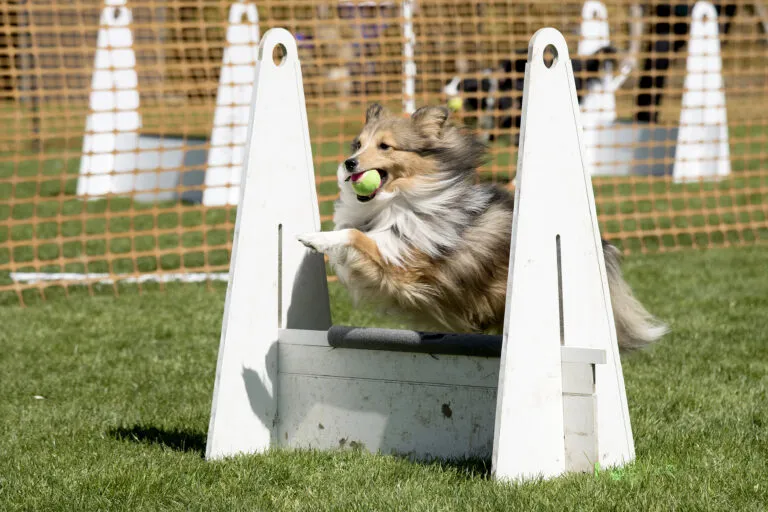
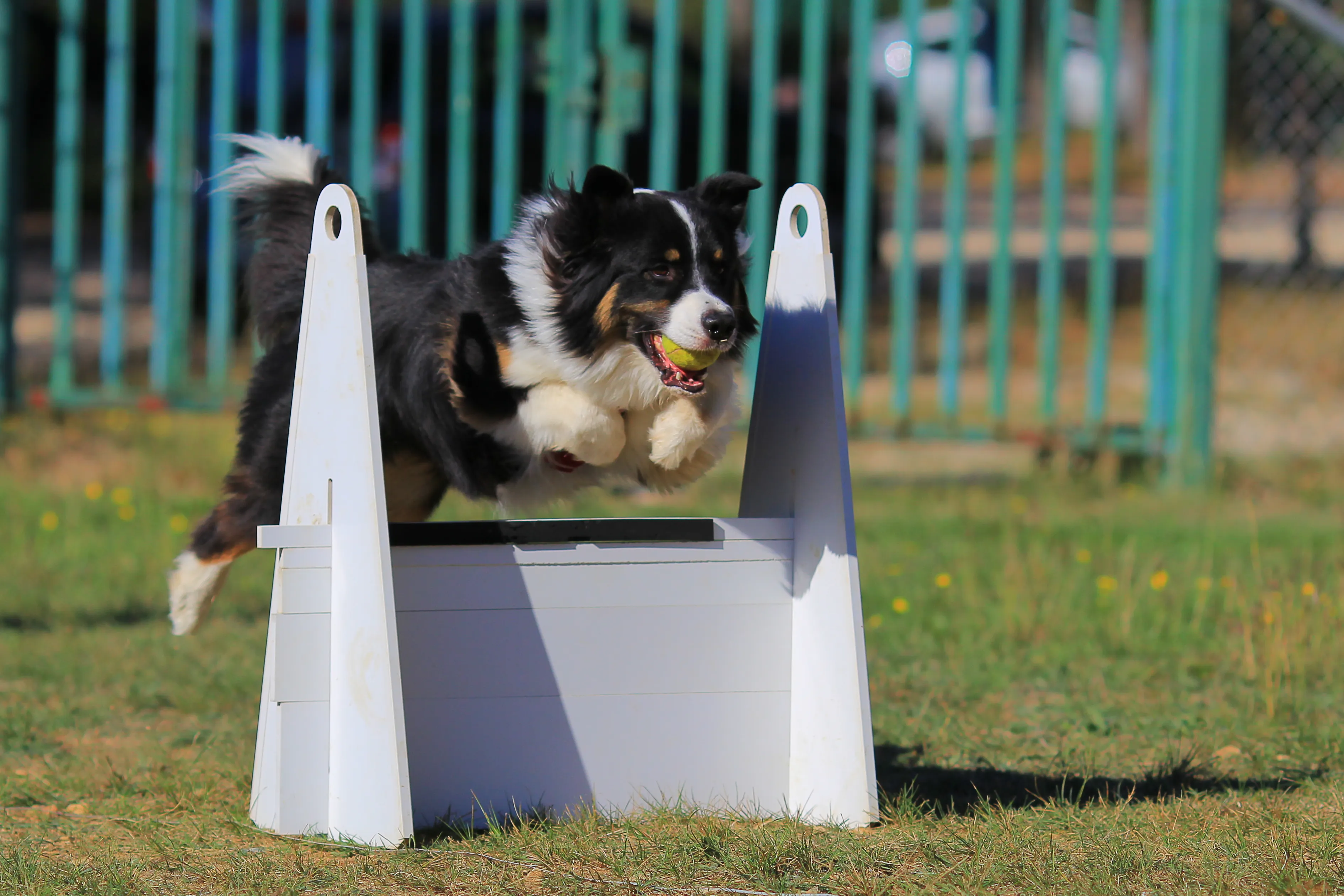
While the humans remain at the start-finish gate, which is around one metre wide, the dogs first have to clear four hurdles on their lane. They then reach the Flyball box.
2. The Turn
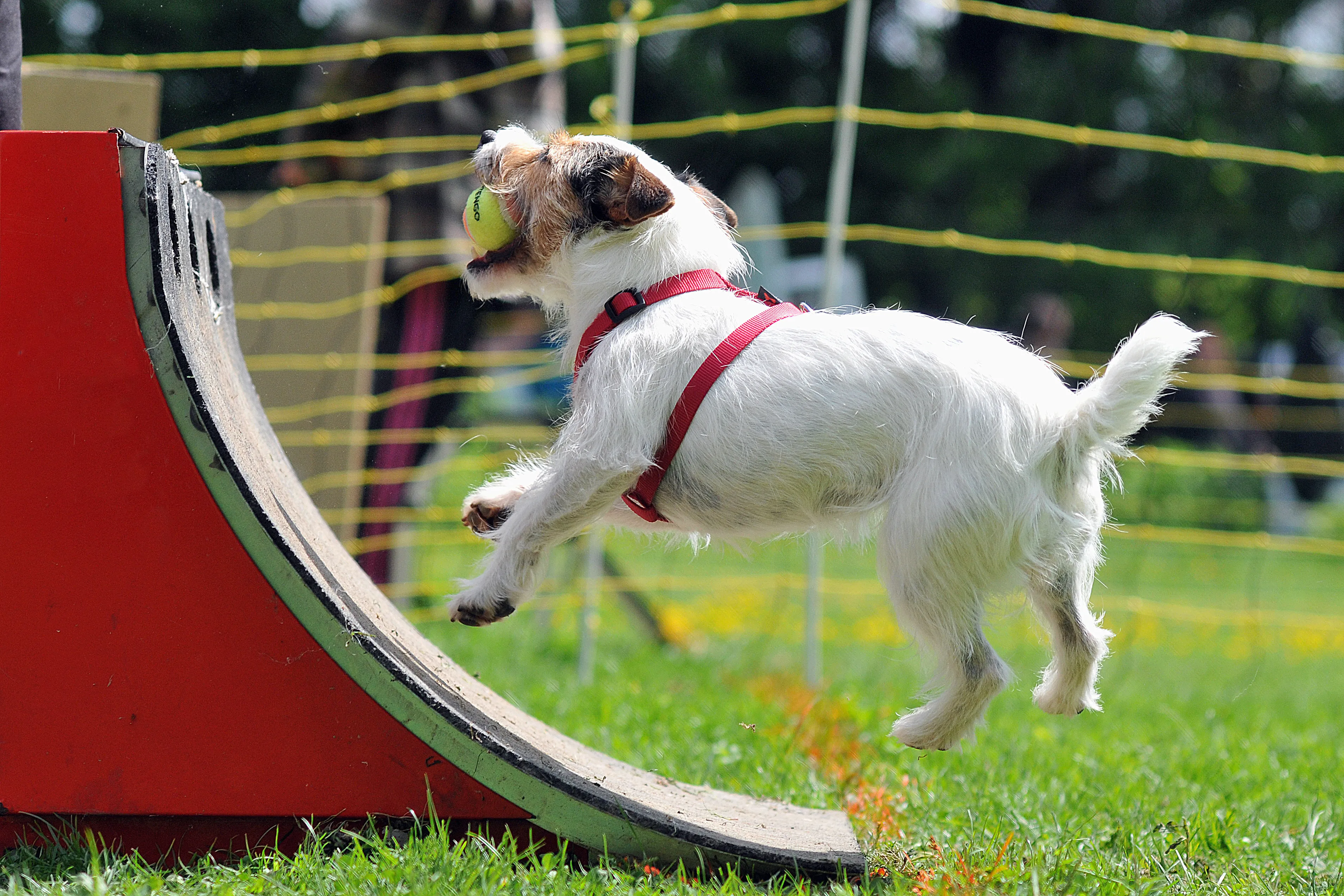
Once they reach the Flyball box, the dogs must activate a mechanism. A press of the paw releases the ball and, after an elegant turn known as a swimmer’s turn, the dogs race back along the same lane with the ball in their mouth.
Once again, they must clear the four obstacles. They then run back to their handler, who starts running away from the dog shortly before it arrives in order to boost its speed even further.
3. The Changeover
At exactly the same moment, the second dog in the team sets off. Ideally, it crosses the start line at the precise moment the previous dog has just crossed the finish line.
Once all four dogs in a team have completed the “relay race” without errors, the time is stopped. The fastest team wins the competition.
With the ball in its mouth, the dog returns to its owner, who is waiting in the finish area.
The Flyball Box: How Does the Flyball Ball Machine Work?
The first Flyball machines were a kind of catapult that launched the ball high into the air in a wide arc. Nowadays, most Flyball tournaments held around the world mainly use what are known as two-hole full-pedal boxes.
The box resembles a ramp from a skate park. The entire sloping front of the box acts as the trigger plate that releases the ball.
Advantages of the Modern Two-Hole Full-Pedal Box
The advantage of this “full-face pedal box” is that the dog no longer has to hit a small pedal precisely. Instead, it can use the entire contact surface while turning. The dog can catch the ball, turn and start the return run all in one movement, saving valuable time.
Another advantage is that, thanks to the two-hole system, the dog can perform the swimmer’s turn both to the left and to the right – depending on its preferred side. Incidentally, the joint-friendly swimmer’s turn is only possible with this type of box.
In addition, the dog can only get to the ball if it activates the box. This prevents the dog from simply running around the box and taking the ball out of a catch tray.
The flyball box is angled so that the dog can turn off it easily.
What Obstacles Are Used?
The four hurdles on the course are set up around three metres apart. To ensure all dogs in a team can jump the obstacles comfortably, the hurdle height is adjusted to suit the smallest dog .
Depending on the size of the dog, the hurdle height ranges between 17.5 and 35 centimetres. The second Flyball lane for the opposing team runs exactly in parallel and is set up four to six metres beside the first lane.
What Are Possible Faults in Flyball?
As with any competitive sport, there are consequences in Flyball if a rule is broken. The most common faults include:
False Start by a Dog
A false start is one of the most common mistakes in a Flyball competition. It occurs when a dog crosses the start line before the previous dog has reached the finish line.
In this case, the clock continues running, but the dog must repeat its run at the end of the relay. The time is only stopped once all four dogs have completed the Flyball course without errors. Only then is the competition over.
Other Faults
These faults can also mean the run has to be repeated at the end:
The dog does not clear all the hurdles.
It does not carry the ball back over the finish line.
The dog leaves the marked lane.
Requirements: Is My Dog Suitable for Flyball?
One of the great things about Flyball is that, unlike some other dog sports, it is generally suitable for every dog. The dog’s size and breed do not matter.
However, for your dog to really enjoy Flyball, it should naturally meet a few requirements. These include the following points:
A Love of Balls
Does your dog love grabbing balls and playing with them? Does it enjoy throwing and catching games with you? Is there no better toy in its eyes than a ball? Then your dog is a true ball addict – an excellent requirement for a future Flyball champion.
Enjoyment of Exercise
Is your dog a little bundle of energy? Is it happiest when it can run, move around and let off steam? Then it is well suited to Flyball, because this sport is fast-paced.
A Willingness to Retrieve
A dog that loves balls and running does not automatically make a good Flyball player. Flyball involves a bit more than that. The dog has to grab the ball quickly, but it also needs to bring it back to its handler just as quickly. A love of retrieving is therefore at least as important as a passion for balls.
Basic Obedience
As with any dog sport, Flyball requires a certain level of basic obedience. Your dog should definitely know the most important commands such as “Drop”, “Sit” and “Come”. As an owner, you should have a good relationship with your dog and be able to rely on it.
Sociability
Flyball is a team sport. Your dog will not only come into direct contact with its own canine teammates, but also with the dogs from the opposing team. If it became distracted by them, growled at them aggressively or ran away from them in fear, this would not only have a negative impact on your time.
Physical Health
It almost goes without saying that a dog with joint problems is not a suitable candidate for Flyball. Other physical limitations that hinder fast running and jumping are also grounds for exclusion.
On the other hand, if your dog is in excellent health and the points above also apply, there is hardly anything standing in the way of a Flyball career. If you are unsure whether your dog really has the physical requirements for this dog sport, you should ask your vet for advice.
For Experts: Flyball Tournaments
In addition to the basic training described above, clubs also practise dealing with distractions from other dogs, people and loud noises. After all, during competitions your dog must not let anything or anyone distract it from its run on the Flyball course.
Motivation Is Key
Naturally, it is also crucial to practise regularly with the team and the other dog-and-owner pairs during training. The start command and finish must be perfectly coordinated so the relay race runs smoothly later on.
Once your dog can complete the Flyball course, it is time for the first timed runs. Flyball trainers and experts know plenty of tricks and techniques to motivate your four-legged friend so it maintains a high speed throughout the run.
Friendly Competitions and Championships
Nothing now stands in the way of your first competition. Many clubs organise regional friendly tournaments where different teams can compete against one another. And who knows? Perhaps one day you and your dog will even take part in international Flyball competitions.
Of course, despite all your ambition, you should never forget that having fun playing Flyball and sharing the experience with your dog is even more important than success.
The Fascination of Flyball: How Did It All Begin?
Throwing balls all day long? At some point, dog owner Herbert O. Wegner from California (USA) found that rather boring.
But how else was he supposed to keep his energetic, ball-mad dog entertained? Without further ado, he built a device in his garage that catapulted tennis balls high into the air “at the press of a paw” for his four-legged friend to catch.
Wegner’s dog was so enthusiastic about his owner’s invention that he trained daily with the ball-launching machine from then on. At the same time, he playfully improved his fitness, jumping ability, reactions, speed and retrieving skills.
Patented Flyball Device
Wegner presented the device to his friends at the obedience club. He received so much positive feedback that in the early 1970s he applied for a patent for his “Animal Training Apparatus”.
When Wegner presented his patent on the popular “Tonight Show” with Johnny Carson, thousands of dog lovers were instantly infected with the “Flyball bug”. Demand for the Flyball box, which at the time still hurled balls metres into the air, rose rapidly during the 1980s. The name “Flyball” also dates back to this period.
The North American Flyball Association (NAFA) eventually turned Flyball into an organised competitive dog sport with fixed rules, which soon fascinated dog owners in Europe and Australia too.
Where and How Is Training Done?
What looks so easy and playful in competition actually requires systematic training. Ideally, you should look for a team or dog sports club near you.
Not only is this more enjoyable than training alone at home, but your dog will also learn together with its teammates. At the same time, you can pick up plenty of valuable tips and tricks from the trainer and the other handlers.
Flyball training for beginners consists of several small steps, with training on the Flyball box coming right at the end. The following four exercises are essential for an aspiring Flyball dog.
1. Ball Work
The very first step is to practise catching a ball with your dog. Stand in front of your dog and throw it a tennis ball, making sure it is easy enough for it to catch.
2. Hurdle Training
If your dog already has experience in agility, you can probably shorten this training. For everyone else, start with just one small obstacle, such as an upside-down flower box in the garden.
If you have a helper, they can hold your dog by its harness until it is released on your command and jumps over the obstacle towards you. Otherwise, tell your dog to wait and then move to the other side of the hurdle.
Tempt it with a treat, a ball or its favourite toy. Praise it enthusiastically if it clears the hurdle successfully. Once your dog has mastered this exercise, gradually add another hurdle. In the end, it should be able to jump over four obstacles to reach the goal.
3. Training the Turning Point
Running at full speed towards an obstacle and making a tight turn without slowing down is something that has to be learned. At dog sports grounds, this is usually practised using a pole stuck into the grass that the dog has to run around.
But this exercise can also be practised perfectly during a relaxed walk. For example, you will need a tree with quite a thin trunk.
Stand next to your dog and guide it around the tree or pole using a treat in your hand. Give it a clear command such as “Round” or “Turn”. As soon as it has run around the trunk, reward it with the expected treat.
To make sure your dog later runs back at the same speed after turning, throw the treat in the direction your dog came from. This teaches it that it still needs to speed up again after circling the pole.
Important: Do not throw the treat too early. After all, your dog needs to learn that it only gets the reward once it has gone around the pole.
4. Activating the Flyball Box
Naturally, getting used to the Flyball box is a fundamental part of training. Later on, the dogs will have to activate it during the game and perform their turn on the box.
If your dog tends to be sceptical of new things, you should never overwhelm it. Introduce it slowly to this strange ball-launching machine.
For example, begin by standing behind the box. Your dog waits in front of it – either alone or on a lead held by another person. Throw the ball over the box so the dog can catch it. Once your dog has managed this confidently and shows no fear of the box, you can move on to the next step.
Practise touching the box with your dog. Similar to basic commands such as “Sit”, “Down” or “Drop”, this is trained using a specific verbal cue, for example “Touch”. This cue is then also used later during the game. With a treat in your hand, show your dog the spot it should step on with its paw.
As soon as your dog approaches in such a way that it touches the box with its paw, give the command “Touch”. Then reward it with the expected treat.
Incidentally, you can also practise this command at home without a box. Simply use a cardboard box that your dog should touch with its paw. Only once your dog responds reliably to the “Touch” command should you load the Flyball box. The next step is to combine touching the box with catching the ball.
Putting the Individual Exercises Together
Step by step, your dog’s training is expanded by adding more and more elements that it should already know from the individual exercises.
For example, place the familiar pole directly in front of the Flyball box that your dog has already learned to run around. This teaches it to combine the tight turn with activating the ball machine.
Next, the obstacles are gradually placed in front of the box. Your dog must first clear these before reaching the box and ball. At first, you still run alongside your dog until it eventually completes the Flyball course on its own and returns to you with the ball.
This article was translated using Artificial Intelligence from the original German zooplus Magazine. While the original content was authored by industry experts and reviewed by our editorial team, this automated translation has not been human-edited and is provided for informational purposes.
"A life without a pug is possible, but pointless," Loriot once said. I would unreservedly agree and add: "A life without horse, cat and rabbit as well!" My heart beats for all animals big and small and I have the great fortune to be able to write about my passion as a freelance author. With my articles I would like to raise awareness for animal welfare and give useful tips to animal lovers.
Whether it’s shorter hikes close to home, day trips at the weekend or a full hiking holiday with your dog: hiking is a paw-sitively great hobby for human–animal teams! We’ve put together everything you need to know about preparing for a hike with your four-legged friend, the equipment you’ll need and what to keep in mind when hiking with a dog.
Cheap and yellow – tennis balls are popular dog toys. However, models designed for sports are unsuitable for four-legged friends and pose certain risks. Find out below why the classic tennis balls can be dangerous for dogs and which pet-friendly alternatives are available.
Only for big dogs? No way! Small dogs too can have plenty of fun with agility. Find out here whether your little dog is suited to this dynamic dog sport and which five factors you as a dog owner have to take into account.