{"url":"https://www.zooplus.co.uk/magazine/dog/dog-health-and-care/wasp-sting-in-dogs-what-should-you-do","title":"Wasp Sting in Dogs: What Should You Do?","mag_id":414064,"is_single":true,"cat_name":"Dog","sub_cat_id":143,"sub_cat_name":"Dog Health and Care","cat_id":3410}
It’s a lovely summer’s day and you’re sitting in the garden with your dog. Suddenly, your dog yelps and frantically snaps at his paw. You rush over and notice a swollen, painful spot on his paw – most likely a wasp sting. In this article, you’ll find out when a wasp sting can be dangerous for your dog and what to do if your dog has been stung.
Insect stings from bees or wasps are not uncommon in dogs. Although the stings are usually unpleasant to painful for your dog, in most cases they are generally not dangerous.
BUT: Some dogs can, however, develop severe allergic reactionsto such a sting. Wasp stings in the mouth and throat area can also swell significantly and, in the worst case, obstruct the airway. In both situations, this is an emergency that requires veterinary attention!
That’s why it’s important to recognise the signs of a possible anaphylactic shock in dogs and to know how to deal with a wasp sting.
Symptoms: How Does a Dog Behave after a Wasp Sting?
Wasp stings are generally painful for your dog. For this reason, many dogs that have been stung will suddenly yelp, which can be quite alarming.
Other typical behavioural changes include:
Snapping at and scratching the affected area of skin
A sting shows up as a swelling at the site of the sting, which is usually painful and warm to the touch. Unlike bees, wasps usually keep their stinger , so it is only in very rare cases that one remains in the wound.
What Happens if a Wasp Stings Your Dog in the Mouth?
If your dog has snapped at a wasp, it may sting inside the mouth. This can cause even more panic, especially if your dog has an allergic reaction.
If the mucous membranes swell up, this can lead to serious breathing difficulties, which may trigger further anxiety and panic in your dog.
How Quickly Does an Allergic Reaction Appear in a Dog after a Wasp Sting?
Insect stings in dogs usually trigger an immediate-type allergic reaction. This occurs shortly after the sting – within ten to 30 minutes afterwards.
The first signs of an allergy are itching and severe skin redness. In more serious cases, vomiting or loss of consciousness may also occur – in the worst case, it can even be fatal.
When Should I Take My Dog to the Vet?
If your dog does not show a strong reaction to a wasp sting, you do not necessarily need to visit a vet.
However, it’s different if your dog has an allergic reaction to the sting or shows other unusual symptoms such as rapid breathing, breathing difficulties, weakness or disorientation.
After giving first aid, you should then take your dog to a vet who has the necessary medication to treat and monitor your dog properly.
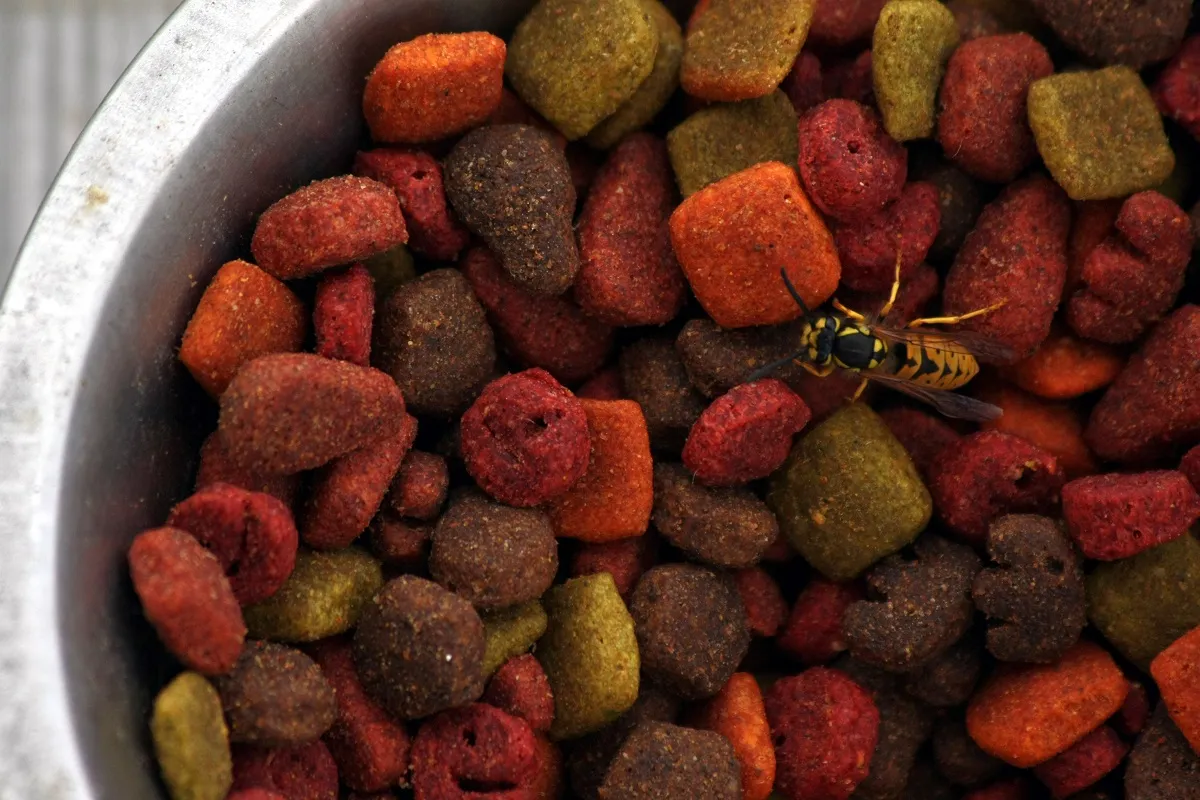
Danger in the dog bowl: Food, including dog food, especially meat, can attract wasps.
First Aid in an Emergency: What to Do if Your Dog Has Been Stung by a Wasp
Rule number one after a wasp sting is to stay calm. This helps you to soothe your dog and think clearly so you can manage the situation.
Treating a Wasp Sting on Your Dog’s Paw
To help your dog get back to running around the garden pain-free, you should cool the sting site. This helps reduce the swelling and eases pressure pain and itching. You can use ordinary ice packs from the freezer and wrap them in a cloth.
Treating a Wasp Sting in Your Dog’s Mouth
If your dog has been stung in the mouth, you need to act particularly quickly to prevent severe swelling in the mouth and throat. Also make sure your dog does not swallow the wasp as well.
Cooling is especially important in this case too. In the mouth, specially made dog ice cream or frozen water that your dog can lick works best.
Treating an Allergic Reaction after a Wasp Sting in Dogs
If your dog has an allergic reaction to the sting and goes into anaphylactic shock, you can administer an adrenaline injector as immediate first aid, if available.
If you suspect your dog is experiencing an allergic shock, seek veterinary attention immediately!
To get the situation under control and prevent further allergic reactions, it’s important that your dog remains under veterinary supervision for at least 24 hours.
Prevention: How Can I Protect My Dog from a Wasp Sting?
Wasps are particularly active in late summer. You can’t completely prevent your dog from being stung, but you can take a few precautions to reduce the risk and avoid attracting wasps unnecessarily:
Do not feed your dog in the garden and leave no food or leftovers outside .
Do not leave your dog unattended when wasps are nearby.
If you have fruit trees, regularly pick up any fallen fruit from your garden.
Avoid walks through meadows with abundant blossoms.
Teach your dog not to snap at insects or play with them.
Important Note: The content provided for informational purposes only and is not intended to replace professional veterinary advice, diagnosis or treatment. If you have any questions or concerns about your pet's health, please always consult a licensed veterinarian.
This article was translated using Artificial Intelligence from the original German zooplus Magazine. While the original content was authored by industry experts and reviewed by our editorial team, this automated translation has not been human-edited and is provided for informational purposes.
At the Justus-Liebig-University of Giessen I was extensively trained as a veterinarian and was able to gain experience in various fields such as small animal, large animal and exotic animal medicine as well as pharmacology, pathology and food hygiene.
Since then, I have been working not only as a veterinary author, but also on my scientifically driven dissertation. My goal is to better protect animals from pathogenic bacterial organisms in the future.
Besides my veterinary knowledge, I also share my own experiences as a happy dog owner and can thus understand and enlighten fears and problems as well as other important questions about animal health.
When does a female dog’s first season begin? How often and for how long is a female dog in season? And what symptoms does a female dog in season show? Find out everything you need to know about these “hot days” and how you and your dog can get through the season calmly and stress-free in the following article.
16 February 2024 |Leishmaniasis is an infectious disease transmitted by sandflies and can often prove fatal for dogs. Find out how you can protect your dog and how to recognise and treat the disease should it emerge.
Neutering has traditionally been a standard veterinary practice, but is it universally recommended? What distinguishes neutering from sterilisation and what expenses should a dog owner anticipate? Here, you can discover all the essential information concerning the advantages and disadvantages of neutering your dog.