

11 min
2.6k
Medium Size Poodle
The Epagneul Breton, also known as Brittany Spaniel, is considered something of an insider tip among hunters. In France, it is by far the most widely used hunting companion of all.
© Dogs / stock.adobe.com
The Brittany Spaniel is a lively hunting dog that needs at least two hours of intensive activity per day.
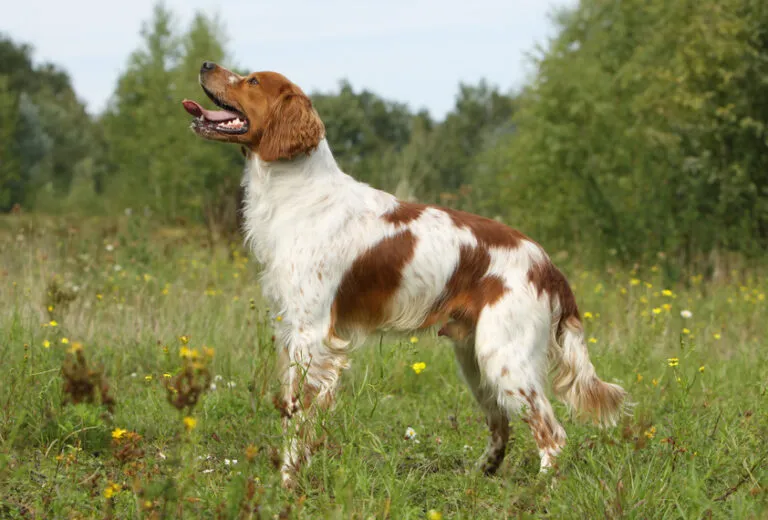
The Epagneul Breton is known for its triangular drop ears and sturdy yet agile build, as well as its long coat, overall, its type is reminiscent of a German Setter.
Males reach a withers height of 51 cm, while females are only slightly smaller at up to 50 cm. This makes the “Breton Spaniel” the smallest of the pointing dogs, although overall they are classed as medium-sized breeds. A naturally short tail can occur, but it is not essential.
The orange and white colouring is the best known today, although the coat may also be black, brown parti-coloured or roan. White markings are usually large and clearly defined. As this four-legged friend is very popular in the USA, a separate, larger variety has since developed there. There are also further differences – for example, the coat colour “black” is not permitted under the American breed standard.
Provided it has enough activity, the Epagneul Breton is a balanced and pleasant companion who is always friendly and open within its pack and easy to handle. It forms a very close bond with its pack leader and, assuming consistent training, shows great obedience.
The breed is considered intelligent and alert. Although the Epagneul Breton hunts with passion, it generally has very little innate aggression. Its gentle and playful nature makes it well suited to life as a family dog, but you should only consider this if you live in a hunting household .
Breton Spaniels enjoy learning and pick things up quickly, so training rarely presents any problems. Thanks to their close bond with their pack leader and their strong desire to please, they are keen to carry out whatever you ask of them. Any harshness is out of place. Apparent “disobedience” is usually simply down to the owner not having communicated clearly enough, leaving the eager dog unsure of what is expected.
These dogs should receive proper hunting training to channel their strong hunting instinct into controlled paths and manage it appropriately. Consistency is, as so often, the key to successful training. It is also important to remember that these dogs can only show obedience if they are exercised and stimulated in a species-appropriate way. Attending a dog training school is highly recommended.
The Epagneul Breton feels most at home with a hunter, as this allows it to follow its passion and demonstrate its talents. This small pointing dog is a reliable retriever and also excellent on the blood trail.
While in France it is mainly used for woodcock hunting, in other countries it is generally valued as a versatile all-rounder and a welcome hunting companion. It also enjoys water work .
Outside of hunting, the Breton enjoys long walks and, with the right training, cycling tours with its owner. Thanks to its agility and pronounced “will to please”, this sporty dog can also be enthusiastic about agility training .
Protein makes up the main component of a species-appropriate canine diet. Support your dog’s wellbeing and health with a protein-rich diet in which protein appears as the primary ingredient at the top of the list. This applies to both dry and wet food.
Make sure that no grain is included in the food. It makes sense to adjust meals to daily activity levels: after long outings across fields and woods, your dog should find a little extra in its bowl; on quieter days, reduce the portion size. Always allow your companion a post-meal nap.
As treats, sugar-free snacks such as dental chews or dried meat pieces are a healthy addition. However, make sure your Epagneul Breton maintains a slim figure. Special dog bones or dried cattle ears provide welcome variety and will keep your dog happily chewing for some time. Ensure your Epagneul Breton always has access to fresh drinking water .
Discover our range of dog food!
It is best to get your puppy used to being brushed once a day from an early age. This simple routine prevents unpleasant matting and allows you to quickly remove any bits picked up on walks, such as small twigs or leaves.
Also take a look inside the drop ears every few days, as the warm, moist environment can quickly lead to inflammation or allow parasites such as ear mites to settle. Use a special ear cleaner for dogs if needed.
If your Breton gets dirty and brushing alone is not enough, you can give it a quick rinse – most representatives of the breed are very fond of water. As with everything, introduce your puppy to this calmly and in small steps so that the adult dog is not startled.
The breed is considered robust , and the average life expectancy of an Epagneul Breton is 12 years, although reaching an age of 14 or 15 is not uncommon. The breed shows a slight predisposition to hip dysplasia – so make sure the breeder can provide proof of appropriate joint examinations for the parent animals. A balanced diet and exercise tailored to age and fitness level can also help prevent hip dysplasia.
Some dogs also carry a genetic predisposition to skin conditions and epilepsy. As with all breeds, a responsible breeder is the most important prerequisite for buying a healthy dog, as they lay the foundations for health and character even before birth.
You can also help ensure your Epagneul Breton remains active into old age with the right diet, grooming and appropriate training. Visit your trusted vet for a check-up at least once a year. They will advise you on the necessary vaccinations, worming treatments and keep an eye on your dog’s overall health.
 © Dogs / stock.adobe.com
As early as the Middle Ages, the ancestors of the Epagneul Breton were used in falconry. Over the centuries, and following crosses with Setters and various Spaniels, the Epagneul Breton gradually developed into its present form.
Like the other French pointing dogs, it is named after its region of origin: its roots lie in the French region of Brittany. Even in the Middle Ages, its ancestors were popular companions on hunts for the wealthy and nobility, who often had themselves portrayed with their canine companions: numerous paintings show Breton-type dogs alongside their owners striking a hunting pose.
Towards the end of the 19th century, the breed was crossed with English Setters, which British aristocrats brought with them on hunting trips to France. This new cross combined the robustness and hunting enthusiasm of the early Bretons with the elegance and outstanding pointing abilities of the Setters.
In 1907, the estate manager Arthur Enaud founded the first club for breed enthusiasts. In the same year, the first breed standard was established, although it differed in many respects from today’s version. At that time, the short tail was still a mandatory breed feature, the overall appearance was quite inconsistent, and crossbreeding to develop desired traits was permitted.
Today, with several thousand registered puppies per year, the Epagneul Breton is considered the most popular hunting dog in France. In English-speaking countries, the Epagneul Breton is known as the “Brittany Spaniel” and is especially popular among many breeders in the USA.
Are you a hunter looking for a suitable dog for hunting and everyday life including family life? Then an Epagneul Breton could be a good match! However, if you cannot work this dog in the field, you should consider a different breed. It is suitable for first-time owners, provided they are willing to seek professional guidance in hunting training.
In keeping with his great love of exercise, the Epagneul Breton does not belong in a city flat but rather in a house in the countryside with a fenced garden to run around in. It gets on wonderfully with children and enjoys playing with them – how about a game of football or paw-ball?
Potential prey animals, especially small pets such as rabbits , should not live in the same household. However, cats can be part of the pack if the Epagneul has been used to living with cats from an early age.
You can also take this generally easy-going dog with you on holiday, for example if you enjoy walking holidays. Many hotels now welcome well-behaved four-legged guests. Otherwise, before your dog’s arrival, clarify who will look after it in case of illness or take care of it during your holiday.
Beforehand, get an overview of the costs you can expect, including species-appropriate food and vet visits, dog tax and dog liability insurance, as well as one-off expenses such as the purchase price from a reputable breeder, basic equipment and any travel costs.
In France , you will find the widest selection of breeders, but you may also be successful in other European countries. In Germany, for example, several dozen Epagneul Bretons are born each year and registered with the umbrella organisation.
Nevertheless, you may have to travel some distance to find your ideal dog. Even so, you should make sure you choose a reputable breeder: only buy this breed from someone who belongs to a recognised club and breeds with pedigree papers. Otherwise, you risk not getting a purebred Epagneul and, even worse, up with a puppy of questionable temperament and health .
Reputable breeders test the parent animals for hereditary diseases and only select dogs that are suitable for breeding in terms of temperament. They also ensure a thorough socialisation phase and all necessary vaccinations and worming treatments before the puppy leaves their home.
Therefore, steer well clear of anyone breeding these dogs out of greed or “just because”. If you would like advice, hunting dog clubs or clubs for French pointing dogs can help. Incidentally, for good reason, breeders in most countries place this breed exclusively in the hands of hunters .
If you would prefer to give an older Epagneul Breton a home, it is best to look online. There you will also find rescue organisations or breed clubs specialising in the rehoming of hunting dogs in need who can support you in your search.
On their websites, you will often also see other French pointing dogs that might interest you, as they share similar traits. As a rule, however, they are somewhat larger than the Epagneul Breton, unless they are crossbreeds. Speaking of which: when adopting from a rescue, be open to dogs without pedigree papers and, if you wish, let yourself be won over by their charm.
Here you will find answers to commonly asked questions about this French pointing dog.
The weight is not specified in the breed standard. However, this breed usually weighs between 14 and 18 kg.
The Epagneul Breton has a robust coat with a rich, oily undercoat, making it well suited to water work .
The Epagneul Breton has a strong urge to move and must be kept properly occupied. Only under these conditions can this agile, lively hunting dog also be kept as a family dog.
As a versatile hunting dog, the Epagneul Breton is suited to many tasks. He is primarily used for small game hunting. However, its excellent nose also qualifies it for tracking wounded game.
The Epagneul Breton is the most widely distributed pointing dog of all. For good reason: this little Frenchman has a fine nose and serves as a loyal helper to the hunter. It is easy to train and shows a calm, easy-going side at home – provided it can really let off steam while hunting. Simple daily walks are not enough to meet the needs of this eager hunting dog.
| Special features: | The Epagneul Breton, also known as the Breton Spaniel, is a small pointing dog with a keen nose. He is primarily used for small game hunting. |
| Character: | intelligent, focused, conscientious, even-tempered |
| Height at withers: | Males: 47–52 cm, ideal 49–50 cm Females: 46–51 cm, ideal 48–49 cm |
| Weight: | not specified, usually 14–18 kg |
| Coat: | fine, straight or slightly wavy, in white-red, white-black, white-brown or tricolour, with patches |
| Coat care: | low maintenance |
| Exercise: | needs plenty of activity and exercise |
| Suitable for first-time owners: | yes (with hunting training) |
| Barking: | barks occasionally |
| Life expectancy: | 12 years |
| Typical illnesses: | hip dysplasia, skin conditions, epilepsy |
| Use: | hunting and family dog |
| FCI group: | 7. Pointing Dogs |
| Exercise requirements: | high |
| Origin: | France |

The zooplus editorial team consists of a dedicated team of experts with many years of experience in the field of animal husbandry: Luisa with her White Swiss Shepherd Elyos, Laura, Julio, and Florian. Together with a large network of animal experts, we work to make the zooplus magazine a trusted source of information for all animal owners and lovers. Our goal is to provide exciting animal knowledge and relevant information on the proper care of pets.
The Irish Wolfhound is one of the largest dogs in the world. Used for hunting wolves and bears in medieval Ireland, today it is kept exclusively as a family dog. Despite its imposing size, this sighthound is very gentle and affectionate. Unfortunately, the friendly giant is also quite prone to illness and has a comparatively short life expectancy. Is an Irish Wolfhound right for me, and what does keeping one involve? You can find everything you need to know in the following article.
Fans of the Bearded Collie agree that those who aren't familiar with this dog breed simply have to get acquainted with it. And those who have experienced how a Bearded Collie bolts across meadows with its flowing fur, how it rolls around full of energy and joy and how it attentively and observantly takes into account its owners wishes become simply addicted to this original dog breed and its unique charm.