

11 min
2.6k
Medium Size Poodle
At first glance, many people easily mistake the Welsh Corgi Cardigan for its close relative, the Welsh Corgi Pembroke. However, the Pembroke and the Cardigan each have their own distinctive traits. Find out here what makes the Welsh Corgi Cardigan such a unique companion for fans around the world.
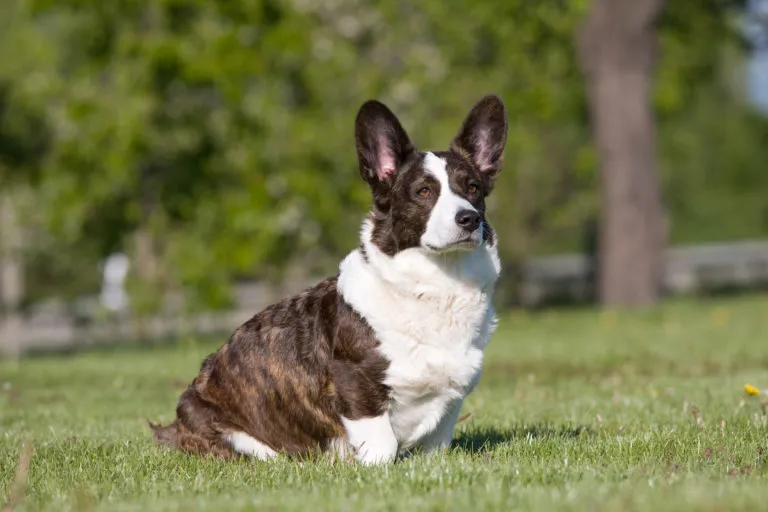
© lenkadan / stock.adobe.com
When properly socialised, the Welsh Corgi Cardigan makes a perfect family dog.
In terms of looks, the Welsh Corgi Cardigan and the other short-legged Welsh breed, the Welsh Corgi Pembroke, are very similar: both breeds are strikingly low-set and sturdy, with weight ideally balanced in proportion to their size. Their proportions are somewhat reminiscent of a robust Dachshund.
The Welsh Corgi Cardigan measures on average between 25 and 30 cm at the shoulder and is generally slightly larger overall than a Pembroke. This Corgi typically weighs between 11 and 17 kg.
The upright, relatively large ears give both breeds an alert expression. Unlike the Pembroke, the Cardigan always has a long tail.
Its short coat is permitted in all colours except pure white. In terms of character, the two British breeds are cut from the same cloth. However, the Cardigan often has a slightly more stubborn streak.
You’ve probably guessed it already: a dog that keeps cattle moving despite its small size must have a great deal of self-confidence. In the Welsh Corgi Cardigan, this trait can sometimes be challenging. A poorly socialised Corgi may quickly pick a quarrel with other dogs.
Around strangers, this British breed, which forms a strong bond with its favourite people, tends to keep its distance. If someone comes too close, it may even bare its teeth. In this respect, the Cardigan is a little more reactive than the calmer Pembroke – good training is essential!
Its past as a drover is also evident in the fact that the Welsh Corgi Cardigan is quite active for its size and certainly not a passive lapdog.
In addition, because they once worked independently, these dogs have a bit of a stubborn streak. They are not especially inclined to submit, but well-timed praise can work wonders!
The breed is considered strongly territorial and therefore makes a good, and often vocal watchdog.
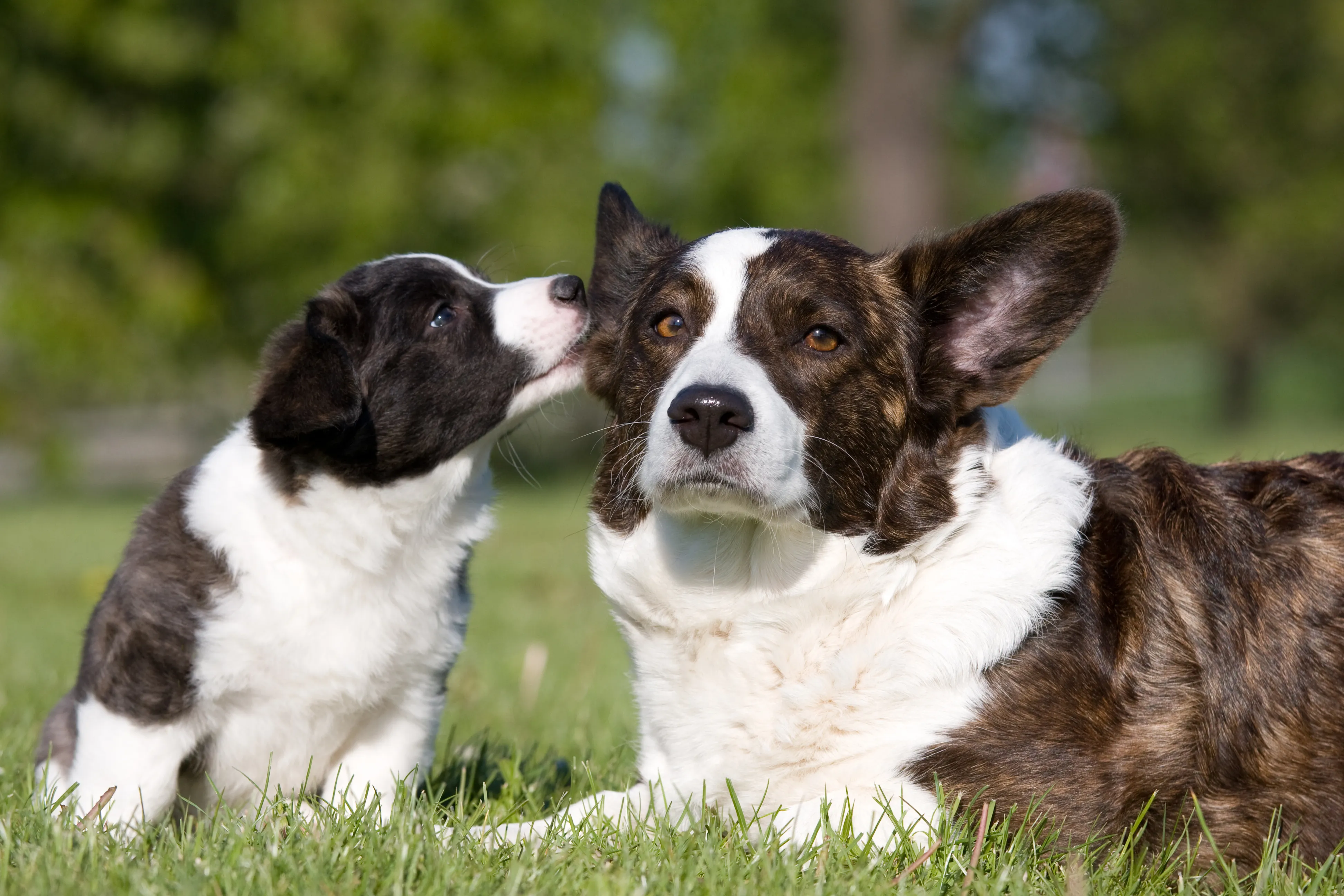 © lenkadan / stock.adobe.com
First-time dog owners should do plenty of research before welcoming a representative of this breed into their home. Agree in advance as a family which rules will apply to your new arrival – permanently, no matter how big those pleading eyes become when your housemate is hoping for an extra treat.
Tip: Discourage your puppy from chasing feet or developing similar bad habits right from the start. What seems amusing in a small puppy can become a real problem in an adult dog.
Consistency is key when it comes to managing these stubborn little characters. Children, cats, kitchen appliances – a breeder who exposes the puppy to as many everyday situations as possible lays the foundations for a relaxed Welsh Corgi Cardigan.
The perfect complement for a growing Corgi is a puppy playgroup, where the little one can meet as many dogs of different breeds as possible.
Although the breed has a short coat, it sheds quite heavily. Brush your four-legged friend several times a week to remove as much loose hair as possible in advance. Even so, it’s wise to stock up on lint rollers and consider a vacuum cleaner designed for pet hair.
Dirt can usually be brushed out easily once dry. For that reason, only bathe your dog in absolute emergencies. If you do need to, use a mild dog shampoo.
Check your Corgi’s large ears regularly and clean them if necessary with a special ear cleaner. If the claws become too long, trim them using nail clippers. If you’re unsure, you can ask your vet to show you how. You can help prevent overgrown claws by walking your dog on a variety of surfaces.
Some dog owners include daily tooth brushing in their pet care routine. If you accustom your puppy early on to contact with a dog toothbrush and special dog toothpaste, you’ll give yourself a good chance of preventing tartar build-up.
Despite their stubborn streak, the breed is considered fairly straightforward, and even first-time owners can welcome a Welsh Corgi Cardigan into their home. These dogs fit well into family life. They are child-friendly and affectionate, making shared cuddle time a real pleasure.
Even less sporty dog lovers can find a wonderful companion in this breed. Although they enjoy being outdoors, the Welsh Corgi Cardigan is no athletic powerhouse simply due to its short legs and needs comparatively moderate exercise.
The breed also copes well with city living and life in a flat. However, if you have to climb stairs every day, you should always carry your small companion, as frequent stair climbing can be harmful to a Corgi.
You and a Welsh Corgi Cardigan sound like a dream team? Great! But remember that bringing a dog into your life means taking on responsibility for many happy years to come.
A Corgi needs daily attention and exercise. There will also be regular expenses, including high-quality food, dog liability insurance and dog tax, as well as routine vet check-ups. Of course, illness can lead to significantly higher costs. It’s wise to have a financial cushion in place just in case.
Before your dog moves in, clarify who will look after your Welsh companion during holidays or in the event of illness. Alternatively, you may wish to take your dog with you, something that is no longer a problem in many hotels, provided your dog is well behaved.
A Welsh Corgi Cardigan needs a few essentials to make everyday life easier for both dog and owner. This naturally includes a small dog set-up for your home or flat: your four-legged friend will need a comfortable place to sleep, such as a bed or basket. It’s also a good idea to buy a few dog blankets, as most dogs like to have more than one sleeping spot.
Of course, bowls for food and drinking water are essential too. Decide whether you prefer walking your Corgi using a harness or a collar , and buy a suitable lead to go with it. Longer leads, such as retractable leads or training leads, can also be useful as an addition during training.
Your four-legged friend will of course appreciate a variety of toys. You may also need a car safety solution. Here, you can choose between a sturdy dog crate, a dog guard or a dog seat belt.
For grooming, as part of your basic equipment, it’s best to get items such as a brush, tick remover, nail clippers and an ear cleaner for dogs.
These little dogs often have a big appetite, so you’ll need to ensure your Corgi maintains a healthy weight. If you’re unsure by simply looking at your dog’s waistline, weigh your dog once a month.
Maintaining, or even reducing, weight is not particularly easy with this breed. Corgis tend to love their food and will seize every opportunity to grab a bite.
Make sure food is stored securely and never give in to begging at the table. If you give treats, it’s best to set aside the entire day’s portion in the morning. Your companion should then make do with this amount, which you factor into the daily food ration. Try not to reward your Corgi only with treats, but increasingly with shared games or affectionate fuss instead.
Choose a high-quality food with a high meat content so your Cardigan stays satisfied for longer. If the scales start to creep up for your adult Corgi, don’t consider a crash diet – instead, reduce the food quantity to around 60%.
Despite its short legs, a Welsh Corgi Cardigan wants to be involved in as much as possible. This is where its herding instincts really shine through. Take your dog out into the countryside every day and choose an activity that keeps your Corgi mentally and physically stimulated.
It goes without saying that this four-legged friend is not the ideal companion for long cycling tours or a candidate for high jumps. However, the agile speed of a Welsh Corgi Cardigan often amazes dog lovers seeing the breed in action for the first time.
Dog sports are certainly an option. Suitable examples include size-appropriate agility, dog dancing or obedience. These activities suit the breed’s eagerness to learn. Its clever mind can also be kept sharp with clicker training. An adult Corgi can also happily accompany you on short jogging sessions. Long-distance running, however, is not necessary to keep a Cardigan happy.
Apart from a tendency towards being overweight, the Welsh Corgi Cardigan is a very robust breed. They are hardly prone to hereditary diseases. However, due to their long body shape, there is an increased risk of spinal problems, arthritis, and degenerative myelopathy.
With good care and preventative healthcare, a Corgi can reach an age of 14 years or more.
Anyone who falls in love with the breed may need to search thoroughly, depending on the region, before welcoming a little Cardigan into their home. Outside Great Britain, the breed is not commonly found.
In Germany, for example, only around 100 Welsh Corgi Cardigans are born each year. Nevertheless, the breed is still more widespread there than the Pembroke.
So you may well face a waiting period and some travel before you can finally hold your Welsh Corgi Cardigan in your arms. Contact a club for British herding dogs, as they can help with your search or put you in touch with breeders. They are also the best point of contact if you would like to offer a home to an adult Welsh Corgi Cardigan. Due to the breed’s rarity, it’s relatively unlikely that a “Welsh dwarf dog” will turn up in a local rescue centre by chance.
A Welsh Corgi Cardigan will move in with you at the earliest at eight weeks of age. By then, it will have been wormed several times and will be vaccinated and microchipped – make sure you don’t miss the booster vaccinations. Along with the official pedigree issued by a breeding association and an EU pet passport, your Welsh youngster will usually bring some of its familiar food and perhaps its favourite blanket to help make settling in easier.
A reputable breeder – and you should buy a puppy from no one else – will generally remain your main point of contact for any questions about your new family member even after the purchase. Even if you don’t need advice, they’ll be delighted to receive updates on how their former protégé is getting on.
The exact origins of the “Welsh dwarf dogs”, the literal translation of “Welsh Corgi”, are unknown. What is certain is that their roots go back a long way: short-legged dogs were already being used to drive cattle in the Middle Ages. Among them were likely the ancestors of the Welsh Corgi Cardigan, which would also make it distantly related to the Dachshund.
These small but nimble and self-confident dogs kept cattle or sheep in line by nipping at their heels. Welsh Corgis were first exhibited at a dog show in 1892.
In 1925, the British Kennel Club recognised them as a breed, although at that time this still included both types, the Pembroke and the Cardigan. Only after years of debate were the Cardigan and Pembroke recognised as separate breeds in 1934.
Incidentally, the Cardigan is not named after a piece of clothing, but after the Welsh county of Ceredigion, known in English as Cardiganshire.

The zooplus editorial team consists of a dedicated team of experts with many years of experience in the field of animal husbandry: Luisa with her White Swiss Shepherd Elyos, Laura, Julio, and Florian. Together with a large network of animal experts, we work to make the zooplus magazine a trusted source of information for all animal owners and lovers. Our goal is to provide exciting animal knowledge and relevant information on the proper care of pets.
Fans of the Bearded Collie agree that those who aren't familiar with this dog breed simply have to get acquainted with it. And those who have experienced how a Bearded Collie bolts across meadows with its flowing fur, how it rolls around full of energy and joy and how it attentively and observantly takes into account its owners wishes become simply addicted to this original dog breed and its unique charm.
The Irish Wolfhound is one of the largest dogs in the world. Used for hunting wolves and bears in medieval Ireland, today it is kept exclusively as a family dog. Despite its imposing size, this sighthound is very gentle and affectionate. Unfortunately, the friendly giant is also quite prone to illness and has a comparatively short life expectancy. Is an Irish Wolfhound right for me, and what does keeping one involve? You can find everything you need to know in the following article.