

11 min
2.6k
Medium Size Poodle
The noble, large sighthound from Russia, whose breed name “Borzoi” derives from the Russian word for “fast”, is one of the oldest dog breeds and among the fastest land animals in the world. If it is allowed plenty of free running, this energetic, full-blooded hunter reveals itself as a calm and affectionate family dog.
© Vincent / stock.adobe.com
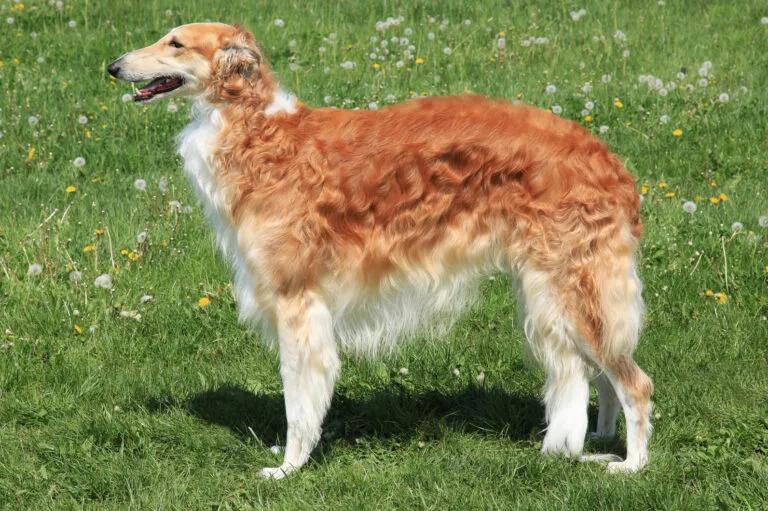
The Borzoi is an elegant Russian sighthound known for reaching exceptional speeds over short distances.
The noble reserve that Borzois sometimes display perfectly matches their aristocratic-looking appearance. The typically elegant physique of a sighthound, the balanced proportions and harmonious movements, as well as the long, narrow head, all contribute significantly to this dog’s noble and proud presence.
The Borzoi’s size is, of course, also impressive. The breed reaches a shoulder height of up to 85 cm, with some males even growing up to 95 cm tall. Despite this imposing height, the weight – which is not fixed in the breed standard – averages just 35 to 45 kg.
The Borzoi’s abundant and fine coat is silky, soft and supple. It is particularly long on the ribs, forequarters and hindquarters, as well as on the flanks. On the head, ears and limbs, by contrast, it is rather short and lies close to the body.
Within the FCI, the Borzoi with FCI standard number 193 belongs to the long-haired or feathered sighthounds (Group 10, Section 1). The Borzoi’s long coat is slightly wavy and in places forms short, fine curls, for example around the shoulder blade and on the croup.
In terms of colour, all combinations are permitted, but never blue or brown. The coat can be either solid-coloured or piebald. The “feathering” on the legs (breeches) and tail (flag) is usually much lighter than the base colour.
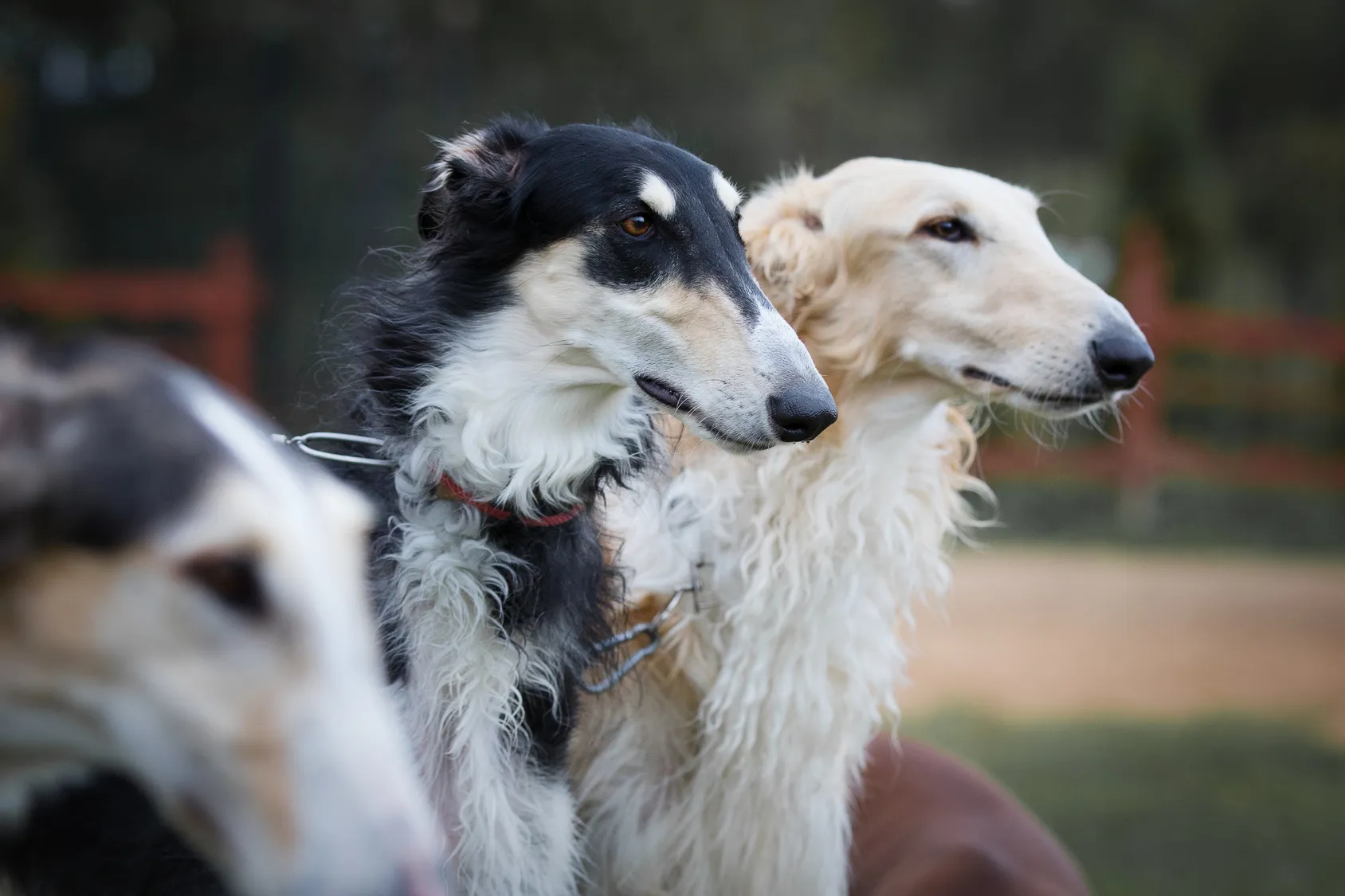
Many Borzois also have a black mask, which is particularly typical of the black-clouded colour varieties. The nose and lips must always be black. The large, almond-shaped eyes of the Russian sighthound should also be as dark as possible.
It is hardly surprising that the fascinating appearance of the Borzoi has also been an extremely popular subject in art. Numerous paintings, ceramic and porcelain figures, as well as bronze sculptures (for example by Marcel Debut (1890) or Georges Gardet (1880)), depict this impressive pedigree dog. The breed was also immortalised in Leo Tolstoy’s famous novel “War and Peace”, featuring the female dog “Milka”.
 © Azaliya (Elya Vatel) / stock.adobe.com
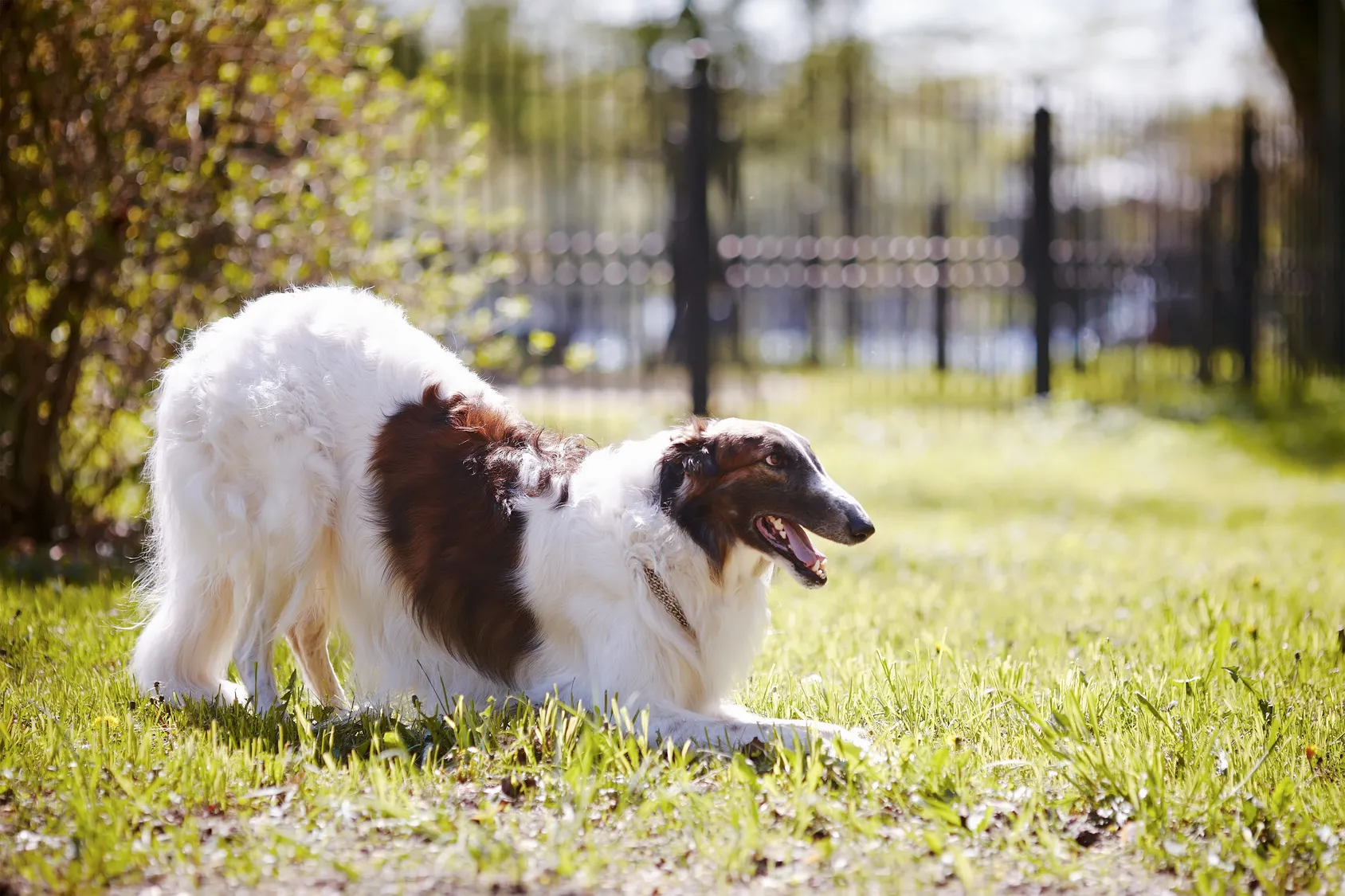
An ambitious hunter and gifted sprinter as a calm family dog? Like hardly any other dog, the Russian Borzoi manages to unite this apparent contradiction within himself.
One moment he is trotting calmly alongside his owner, the next he suddenly sprints off to chase some potential prey animal. Anyone who can rely on their Borzoi’s obedience when it comes to the recall clearly has an advantage here.
Thanks to his friendly, people-oriented nature, the Borzoi is fortunately easy to train. Despite his pronounced hunting instinct and self-confidence, he is considered intelligent, loyal and well balanced.
Just as much as he loves the race track , he also enjoys the sofa at home, where he recovers from sporting exertion and relishes being close to his family. At home, the energetic fighter turns into a pleasant and gentle companion, radiating calm and serenity.
Even though the Borzoi has all the qualities of a good family dog and generally presents himself as a very adaptable, easy-going and sensitive dog, as a full-blooded sighthound and hunting dog he also has a great need for running and activity. At least an hour and a half of exercise per day is recommended.
Only if he is allowed to live this out will his positive character traits truly come to the fore. Anyone wishing to keep a Russian sighthound as a family dog would therefore do well to offer him regular opportunities to run extensively and freely. Simple walks on the lead will certainly not be enough to satisfy this athletic Borzoi.
A dog that is allowed to run a lot and really burn off energy while hunting, coursing or on the dog race track will also be far more receptive to obedience training . If a Borzoi feels understood by his owner and that his needs are taken seriously, he will in turn do everything he can to please his owner.
Borzois are incredibly loyal and affectionate dogswho want to be closely involved in the family life of their “pack”. Towards strangers, however, they show noble reserve , without being shy, dominant or even aggressive.
Anyone who shows a bit of skill and is familiar with the basics of dog training should therefore have no problems with the training and socialisation of this peaceable sighthound.
As with all dogs, the same applies to the Borzoi: the earlier he is socialised and gets to know different people, animals and environments, the less likely he will later be unsettled by or develop fear of new situations.
It is important that he also encounters other dogs (of all ages and sizes) at an early stage, as Borzois have a reputation for not always getting along well with other dogs. However, if he grows up closely with them, there are usually no dominance problems later on.
The more you know about the breed before buying, the better prepared you will be for life with a Borzoi. This also includes thinking about the nutrition of this dog breed. After all, a balanced diet makes a decisive contribution to the dog’s wellbeing and state of health.
A Borzoi’s diet should consist largely of protein – but not only that! Vegetables and a small amount of “carbohydrate” such as rice, potatoes or pasta are also important to provide your dog with sufficient nutrients. Cereals, animal and plant “by-products”, or sugar, as found in some commercial foods, are not needed by your dog and should be avoided in a healthy diet.
To tailor the food optimally to your dog’s needs, you should be familiar with your Borzoi’s nutritional requirements. When calculating these, individual factors such as age, weight, size, sex and activity level must always be taken into account.
Like many large to very large dogs, the Borzoi is also prone to the dangerous condition known as gastric torsion. To keep the risk as low as possible, your dog should rest after eating. Avoid any form of exertion after meals.
Ideally, you should always feed your dog after an activity. Vets also recommend dividing the daily ration into several (smaller) meals.
Proper care of the Russian sighthound includes not only plenty of exercise and activity as well as a healthy diet, but also appropriate grooming. To ensure that the fine, long coat retains its well-groomed appearance, it should be brushed regularly.
Using a comb once a week is not sufficient for a Borzoi. It is better to brush your dog daily – or at least thoroughly every other day.
Ears, claws and teeth should also be checked and cleaned regularly. This will help maintain your Borzoi’s health and wellbeing throughout his life.
In principle, the Borzoi is considered a healthy, robust dog breed. Nevertheless, certain breed-specific conditions can occur, including metabolic bone diseases and hereditary eye diseases such as progressive retinal atrophy (PRA). Affected animals should be excluded from breeding.
In addition, this breed is more frequently affected by hypothyroidism as well as heart problems such as ventricular arrhythmias and dilated cardiomyopathy (DCM).
The life expectancy of a healthy Borzoi kept in a breed-appropriate way is around 10 to 12 years.
The roots of this impressive breed go back a long way. Genetic analyses from 2017 (led by Heidi Parker) show that the Russian Borzoi is related to the Greyhound and the Irish Wolfhound. These ancient European sighthounds were already bred thousands of years ago by the Celts.
In its home country of Russia, the Borzoi has been known and popular at least since the 13th to 15th centuries. Princes and tsars used the large, fast sight hunter for coursing foxes, wolves, hares and even big game. As there were still no long-range, precise firearms at the time, hunters relied on the abilities of their sighthounds. In groups, the dogs chased and held the game until the hunter on his horse could get close enough to dispatch it.
Russian landowners valued Borzois not only for their hunting talent, but also for their gentle and loyal nature, which made them obedient and reliable companions not just in the hunt, but also in private life.
In vast kennel complexes with up to 500 dogs, princes and tsars bred Borzois. Even though organised dog breeding only developed much later, they already proceeded in a very systematic and professional manner. At that time, however, there was still no uniform breed type.
This only developed at the end of the 19th century, when the various dog types were assigned to specific breeds and standardised accordingly. The modern Borzoi was bred from around ten different strains.
With the Russian Revolution, breeding of the Borzoi – which had been Russia’s “national dog” until around 1914 – became increasingly difficult in its home country. In other European countries, however, the breed continued to establish itself more and more.
Especially in England, the Russian sighthound continued to be bred and developed according to local preferences. In 1956 , the Borzoi was finally officially recognised by the international umbrella organisation FCI (Fédération Cynologique Internationale).
A reputable breeder will not simply sell you a puppy, but will want to make sure in a personal conversation that you are a suitable owner for a Borzoi. Before visiting the breeder, you should therefore be absolutely clear about why the Borzoi is the right dog for you and what goals you actually have with your dog.
People who want to keep this fascinating pedigree dog purely for reasons of prestige and have no idea how much activity, exercise and space this large sighthound really needs should not be surprised if the breeder advises them against the purchase of a Borzoi puppy.
The following set of questions will help you prepare optimally for the conversation with the breeder. At the same time, it should also help you find out whether the Borzoi is actually the right breed for you and whether you are sufficiently prepared for life with him.
 © Svetlana / stock.adobe.com
Today, the Borzoi is one of the rarer dog breeds, but it enjoys a stable base of enthusiasts in many countries, who value it as a hunting dog, family dog and racing dog.
In addition to preserving external characteristics and inner temperament traits, Borzoi breeders place great importance on the breed’s health. Independent breeding inspectors check compliance with prescribed health tests and ensure that only healthy, genetically sound animals are approved for breeding. Anyone interested in this Russian sighthound breed should therefore make sure to contact a reputable breeder.
When searching for a suitable breeder, national sighthound breeding and racing associations can be helpful. Cynological umbrella organisations also provide lists of registered breeders. The first prerequisite for buying a puppy is that all the necessary papers (with the FCI logo) are available. However, this alone should not be decisive.
It is also important that you have met the breeder in person beforehand and have been able to see the breeding conditions on site. You should have seen the breeding premises and the mother dog, and gained a comprehensive impression of the environment, rearing and socialisation of the dogs.
Here you will find answers to frequently asked questions about the elegant sighthound from Russia:
The Borzoi shows no extreme physical features such as a shortened muzzle, dwarfism or hairlessness, and is therefore not classified as a torture breed.
In general, the Borzoi is considered a healthy breed. However, various hereditary eye, bone or heart diseases can occur.
Thanks to its slim build and long legs, the Borzoi is a fast sprinter, reaching top speeds of almost 60 km/h.
The Borzoi is also known as the Russian hunting sighthound. It was bred to chase running game. Accordingly, it may happen that a Borzoi sees cats as prey. If it is to be kept together with feline companions, it must be accustomed to them early on. Then harmonious coexistence is possible.
For beginners, the sensitive Russian hunting sighthound is not necessarily recommended due to its hunting instinct and independence. It requires sensitive training, for which a certain amount of dog-handling experience is an advantage.
The Borzoi is a graceful, fascinating dog that combines two souls within itself: that of a agile, independent hunter and that of a calm house companion. Anyone looking for a exercise-loving, energetic four-legged companion with a pleasant, affectionate character will find the Russian sighthound to be an excellent choice.
| Special characteristics: | The Borzoi, also known as Barzaia, Russian (hunting) sighthound or Russian wolfhound, is a fast sprinter with a pronounced hunting instinct. |
| Character: | affectionate, calm, loyal, attentive |
| Shoulder height: | Male: 75–85 cm Female: 68–78 cm |
| Weight: | not specified, usually 35–45 kg |
| Coat: | long, silky coat, wavy or slightly curly, solid-coloured or piebald, all colours except blue and brown |
| Coat care: | moderate effort |
| Exercise: | needs plenty of activity and exercise |
| Suitable for beginners: | rather no |
| Barking: | rarely barks |
| Life expectancy: | up to 12 years |
| Typical illnesses: | hypothyroidism, progressive retinal atrophy (PRA), dilated cardiomyopathy (DCM) |
| FCI group: | 10. Sighthounds |
| Exercise requirement: | high |
| Origin: | Russia |

"A life without a pug is possible, but pointless," Loriot once said. I would unreservedly agree and add: "A life without horse, cat and rabbit as well!" My heart beats for all animals big and small and I have the great fortune to be able to write about my passion as a freelance author. With my articles I would like to raise awareness for animal welfare and give useful tips to animal lovers.
The Irish Wolfhound is one of the largest dogs in the world. Used for hunting wolves and bears in medieval Ireland, today it is kept exclusively as a family dog. Despite its imposing size, this sighthound is very gentle and affectionate. Unfortunately, the friendly giant is also quite prone to illness and has a comparatively short life expectancy. Is an Irish Wolfhound right for me, and what does keeping one involve? You can find everything you need to know in the following article.
Fans of the Bearded Collie agree that those who aren't familiar with this dog breed simply have to get acquainted with it. And those who have experienced how a Bearded Collie bolts across meadows with its flowing fur, how it rolls around full of energy and joy and how it attentively and observantly takes into account its owners wishes become simply addicted to this original dog breed and its unique charm.