{"url":"https://www.zooplus.co.uk/magazine/cat/cat-health-and-care/ticks-in-cats-proper-removal-and-prevention","title":"Ticks in Cats: Proper Removal and Prevention","mag_id":410321,"is_single":true,"cat_name":"Cat","sub_cat_id":152,"sub_cat_name":"Cat Health and Care","cat_id":138}
As soon as the temperatures consistently rise above seven degrees, annoying parasites start to reappear. As the weather becomes milder, ticks are now active in many places even during winter. Ticks are particularly unpleasant for cats. Why you should remove these pests as quickly as possible and the best way to do so is explained in our guide.
Since ticks can transmit dangerous diseases, you should check your outdoor cat thoroughly for ticks at least once a day. Combined with a cuddle, you can carefully examine your cat’s entire body.
Pay particular attention to the areas with little fur that ticks prefer. They tend to settle around the head, neck, ears, tummy and the insides of the thighs.
Regular Tick Checks Are a Must
Depending on how much blood the tick has already ingested, its size can vary from just a few millimetres up to the size of a cherry stone.
Keep an eye on the bite site for some time after removal. Redness, fever or loss of appetite may indicate that your cat has developed an illness.
Removing Ticks Properly: What To Do If Your Cat Has Ticks
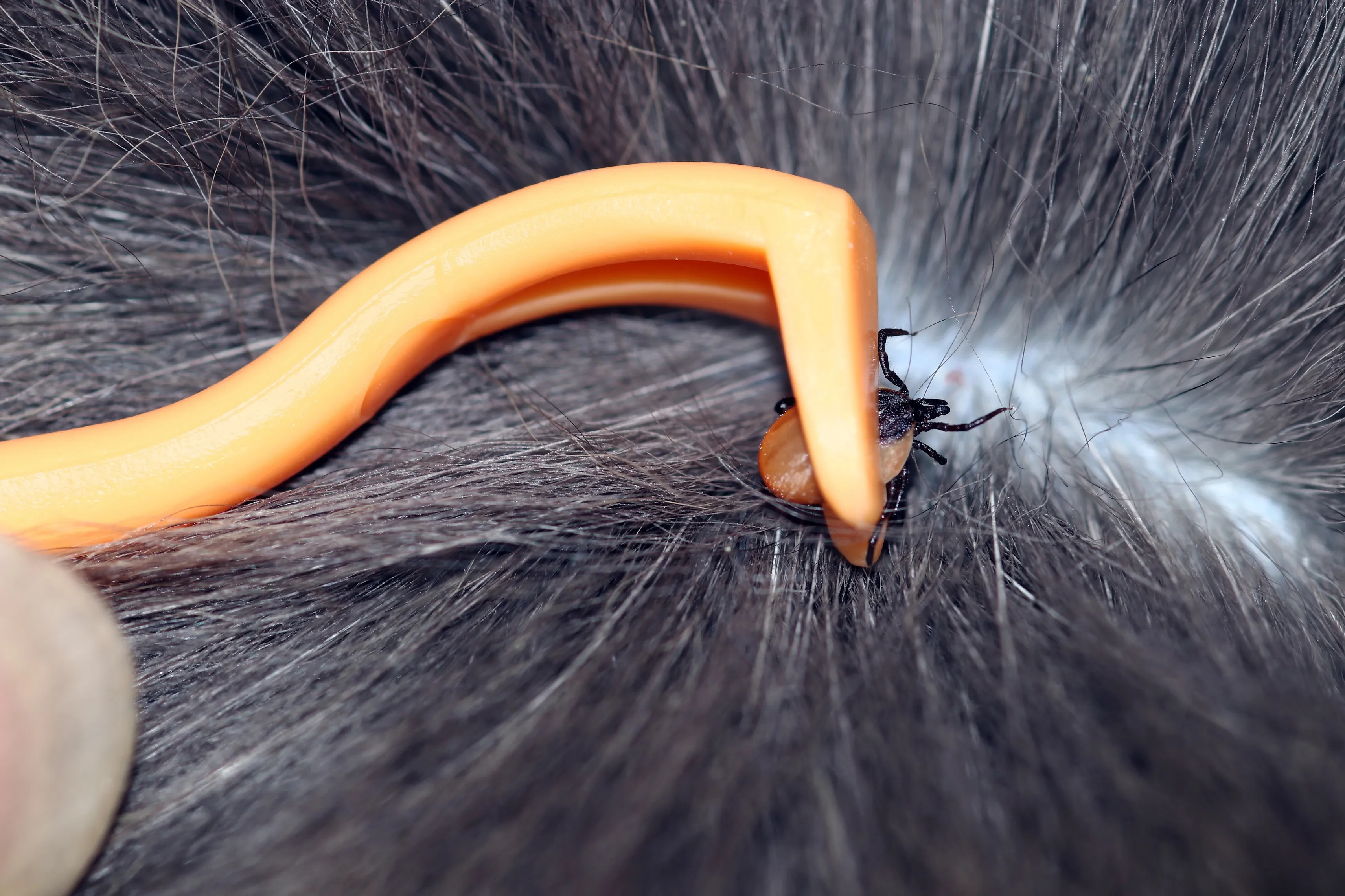
If your cat comes home from one of its adventures with a tick, remove it as quickly as possible. The best way to proceed is as follows:
With a tick hook, you can usually remove ticks from your cat easily, quickly and safely.
Which Diseases do Ticks Transmit?
Ticks on cats are not only irritating and blood-sucking; they can also transmit serious diseases. Depending on the region in Germany, between 15 and 30% of ticks are infected with pathogens.
Compared to dogs, these diseases are fortunately transmitted to cats much less frequently – or cats fall ill far less often for reasons that are not yet fully understood. Nevertheless, every tick bite carries the possibility that your cat could become infected with a pathogen. The most common infectious diseases include Lyme disease, anaplasmosis and babesiosis.
What Happens If You Don’t Remove a Tick From a Cat?
The pathogens are located in the tick’s gut and migrate to its salivary glands while it feeds. On average, this takes twelve to 24 hours.
The longer the tick feeds on your cat’s blood, the more likely it is that pathogens will be transmitted. By removing ticks from cats promptly after the bite, you can easily minimise this risk.
Do Ticks Fall Off Cats on Their Own?
A tick feeds on a cat’s blood for around three to seven days. Once fully engorged, it drops off. However, while the tick is attached, there is an risk of infection with serious diseases such as Lyme disease. You should therefore not wait for the tick to fall off by itself, but remove it properly.
What’s more, if the tick drops off indoors, it may eventually look for a new host – which could be a human. In this case, the cat acts like a taxi, bringing the unwelcome guest home. However, cats do not transmit ticks directly to humans (nor the diseases caused by ticks).
Prevention: What is The Best Protection Against Ticks for Cats?
When it comes to ticks on cats, prevention is always better than cure. You should therefore protect your cat in advance against tick bites and the risk of disease transmission.
What do Ticks Dislike on Cats?
There are various preparations (antiparasitics) available that either kill ticks or prevent them from attaching. The following options are available:
Spot-on treatments are applied between the shoulder blades and then spread across the entire body. Depending on the duration of effectiveness (between four and twelve weeks), you will need to treat your cat several times a year.
Sprays work in the same way as spot-on treatments.
Tablets for ticks are only available from your vet.
Collars release their active ingredients continuously. They usually repel ticks and other parasites over a longer period (around five to six months). However, they also carry a risk of injury, as cats can get caught on something while wearing a collar.
Are Antiparasitics Harmful to My Cat?
There are many reservations about anti-tick products. Above all, people question whether they might be harmful to humans and animals, as they are essentially neurotoxins.
Most antiparasitics are indeed neurotoxins. However, unlike insects, humans and cats have what is known as a blood-brain barrier. This means the active ingredient does not reach the area where it could cause harm.
What do Vets Recommend Against Ticks in Cats?
Of course, intolerances can still occur with anti-tick treatments. Every medication has not only an effect but also side effects. The range of products available is now so wide that you should be able to find one your cat tolerates better.
However, there are also problematic active ingredients: permethrin, flumethrin and deltamethrin are, for example, toxic to cats. So always make sure that the product is approved for cats.
Are There Home Remedies for Ticks on Cats?
Various sources repeatedly promote home remedies such as coconut oil, black seed oil, garlic or amber necklaces for ticks on cats. But do these remedies really work?
So far, scientific evidence has shown only a slight effect of coconut oil – and only when applied externally. However, the cat would need to be treated all over its body every day. For our naturally very clean cats, this is certainly anything but pleasant.
Important: home remedies such as garlic or black seed oil are toxic to cats. You should therefore never use them to repel ticks.
Even if home remedies may keep ticks away in individual cases, there is another point to consider: if your cat does not bring home any ticks, there may be other reasons. After all, not all cats are equally attractive to parasites. Some are true tick magnets, while others are only very rarely bitten.
Ticks on Cats: The Three Most Common Myths
When it comes to ticks on cats, there are still many misconceptions. We have taken a closer look at the three most important ones for you.
1. Ticks Drop from Trees Onto Their Host.
Ticks mainly live in tall grass or shrubs. They do not drop from trees onto cats or humans.
2. You Always Have to Twist to Remove a Tick.
It is not absolutely necessary to twist the tweezers to remove a tick from your cat. After all, these parasites do not have a thread. However, if a gentle twisting motion makes it easier for you, that is perfectly fine.
3. It is Dangerous if the Tick Has Not Been Completely Removed.
If you cannot remove the tick entirely and the head remains in the skin, this is not the end of the world. Normally, the tick’s head is enclosed by your cat’s body in a scab and will eventually fall off with it. However, check the bite site regularly. If you notice signs of inflammation, consult your vet.
Nevertheless: since a retained head theoretically means there is still a risk of pathogen transmission, you should always aim to remove the tick completely.
Conclusion: How Serious Are Ticks for Cats?
Ticks can be unpleasant to dangerous for cats. The bite site can become inflamed if the cat scratches a lot or if the parasite was not removed properly. The main concern is the transmission of pathogens – although cats develop Lyme disease and similar illnesses less often than dogs. A heavy tick infestation can be particularly serious for animals with pre-existing conditions and young kittens: they may suffer from dangerous anaemia.
Important Note: The content provided for informational purposes only and is not intended to replace professional veterinary advice, diagnosis or treatment. If you have any questions or concerns about your pet's health, please always consult a licensed veterinarian.
Franziska Pantelic, Veterinarian
I am supporting the zooplus magazine for several years with my extensive expertise. I became a licensed veterinarian as early as 2009 and currently operate a mobile small animal practice in the metropolitan area of Munich.
It’s not just the right type of litter tray that will make your cat happy, but also the right type of cat litter. The best litters are ones that are very absorbent and ideally neutralise odours too, but finding the perfect cat litter can be no easy task with so many varieties on offer from natural clumping litter made of clay, non-clumping litter, litter made of wood or silica.
Are you worried because your ageing feline friend no longer responds to her name? Or are you wondering why your house cat can’t find her food bowl straight away? Your cat has probably reached a proud senior age and now needs special care. Find out how to spot the symptoms of senility in your cat early on and give her an age-appropriate life.
Coconut oil is very popular among cat owners as it provides natural protection from ticks and other parasites. In addition, this on-trend product is said to have numerous benefits. We will give you tips and information on how and when coconut oil can be a practical alternative to conventional remedies.