{"url":"https://www.zooplus.co.uk/magazine/cat/cat-health-and-care/ear-mites-in-cats","title":"Recognising & Treating Ear Mites in Cats","mag_id":363714,"is_single":true,"cat_name":"Cat","sub_cat_id":152,"sub_cat_name":"Cat Health and Care","cat_id":138}
Is your cat scratching its ears unusually often or repeatedly shaking its head? Ear mites could be the cause. This particular type of mite can trigger intense itching in your cat. In the following article, you’ll find out how to recognise and treat ear mites in cats.
Ear mites are generally not particularly dangerous for your cat. In very rare cases, inflammation of the outer ear can spread to the middle or inner ear. However, this is the exception rather than the rule.
Even so, ear mites cause almost unbearable itching for cats. Prompt and effective treatment against the mites is therefore essential.
Can Ear Mites Be Transmitted to Humans?
Ear mites in cats are contagious to other animals. Humans, however, are what’s known as a false host, meaning the mites do not find the right conditions on us to spread. Although transmission is theoretically possible, it happens only rarely. To reduce the risk of infection and help the affected animal recover more quickly, thorough hygiene is important.
Symptoms: How to Recognise Ear Mites
Ear mites cause a condition known as ear mange (otitis externa parasitaria) in cats. Depending on the severity of the infestation, various symptoms may occur, which can help you identify ear mites in your cat. These include:
Itching (increased scratching at the ears, head shaking)
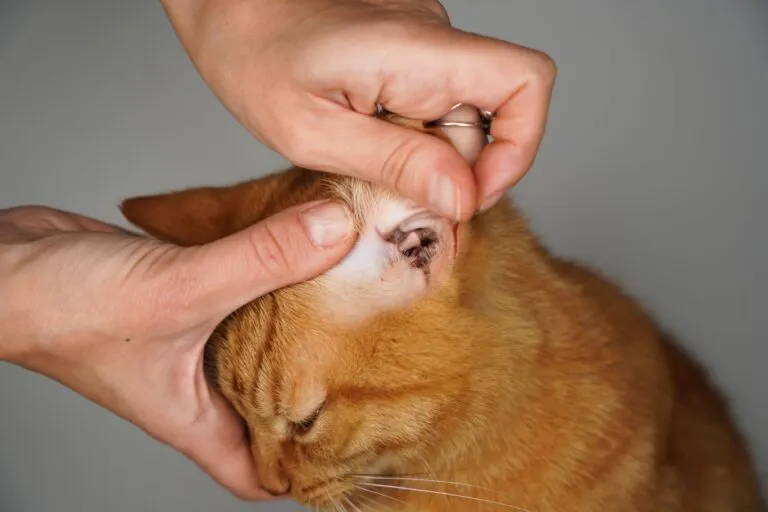
Dark, coffee-ground-like deposits in the ears (made up of blood, ear secretions, cell debris and mite excretions)
In rare cases: middle or inner ear infection (otitis media/interna), which can even lead to inflammation of the brain (encephalitis)
Not every affected cat will show the full range of symptoms. In some cases, the typical deposits in the ears are the only sign by which you can recognise ear mites.
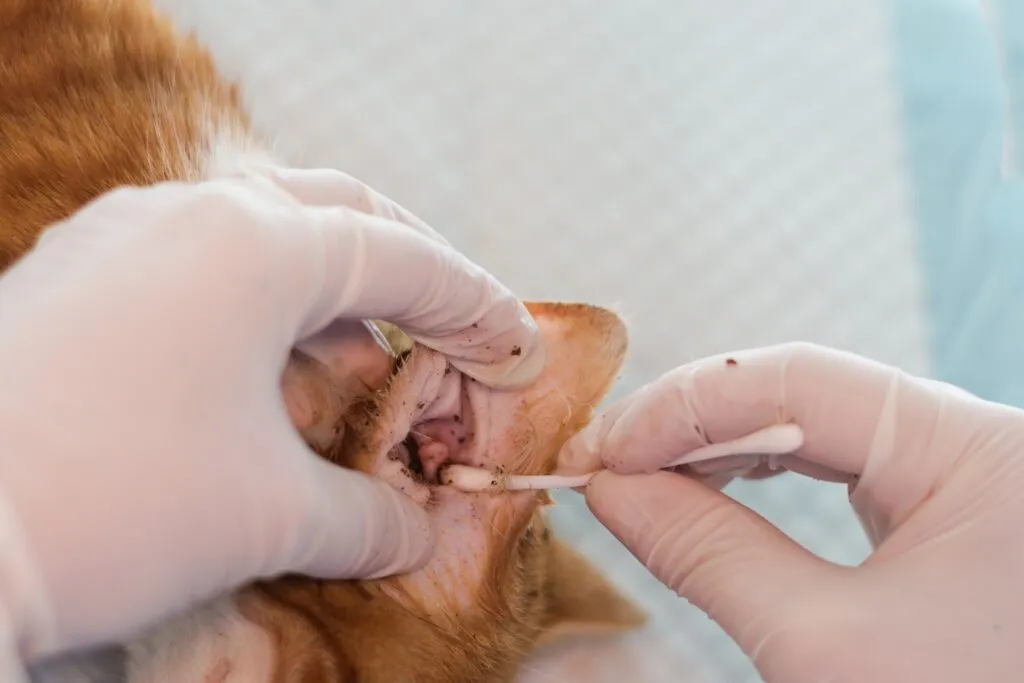
You can recognise ear mites in cats by the dark, coffee-ground-like debris in the ear flap.
Diagnosis: How Are Ear Mites Detected in Cats?
As ear mites are difficult to see with the naked eye, a vet must confirm the diagnosis.
How Is Your Cat Examined for Ear Mites?
During the medical history discussion and the general clinical examination, the vet will first gather all the key information. This is followed by a specific examination: using an otoscope, the vet will inspect your cat’s ears. This funnel-shaped instrument is equipped with a light and a magnifying lens, making it easier to examine (inspect) the ear canal.
Sometimes the mites can already be seen as tiny, moving dots in the ear. If the ear canal is soiled with a dark, waxy mass, the vet will take a swab. Under the microscope, the mites are then clearly visible.
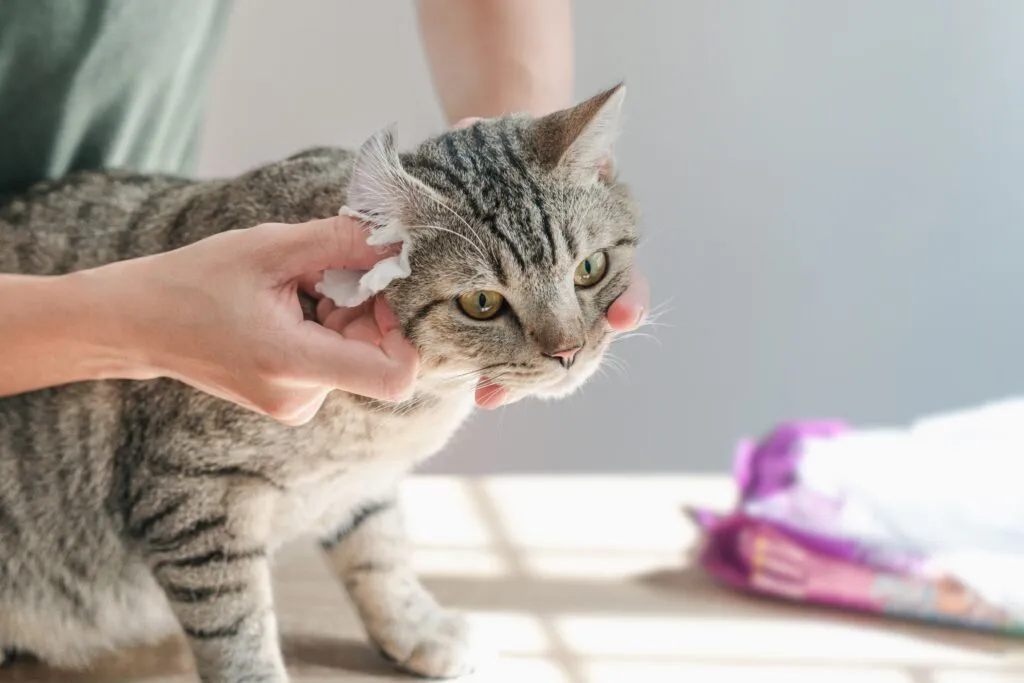
When treating ear mites, it may be necessary to gently clean your cat’s ears, depending on the type of treatment used.
Treatment: How to Treat Ear Mites in Cats
Treatment for ear mites consists of medication and additional supportive measures. To eliminate every stage of the mites, therapy must continue for at least three weeks. You should also treat any other cats in your household to prevent them from repeatedly infecting one another.
Medication
Depending on the severity of the infestation, the vet may prescribe different medications or combinations for your cat. These include:
antiparasitic treatments
anti-inflammatory ointments
antibiotic ear drops in cases of bacterial secondary infections
To ensure the medication works as effectively as possible, it’s advisable to first gently clean the ear flaps with a damp paper towel or use an ear rinse until all crusts have been loosened.
Supportive Measures: How Can You Treat Ear Mites in Cats Yourself?
To help your cat recover as quickly as possible, you should take a few additional steps at home. Contaminated surfaces, blankets and items such as brushes must be thoroughly cleaned and disinfected.
During treatment, you should also clean and care for your cat’s ears regularly. Agree the frequency and suitable ear cleaners with your vet. With some treatment methods, it’s important not to clean the ears between applications.
Are There Home Remedies for Ear Mites?
Various oils such as coconut oil or olive oil may help to relieve itching in the affected area and combat the mites. However, home remedies should only be used in consultation with your vet and only as a supportive measure alongside professional treatment.
Prognosis: What Are the Chances of Recovery from Ear Mites?
An ear mite infestation in cats is treatable in most cases. However, you must carry out the treatment consistently for at least three weeks to prevent the stubborn parasites from returning. The itching usually subsides after just a few days.
Causes: Where Do Ear Mites Come from?
Ear mites prefer to live in the ear canals of animals such as dogs and cats. Contact with other pets is therefore a potential source of infection. As ear mites also occur in the wild, outdoor cats can pick them up while roaming their territory.
How Does Ear Mange Develop in Cats?
Ear mites (Otodectes cynotis) cause ear mange in cats. These arachnids, measuring around half a millimetre, cling to the skin of the ear canal with their long legs. Using their chewing mouthparts, they feed on skin cells and cellular secretions.
Meanwhile, female Otodectes cynotis lay their tiny eggs on the surface of the skin in the ear canal. After a few days, the larvae hatch. They then develop through two nymph stages (protonymph and tritonymph) into adult mites.
Prevention: How Can I Avoid Ear Mites in Cats?
The following preventative measures can help protect your cat from ear mites:
Ear mites are mainly transmitted through close contact with other infected cats. Therefore, flea collars or spot-on treatments for cats are an effective way to prevent mites.
Regular cleaning of grooming items and warm sleeping areas is important to help prevent an ear mite infestation.
Pregnant cats should always be checked for infestation. Close contact with kittens means ear mites can quickly be passed on. This is why infestations are particularly common in young cats and kittens.
By staying vigilant and maintaining good hygiene, you can protect your cat from troublesome ear mites. If an infestation does occur, your vet’s guidance and your attentive care will help treat your cat properly and get rid of the parasites quickly.
Important Note: The content provided for informational purposes only and is not intended to replace professional veterinary advice, diagnosis or treatment. If you have any questions or concerns about your pet's health, please always consult a licensed veterinarian.
At the Justus-Liebig-University of Giessen I was extensively trained as a veterinarian and was able to gain experience in various fields such as small animal, large animal and exotic animal medicine as well as pharmacology, pathology and food hygiene.
Since then, I have been working not only as a veterinary author, but also on my scientifically driven dissertation. My goal is to better protect animals from pathogenic bacterial organisms in the future.
Besides my veterinary knowledge, I also share my own experiences as a happy dog owner and can thus understand and enlighten fears and problems as well as other important questions about animal health.
It’s not just the right type of litter tray that will make your cat happy, but also the right type of cat litter. The best litters are ones that are very absorbent and ideally neutralise odours too, but finding the perfect cat litter can be no easy task with so many varieties on offer from natural clumping litter made of clay, non-clumping litter, litter made of wood or silica.
Are you worried because your ageing feline friend no longer responds to her name? Or are you wondering why your house cat can’t find her food bowl straight away? Your cat has probably reached a proud senior age and now needs special care. Find out how to spot the symptoms of senility in your cat early on and give her an age-appropriate life.
Coconut oil is very popular among cat owners as it provides natural protection from ticks and other parasites. In addition, this on-trend product is said to have numerous benefits. We will give you tips and information on how and when coconut oil can be a practical alternative to conventional remedies.