{"url":"https://www.zooplus.co.uk/magazine/cat/cat-health-and-care/fleas-in-cats-how-to-identify-and-treat-them","title":"Fleas in Cats: How to Identify and Treat Them","mag_id":411194,"is_single":true,"cat_name":"Cat","sub_cat_id":152,"sub_cat_name":"Cat Health and Care","cat_id":138}
Is your cat suddenly suffering from severe itching, fleas could be the cause. These parasites are not only a nuisance, but often lead to further problems. We’ve summarised how to spot fleas in cats and get rid of them effectively.
At first glance, apart from the intense itching, there may not seem to be a major risk from fleas. However, an infestation with these parasites can always have further consequences:
Flea saliva allergy: When a flea bites, it releases saliva. This is responsible for the itching. Some cats react allergically to flea saliva, which leads to particularly intense itching.
Tapeworms: Fleas can carry tapeworm larvae. If your cat swallows a flea while grooming or trying to scratch, the eggs enter the cat’s intestines. That’s why you should worm your cat if they have fleas.
Anaemia: A very heavy flea infestation can result in significant blood loss and lead to anaemia.
Haemobartonellosis: This infectious disease is caused by bacteria from the Mycoplasma family (Haemobartonella felis). Fleas transmit the bacteria, which destroy the cat’s red blood cells.
Bartonellosis (cat scratch disease): Fleas are the main carriers of Bartonella bacteria. In cats, the bacteria usually cause no symptoms, but in humans they can lead to bartonellosis.
Symptoms: How Does a Cat Behave if It Has Fleas?
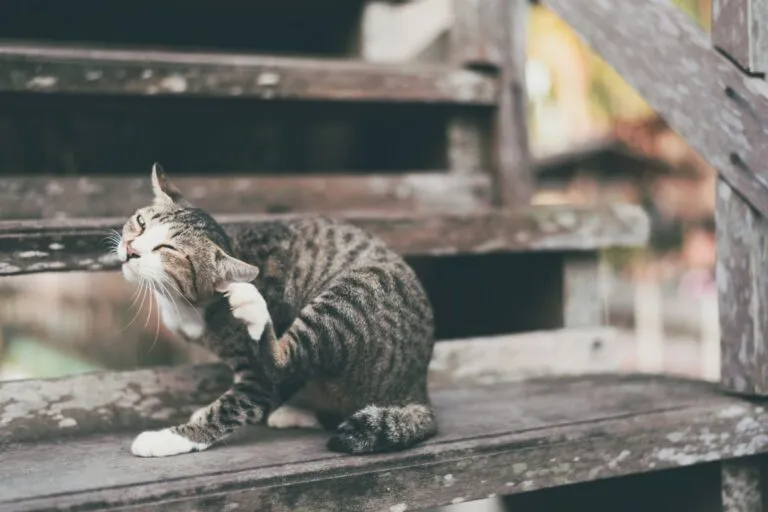
The most important symptom of fleas in cats is itching. If your cat is scratching noticeably often, fleas should be high on your list of suspects.
Local skin reactions such as red spots are additional signs. Scratching flea bites can also lead to pustules and scabs.
Diagnosis: Where Are Most Fleas Found on Cats?
Depending on the severity of the infestation, you may be able to spot fleas on your cat with the naked eye in the fur. Bites and redness in areas favoured by fleas (ears, back, base of the tail, belly and inner thighs) are also important clues.
Check Your Cat for Flea Dirt
If you can’t see the fleas straight away, check your cat for flea dirt:
Place your cat on a smooth, light-coloured surface – such as tiled flooring or the bath.
Now comb your cat’s fur with a fine-toothed comb if possible. If flea dirt is present, it will either remain in the black crumbs or fall down.
Put the crumbs on a white cloth and dampen it.
If reddish stains appear around the crumbs, it is flea dirt, as it contains digested blood from your cat.
Treatment: How Do I Get Rid of Fleas in Cats?
Successful flea treatment always consists of two components:
1. Treat the Cat with the Flea Infestation
First of all, the fleas living on your cat and making life difficult need to be tackled. There are medications with different active ingredients and methods of application available. You can choose between collars, spot-ons, and tablets.
Most medications not only kill the adult fleas but also prevent egg laying or the development of larvae. Even so, you should carry out the treatment three times at four-week intervals in total.
2. Treat the Environment and Any Other Animals
If there are other animals in your household, they must all be treated for fleas as a precaution. Otherwise, your pets will keep reinfecting one another. In the same way, you should worm all animals in your household, as tapeworms can be transmitted to them too.
What’s more, only around five percent of the flea population is actually on the cat. That’s why you must treat your entire home for fleas.
Are Antiparasitic Products Harmful to My Cat?
There are many reservations about antiparasitic treatments. The fact that they are neurotoxins worries many cat owners. Unlike insects, however, humans and cats have what is known as a blood-brain barrier. This means the active ingredient does not reach the areas where it could cause harm.
Intolerances to anti-flea products can of course occur, as unfortunately every medication can have side effects as well as benefits. The range of products is now so wide that you’re sure to find something your cat tolerates better.
However, there are also problematic active ingredients: permethrin, flumethrin and deltamethrin, for example, are toxic to cats. Always make sure that the product is approved for cats .
Are There Any Home Remedies for Fleas in Cats?
In individual cases and with a mild infestation, home remedies such as vinegar spray or herbal infusions may help cats. However, these gentle methods are not suitable for severe infestations, as they put strain on both your cat’s sense of smell and their need for cleanliness.
Within the wide range of approved medications, you’re sure to find a suitable product for every cat to get rid of fleas reliably.
Prognosis: How Long Does It Take to Get Rid of Fleas in Cats?
If you treat your cat and your home as recommended, it should be no problem to get rid of the parasites quickly again. As a rule, it takes four weeks before you can complete the treatment. But even here, the same applies: prevention is better for your cat than cure!
Prevention: How to Prevent a Flea Infestation
The same products used to treat a flea infestation are also suitable for prevention. In addition, most medications are also effective against ticks. This way, you protect your cat against two types of parasites.
Prevention is particularly important if your pet suffers from a flea saliva allergy. As even a single flea bite can trigger severe itching, you should use parasite protection regularly in this case.
Cause: How Does a Cat Get a Flea Infestation?
Cats usually become infected with fleas through contact with other infested animals . However, the parasites may also lurk on contaminated objects. Cat fleas like to settle in fabrics such as carpets, cushions, and sofas.
In addition, living spaces unfortunately offer ideal conditions for fleas to develop. And if conditions aren’t perfect, the fleas simply pupate and can survive for several months even in inhospitable surroundings.
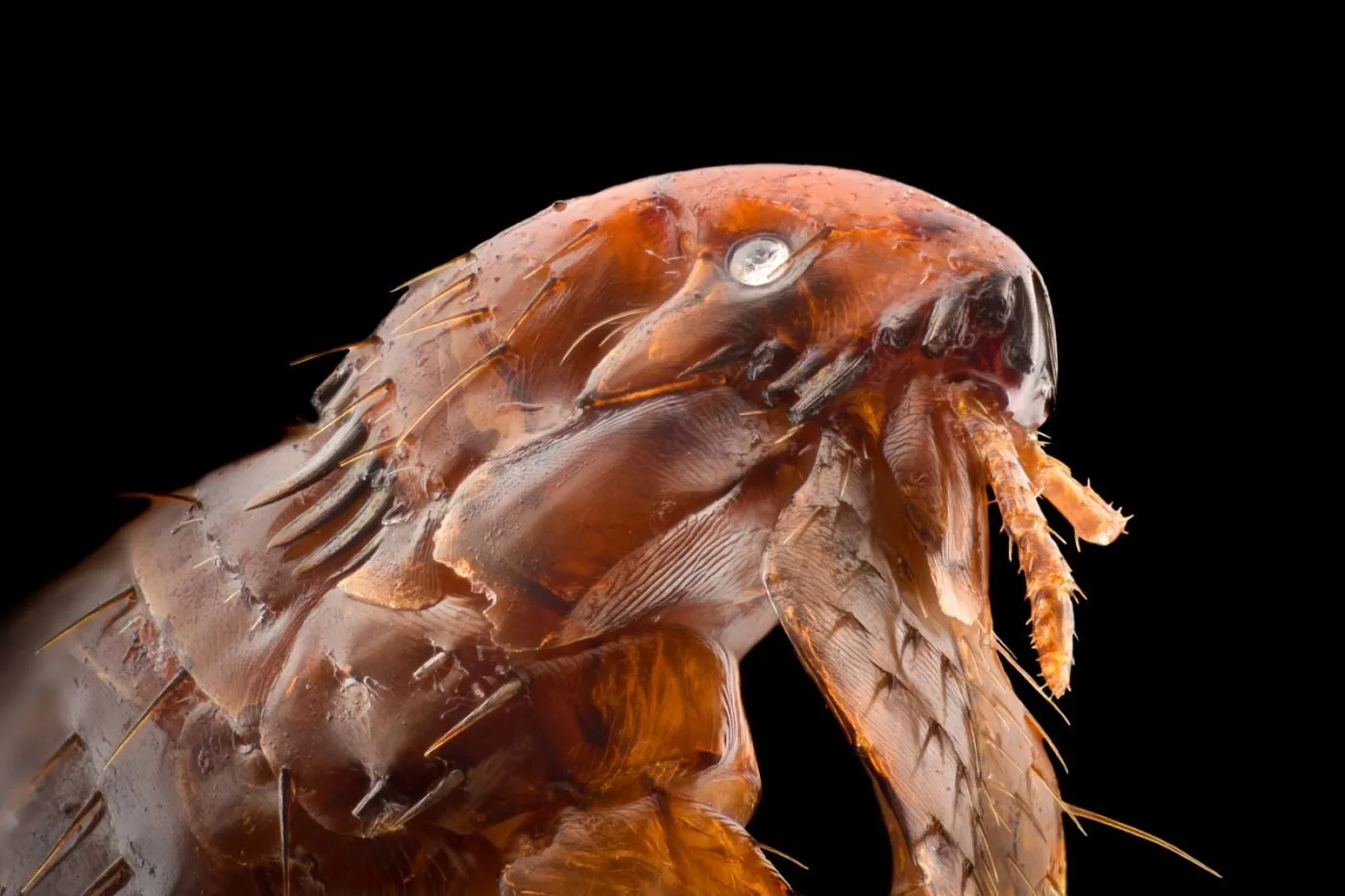
Under the microscope, fleas can be seen in even greater detail.
A Closer Look: What Exactly Are Fleas?
With more than 2,000 species, fleas are among the most common parasites of mammals and birds. Among cats and dogs , the cat flea (Ctenocephalides felis) is the most common. However, other species such as the dog flea (Ctenocephalides canis) or the hedgehog flea (Archaeopsylla erinacei) also like to feed on the blood of our cats.
Fleas are one to six millimetres long, laterally flattened and wingless insects. With their powerful hind legs, jumps of 25 centimetres are not uncommon. Cat fleas are light to dark brown and equipped with strong, piercing-sucking mouthparts .
Flea Reproduction
Fleas develop from an egg, through three larval stages to a pupa, and then into an adult flea.
Adult females begin feeding on blood shortly after infesting the cat and lay their first eggs after about a day. During the flea’s lifespan of between 50 and 100 days, it lays an average of 30 eggs per day.
When the cat is resting, the eggs fall onto the sleeping area or other places the cat frequently visits. There, they continue to develop up to the pupal stage. If external conditions are unfavourable for further development, the pupated larvae can survive in their cocoon for up to 50 weeks .
Can Cat Fleas Be Transmitted to Humans?
Although it’s called the cat flea, this parasite can also infest us humans and feed on our blood. Cat fleas are generally transmissible to humans, but prefer furry hosts – such as cats or dogs. In people, a flea infestation mainly appears as bite marks on the arms and legs, which cause unpleasant itching.
Important Note: The content provided for informational purposes only and is not intended to replace professional veterinary advice, diagnosis or treatment. If you have any questions or concerns about your pet's health, please always consult a licensed veterinarian.
This article was translated using Artificial Intelligence from the original German zooplus Magazine. While the original content was authored by industry experts and reviewed by our editorial team, this automated translation has not been human-edited and is provided for informational purposes.
Franziska Pantelic, Veterinarian
I am supporting the zooplus magazine for several years with my extensive expertise. I became a licensed veterinarian as early as 2009 and currently operate a mobile small animal practice in the metropolitan area of Munich.
It’s not just the right type of litter tray that will make your cat happy, but also the right type of cat litter. The best litters are ones that are very absorbent and ideally neutralise odours too, but finding the perfect cat litter can be no easy task with so many varieties on offer from natural clumping litter made of clay, non-clumping litter, litter made of wood or silica.
Are you worried because your ageing feline friend no longer responds to her name? Or are you wondering why your house cat can’t find her food bowl straight away? Your cat has probably reached a proud senior age and now needs special care. Find out how to spot the symptoms of senility in your cat early on and give her an age-appropriate life.
Coconut oil is very popular among cat owners as it provides natural protection from ticks and other parasites. In addition, this on-trend product is said to have numerous benefits. We will give you tips and information on how and when coconut oil can be a practical alternative to conventional remedies.