{"url":"https://www.zooplus.co.uk/magazine/dog/dog-health-and-care/ticks-in-dogs-proper-removal-and-prevention","title":"Tick Bite in Dogs: Removing and Preventing Ticks","mag_id":402553,"is_single":true,"cat_name":"Dog","sub_cat_id":143,"sub_cat_name":"Dog Health and Care","cat_id":3410}
Once winter is over, ticks quickly become a nuisance for our pets. A tick bite in dogs can be genuinely dangerous. Find out why it’s so important to get rid of these tiny bloodsuckers as quickly as possible and how to remove ticks properly from your dog in our guide.
Unfortunately, ticks are not only annoying for people and dogs, but these blood-sucking parasitesalso transmit numerous diseases. So ticks on dogs are not something to be taken lightly. That’s why the rule is:
The earlier you spot and remove ticks on dogs, the lower the risk of pathogens being transmitted.
This is because most pathogens are located in the tick’s gut. From there, they must first migrate to the tick’s salivary glands in order to infect a new host. This process takes several hours. If you remove the tick from your dog in good time, you also reduce the likelihood of disease transmission.
Regular Tick Checks Are a Must
It’s best to check your dog for tick bites after every walk. Examine your dog’s entire body carefully: pay particular attention to the head area, ears, neck, belly and inner thighs. Ticks prefer areas with thin skin and little fur.
Tip: Run a fine-toothed dog comb through your dog’s coat. This can help you spot ticks more easily – even in black or brown fur.
Ticks are sometimes easier, sometimes harder to see. Depending on how much blood they have ingested, their size ranges from as small as a pinhead to as large as a cherry stone.
When do Symptoms Appear After a Tick Bite in Dogs?
Also watch out for symptoms that may occur after a tick bite in dogs. These include, for example, diarrhoea, fever or loss of appetite. This may indicate a possible illness.
Initial symptoms such as swelling of the skin can usually be seen after just a few hours. The small lump or mild skin irritation is a normal local reaction to the tick bite and is not yet an indication that pathogens have been transmitted. However, a warning sign is a ring-shaped redness around the bite site, which appears after several days to weeks and spreads over a large area: this may be a sign of a Lyme disease infection.
Removing Ticks: What Should I Do If My Dog Has a Tick Bite?
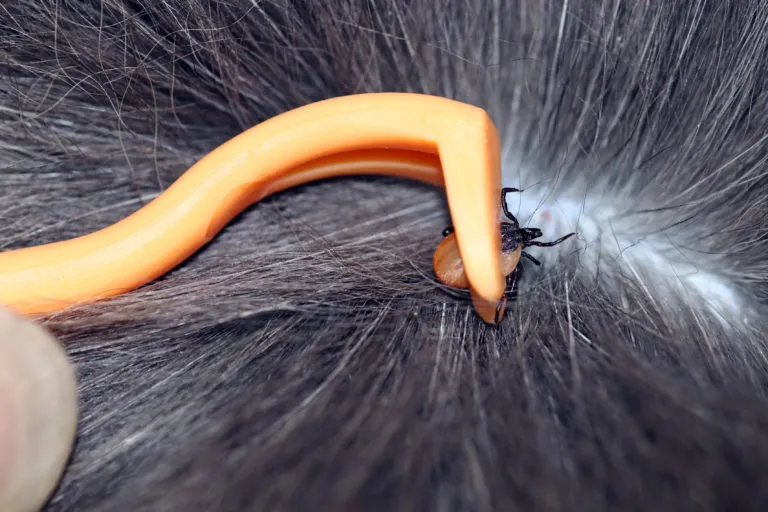
For the safe removal of a tick, it’s recommended to use special tick tweezers or a tick hook. Place the tool as close to your dog’s skin as possible, taking care not to squeeze the tick’s body.
Then grasp the tick’s mouthparts and the parasite pull it slowly, carefully and straight out of the skin, without any jerky movements. Afterwards, check that the tick has been removed completely.
Keep an Eye on the Bite Site
The removed tick should then be disposed of properly, so that it cannot infest another host. The affected area of skin should be thoroughly disinfected and monitored regularly over the following days.
If a ring-shaped redness develops around the bite site, this may indicate a possible Lyme disease infection. Your dog’s general condition should also continue to be observed: if they show signs of lethargy, illness or fever, you should consult a vet promptly.
Tick Bite in Dogs: Which Diseases do Ticks Transmit?
Many dog owners ask: Are ticks dangerous for dogs? The answer is quite clear: yes, they are!
This is because ticks can transmit numerous pathogens through their saliva. These, in turn, can cause very serious illnesses in your dog. These include:
Tick-borne encephalitis (TBE): TBE is transmitted by viruses but occurs only very rarely in dogs and mainly affects animals with weakened immune systems.
Prevention: Protecting Your Dog Against Ticks
When it comes to tick infestations in dogs, prevention is far more sensible than treating the consequences later. That’s why your dog should be protected against tick bites and the associated risk of disease transmission at an early stage. Various antiparasitic products are available for this purpose, which either kill ticks or prevent them from attaching to the skin in the first place.
Spot-on, spray, collar or tablets
One option is so-called spot-on treatments, which are applied to the area between the shoulder blades and then spread over the entire surface of the skin. Depending on the duration of action, which is usually up to four weeks, regular application throughout the year is necessary. Sprays work on a similar principle and offer comparable protection.
Tick collars, on the other hand, release their active ingredients continuously and can keep ticks and other parasites at bay for a longer period of around five to six months. In addition, tablets are available, which are prescribed by a vet and, depending on the product, provide protection for three to six months.
Apply the spot-on solution to the back of your dog’s neck or between their shoulder blades.
Removing Ticks From Dogs: FAQ
There are still numerous misconceptions surrounding ticks in dogs – and in other animals too. However, some of the most common myths can easily be cleared up.
Contrary to popular belief, ticks do not drop from trees onto their hosts. Instead, they are found mainly in tall grass, undergrowth or low shrubs and from there transfer onto animals or people.
Tick Bite or Tick Sting?
Strictly speaking, ticks do not bite their victims – they sting. The parasites have a piercing mouthpart, which is why the scientific term is tick sting. In everyday language, however, the (not entirely accurate) term tick bite is often used.
Pull or Twist?
There is often uncertainty about the correct way to remove ticks. Whether you gently twist the tick or pull it straight out is generally not crucial. A slight twisting motion can make removal easier, but it is by no means essential, as ticks do not have a threaded mouthpart.
What Happens If the Head Remains Stuck?
If the tick’s head remains in your dog’s skin during removal, this is not automatically a problem. In many cases, the remaining fragment becomes encapsulated by the body, forms a scab and falls off on its own during the natural healing process. It’s important to check the affected area regularly and consult a vet if there are signs of inflammation.
Theoretically, if part of a tick remains behind, there may still be a slight risk of pathogens being transmitted. All the more reason to remove ticks as carefully and completely as possible.
With a tick hook, you can usually remove ticks from your cat easily, quickly, and safely.
Are There Home Remedies for Ticks in Dogs?
The topic of home remedies for ticks in dogs is often mentioned. From time to time, people still claim that oil, glue, nail varnish remover or similar substances help with tick removal.
However, the opposite is true. When trying to kill ticks on dogs using such substances, more pathogens often enter the wound. Adhesives or alcohol-based products can irritate your dog’s skin. Manual removal with tweezers remains the only safe way to remove ticks from dogs.
Natural Tick Protection for Dogs: How Effective Are Coconut Oil, Garlic and Such?
Home remedies are also frequently promoted for preventing tick bites in dogs – for example tea tree oil, black cumin oil or coconut oil, essential oils such as lavender and mint, or even garlic. While there are reports suggesting that essential oils may have a slight repellent effect, this usually lasts only a very short time. However, there is still a lack of reliable scientific studies proving their effectiveness.
The biggest problem, however, is this: some home remedies for ticks are far from safe for dogs. Tea tree oil and garlic in particular can, if given in excessive amounts, be toxic. Strong-smelling oils can also be unpleasant for some dogs’ sensitive noses.
The European Scientific Counsel Companion Animal Parasites (ESCCAP) – an association of European veterinary parasitologists – therefore advises against using most of these home remedies.
Conclusion: When Should I Take My Dog to The Vet After a Tick Sting?
A tick bite is always a reason to visit the vet if your dog seems unwell or shows a sudden change in behaviour. Lameness, reluctance to move, apathy, loss of appetite or restless behaviour are symptoms you should take seriously. You should also have a severely reddened, weeping or pus-filled bite site examined by a vet.
Important Note: The content provided for informational purposes only and is not intended to replace professional veterinary advice, diagnosis or treatment. If you have any questions or concerns about your pet's health, please always consult a licensed veterinarian.
Franziska Pantelic, Veterinarian
I am supporting the zooplus magazine for several years with my extensive expertise. I became a licensed veterinarian as early as 2009 and currently operate a mobile small animal practice in the metropolitan area of Munich.
When does a female dog’s first season begin? How often and for how long is a female dog in season? And what symptoms does a female dog in season show? Find out everything you need to know about these “hot days” and how you and your dog can get through the season calmly and stress-free in the following article.
16 February 2024 |Leishmaniasis is an infectious disease transmitted by sandflies and can often prove fatal for dogs. Find out how you can protect your dog and how to recognise and treat the disease should it emerge.
Neutering has traditionally been a standard veterinary practice, but is it universally recommended? What distinguishes neutering from sterilisation and what expenses should a dog owner anticipate? Here, you can discover all the essential information concerning the advantages and disadvantages of neutering your dog.