

11 min
2.6k
Medium Size Poodle
The Old English Sheepdog, also known as the Bobtail, is an impressive British breed with a unique coat. This four-legged friend is an ideal companion for nature lovers with plenty of space, who enjoy being outdoors and take pleasure in caring for its magnificent coat.
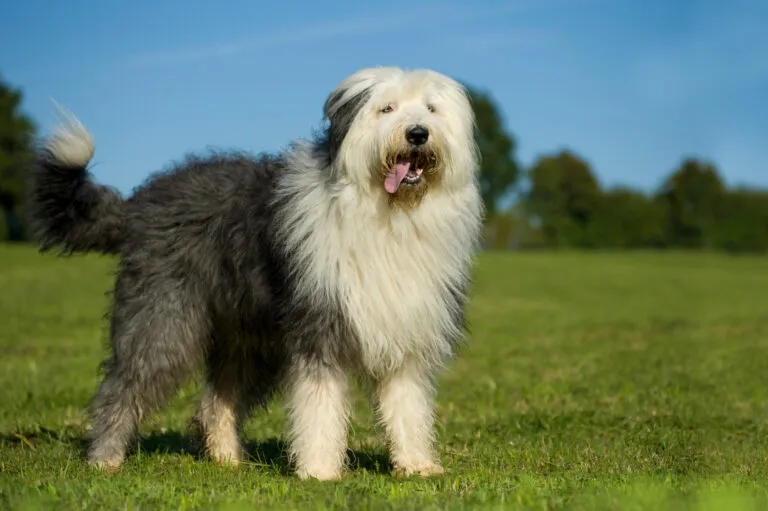
© DoraZett / stock.adobe.com
The Bobtail (Old English Sheepdog) is an adventurous British breed with a luxuriant coat.
The most striking feature of this British sheepdog is undoubtedly its coat: thick and full covering the entire dog, making it look bulkier than it actually is beneath all that hair. The Bobtail’s coarse coat does not form curls but falls shaggy. The dense undercoat is water-resistant.
The body and hindquarters are consistently grey or blue in all permitted shades. White patches in the otherwise solid-coloured coat should not be encouraged. The head, neck, forequarters and underbelly should be white, with or without markings.
Contrary to popular belief, the Old English Sheepdog does not carry a gene for “naturally short tails”. Bobtails therefore almost always wag a long tail.
The Bobtail’s height at the withers ranges from 56 centimetres (bitches) to 61 centimetres (dogs) and more. On average, the Old English Sheepdog weighs between 30 and 45 kilograms.
Another distinctive feature of the Bobtail is its unusual voice as well as its movement, which in part resembles that of a bear.
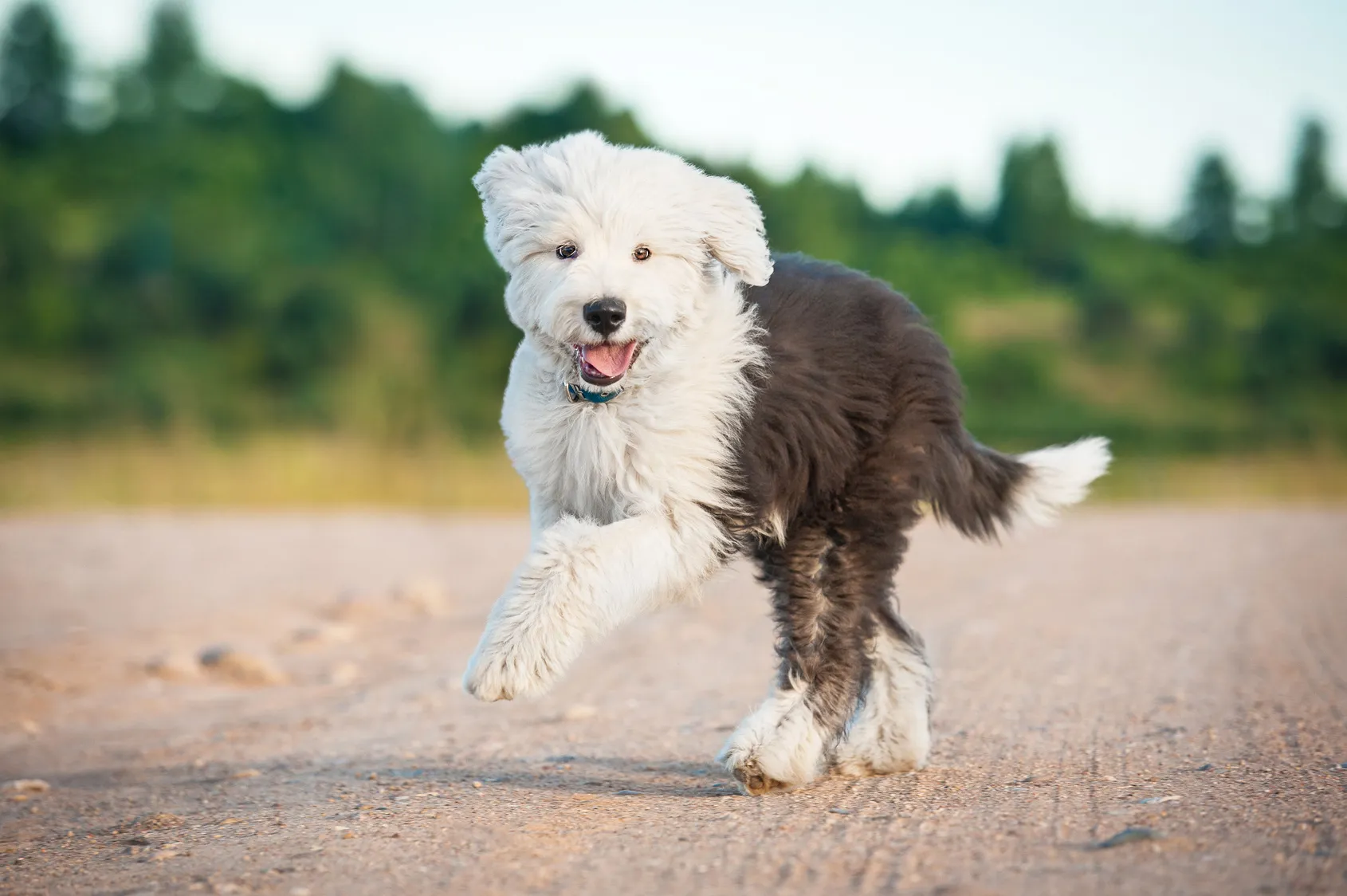 © Grigorita Ko / stock.adobe.com
Bobtails are friendly and adventurous companions with the typical charm of independent herding dogs.
The cheerful nature of the Old English Sheepdog brings a smile to every dog lover’s face. Bobtails are deeply attached to their human family and are known to be very fond of children.
The Bobtail is always ready for fun and enjoys working alongside its owner. Aggression is generally foreign to the breed. Nevertheless, these dogs are alert and can protect family members if necessary. They are also strongly territorial – and sometimes stubborn.
Note: The Old English Sheepdog dislikes it when its “flock” becomes scattered. It may therefore try to “herd” its two-legged family during a walk or if individual members stray too far.
This breed has no strong hunting instinct and is not prone to barking. But when it does bark, it barks loudly and with a resonant tone.
Despite its friendly nature, the Bobtail carries the heritage of all herding dogs: This intelligent dog feels responsible for the safety of the pack and will shoulder this responsibility alone if necessary.
And if the humans are not consistent, the Bobtail will immediately follow its own will – after all, someone has to know the way!
However, this stubborn dog is also a sensitive soul. So always be patient and never harsh with your canine companion. Sensitive yet consistent leadership along with thorough socialisation are the keys to success in Bobtail training.
Training a Bobtail requires sensitivity and some prior experience. For first-time owners, this breed is therefore, despite its pleasant nature, not entirely recommended.
Active families with children can greatly enjoy living with a Bobtail. With cats, provided it has been well socialised, it can get along well.
What should dog lovers consider before bringing a Bobtail home? As friendly as this dog may be, it is demanding in terms of care and especially when it comes to grooming.
Anyone considering bringing a Bobtail into their home should definitely enjoy grooming: The “OES”, as it is sometimes abbreviated, is among the most grooming-intensive breeds. For owners, this means: brush, brush, brush! This involves daily routines as well as weekly “fur-care” sessions that can last up to two hours.
A Bobtail owner’s daily routine also includes checking the ears, eyes, genital area and the daily wiping away of tear fluid around the eyes. This helps prevent discolouration of the fur in this area.
If necessary, wash your companion’s “beard” with lukewarm water and a mild dog shampoo. Take plenty of time for your Bobtail’s weekly grooming and ideally carry it out after a long walk so that the dog remains calm.
Many owners make it easier for their Bobtail to see by tying the hair above its eyes together or trimming it.
Those who prefer clinically clean homes should steer clear of the Old English Sheepdog. Despite regular grooming, this breed will still shed hair from time to time and bring in a fair amount of dirt after walks in the rain.
An Old English Sheepdog is generally not suited to living in a flat. Ideally, it should have a house with a fenced garden, allowing it to enjoy plenty of fresh air.
As an enduring herding dog, the Bobtail is an all-rounder and can enjoy many dog sports. It’s best to simply try out what you both enjoy most.
Repetitive routines are likely to bore this intelligent dog quickly – so make sure to provide variety! Bobtails have good stamina, so dog sports such as organised cross-country runs over two or five kilometres in length could be a great option for sporty Bobtail owners.
Also agility or work as a tracking and rescue dog can bring your Bobtail great enjoyment. Daily routines should include long walks, as this breed loves being outdoors in all weathers. Two hours a day is a good amount.
In general, the Old English Sheepdog is a robust breed with good health. Occasionally, elbow and hip dysplasia can be found. This underlines the importance of maintaining a good breeder who carries out appropriate health screening.
These should also include eye examinations, as the breed may have a predisposition to cataracts. In addition, Old English Sheepdogs are more frequently observed to have hypothyroidism and the MDR1 defect.
With a diet and exercise tailored to its needs, this dog will remain fit well into old age. With good care, the Bobtail can liveup to 15 years.
Over the centuries, the Bobtail has evolved from a livestock guardian dog to a herding dog and finally to a family companion.
The Old English Sheepdog originated from shepherd dogs, which, following the eradication of wolves in Great Britain, were increasingly used as drovers. Appearance was not important; robust health and a temperament suited to herding were the key factors.
Which breeds contributed to the early Bobtail is now unclear. Some canine experts believe they were crosses of Owtscharkas and Bergamasco Shepherd dogs with British Sheepdogs as the origin of today’s Old English Sheepdogs.
From 1873, dog lovers could admire the direct predecessors of the breed at shows, and two years later the first two dogs were officially registered under the name “Short Tailed English Sheepdog”.
The British Kennel Club recognised the bree din 1890. Since then, the once rugged working dog has become the beautiful breed we know today.
If you have decided to buy an Old English Sheepdog, you should look for a reputable breeder. Take your time to look around and consider seeking advice from dog clubs for livestock guardian or herding dogs. Due to the growing popularity of the Bobtail, there are more and more breeders who focus on appearance rather than health and temperament.
Like the Bobtail, the slightly smaller Bearded Collie has evolved over the years from a hardy herder to a popular family companion. The Bearded Collie not only has a similarly demanding coat but also a cheerful and adventurous nature.
There are other “sheepdogs” that resemble the Bobtail, such as the smaller Dutch Schapendoes and Polish Lowland Sheepdog. However, prospective owners should thoroughly research the temperament and various requirements of each breed. For example, the Catalan Sheepdog needs plenty of physical activity, while the Berger de Brie (Briard) also absolutely requires experienced dog owners.
Visiting a dog show can help you get to know different breeds better and make contact with one or another breeder.
This high-maintenance breed is well suited to people who are not afraid of hard work and the considerable time needed for brushing and more. Grooming should not be seen as a “necessary evil” but as something you enjoy, so you can carry it out for years without resentment.
Those who do not underestimate the grooming and can give the Bobtail plenty of space and time will find in this dog a loyal and active family companion.
We wish you much joy with your unique Old English Sheepdog!
| Special features: | The Bobtail is a former livestock guardian dog, now mainly kept as a family and companion dog. |
| Character: | reliable, affectionate, enduring, protective |
| Height at withers: | from 56 cm (bitches) from 61 cm (dogs) |
| Weight: | approx. 30–45 kg |
| Coat: | thick, coarse and shaggy, in grey or blue with white |
| Grooming: | very high maintenance |
| Exercise: | needs plenty of activity and movement |
| Suitable for first-time owners: | rather no |
| Barking: | tends to bark little |
| Life expectancy: | 15 years |
| Common health issues: | hip and elbow dysplasia, MDR1 defect, hypothyroidism |
| FCI group: | 1 Herding dogs and drovers |
| Activity level: | high |
| Origin: | Great Britain |
The zooplus forum was my entry into freelance writing: Here, interested cat lovers came together in 2011 to develop their own print magazine called "Pfotenhieb." In addition to my German studies, I was allowed to write some articles for the "Pfotenhieb". Today, as a happy dog owner, I devote myself mainly to animal and health topics.
Fans of the Bearded Collie agree that those who aren't familiar with this dog breed simply have to get acquainted with it. And those who have experienced how a Bearded Collie bolts across meadows with its flowing fur, how it rolls around full of energy and joy and how it attentively and observantly takes into account its owners wishes become simply addicted to this original dog breed and its unique charm.
The Irish Wolfhound is one of the largest dogs in the world. Used for hunting wolves and bears in medieval Ireland, today it is kept exclusively as a family dog. Despite its imposing size, this sighthound is very gentle and affectionate. Unfortunately, the friendly giant is also quite prone to illness and has a comparatively short life expectancy. Is an Irish Wolfhound right for me, and what does keeping one involve? You can find everything you need to know in the following article.