{"url":"https://www.zooplus.co.uk/magazine/dog/dog-health-and-care/hip-dysplasia-in-dogs","title":"Hip Dysplasia in Dogs (HD)","mag_id":178143,"is_single":true,"cat_name":"Dog","sub_cat_id":143,"sub_cat_name":"Dog Health and Care","cat_id":3410}
Hip dysplasia (HD) in dogs is a disorder of joint development. It is genetically inherited. However, external influences such as environmental factors, housing conditions and diet can also have a negative impact on joint development. How can you recognise HD in dogs and treat it? You’ll find the key information on the causes, symptoms and treatment of hip dysplasia in dogs in the following article.
As hip dysplasia in dogs is a congenital condition, affected dogs show symptoms of HD from puppyhoodto different extents. In some cases, a dog’s life can be so severely restricted that they can hardly walk. In any case, hip dysplasia in dogs is associated with significant and usually lifelong pain.
Symptoms: How to Recognise Signs of HD in Dogs
The first signs of HD in dogsappear early on. HD in dogs is particularly noticeable through a change in gait.
Gait in HD: How Do Dogs with Hip Dysplasia Walk?
In young dogs (four to eight months), hip dysplasia presents as a wide-based, waddling gait and a reluctance to move. As the condition progresses, dogs may develop lameness, have difficulty getting up and become less mobile in their hind legs.
Tip: In winter, an abnormal gait is often particularly easy to spot: look out for drag marks from your dog’s paws in the snow!
HD in Dogs: Typical Symptoms
The muscles in the hind legs decrease in size because affected dogs spare their hind legs due to pain. Dogs also suffer from hip pain, as the muscles surrounding the hip joint become shortened (contracture).
How Does a Dog with HD Sit?
When sitting, many dogs with HD adopt a relieving posture and, for example, stretch their hind legs clearly forwards. This is also known as the “puppy sit” , as this position is otherwise typical only in puppies.
However, the symptoms of hip dysplasia in dogs vary depending on age, severity and the level of hip joint function to different extents. For this reason, HD in dogs can only be clearly diagnosed by a vet.
Diagnosis: How Is Hip Dysplasia in Dogs Diagnosed?
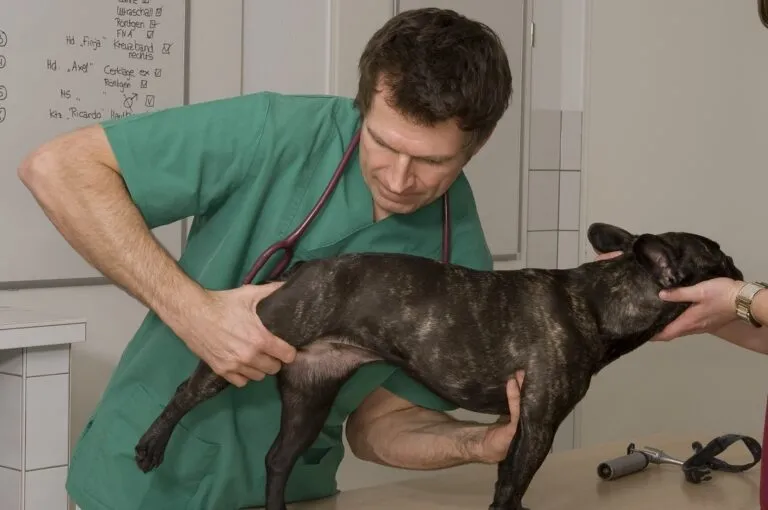
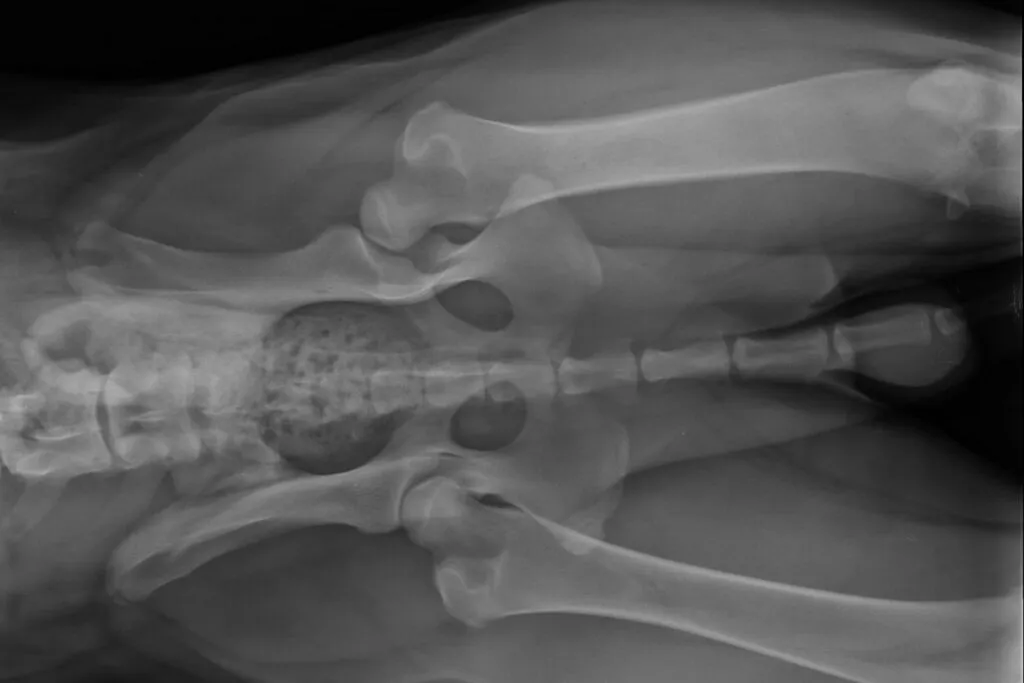
A vet diagnoses hip dysplasia in dogs using a veterinary surgeon and an X-ray examination. In order to properly assess an X-ray image of the hip joints, the HD X-ray must always be taken under sedation with the dog positioned in a standardised way. Sedation is necessary so that the dog’s muscles are relaxed and they do not feel any pain while being positioned for the image.
The vet then assesses the severity of the hip dysplasia and the changes in the hip joint based on the X-rays. A key assessment criterion is the so-called “Norberg angle”, which is determined using two lines drawn between the centres of both femoral heads and the front edge of the socket. In a dog without HD, the angle should be more than 105 degrees.
This X-ray shows that the dog’s left hip joint is affected by dysplasia.
Further Signs of Hip Dysplasia
The following changes are also indicators of hip dysplasia: The hip socket, the femoral head or both are flattened. As a result, the femoral head does not sit optimally in the hip socket.
In addition, a misalignment of the femoral neck or head is often visible. There are also frequently early signs of osteoarthritis, such as bony growths on the front and rear edge of the socket and at the transition from the femoral neck to the head.
X-ray Examination for Breeding Dogs
For the selection of breeding dogs, certain criteria for taking X-rays and assessing them are required. For some dog breeds, in certain countries or for second-opinion assessments, an additional X-ray with the thighs spread and the hocks raised (“frog view”) is also required. This position makes changes to the socket edge and femur easier to see.
Assessment of Severity
The classification for breeding dogs follows FCI (Fédération Cynologique Internationale) guidelines in five categories:
A = no signs of hip dysplasia in the dog
B = borderline case
C = mild hip dysplasia
D = moderate hip dysplasia
E = severe hip dysplasia
In addition to the X-rays, the results of the clinical examination and the symptoms are decisive for treating a dog with hip dysplasia.
Treatment: How Can HD in Dogs be Treated?
There are several options available for the treatment of hip dysplasia in dogs. However, none of them provides a cure.
All forms of therapy aim to relieve pain and inflammation, slow the progression of osteoarthritis and improve joint mechanics and mobility. The chosen treatment depends on many different factors, such as the severity of symptoms, X-ray findings, breed, age and weight of the dog as well as the owner’s preferences.
What to Do if Your Dog Has Hip Dysplasia?
Vets distinguish between conservative and surgical treatment for hip dysplasia in dogs.
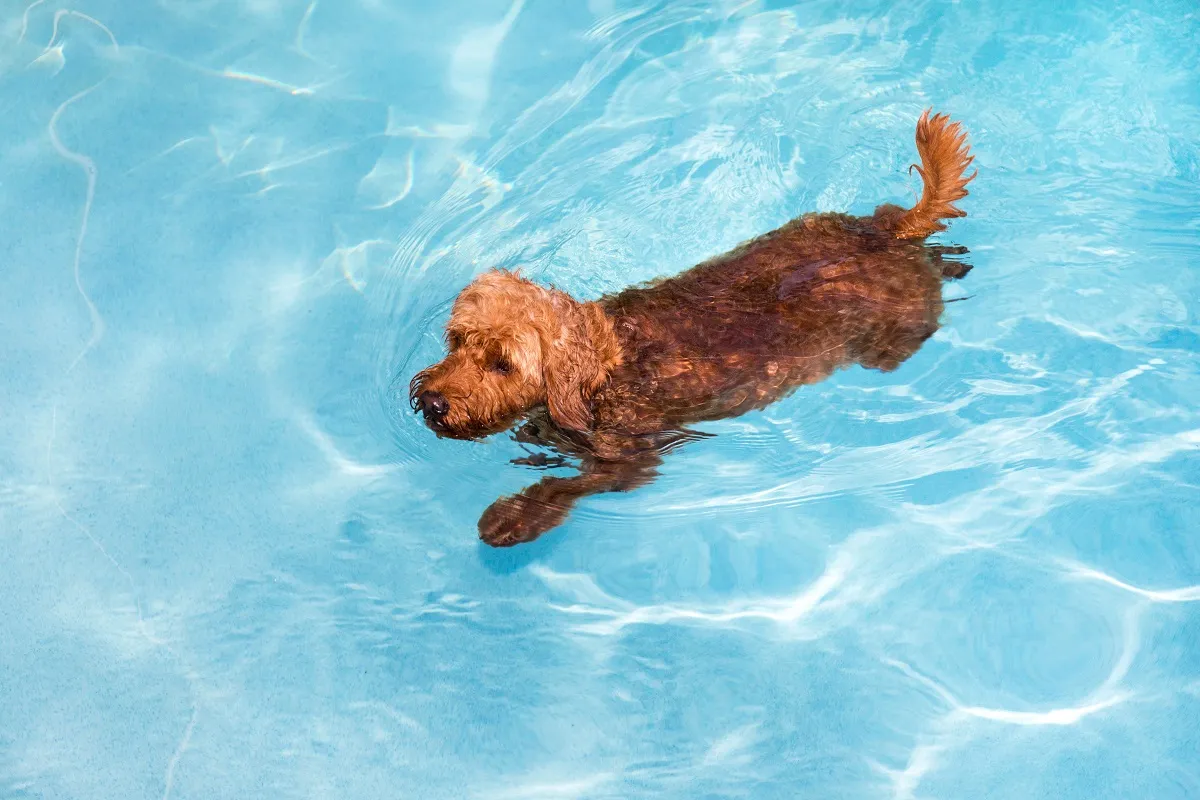
Conservative treatment focuses on reduced strain and supporting the joints. You should therefore prevent overexertion by ensuring controlled exercise on soft ground. This protects the hip joints and helps build muscle. Swimming for dogs is a good example.
In addition, physiotherapy measures help with reducing pain and inflammation, as well as relieving muscle tension. Anti-inflammatory medication and pain relief are also often used, sometimes in combination.
If your dog is overweight, weight loss is essential to avoid placing additional strain on the joints.
Note: Choosing a suitable veterinary diet food can support your dog’s natural body functions. However, please note that diet foods diseases cannot cure or prevent. You should always discuss your dog’s diet with your vet.
What Should a Dog with Hip Dysplasia Avoid?
Sudden movements, such as those that occur during play, jumping and turning, should be avoided. They place excessive strain on the joint surfaces, joint capsule and surrounding tissue.
Surgical Measures for Hip Dysplasia
A range of methods is also available for surgical treatment. When choosing the method, the vet differentiates between young dogs without joint changes and adult dogs with existing joint changes.
In the worst-case scenario – as in humans – only replacement of the hip joint with an artificial joint will help. The costs of such a hip dysplasia operation in dogs can quickly amount to several thousand euros.
Prognosis: Can a Dog Live Well with Hip Dysplasia?
Dogs can certainly live with HD. However, the prognosis depends on the severity and the symptoms that occur in the affected dog.
By combining treatment options, symptoms improve in many dogs. This can help achieve the longest possible symptom-free or low-pain period. Unfortunately, a cure for hip dysplasia is not possible.
When Should a Dog with Hip Dysplasia Be Put to Sleep?
In principle, dogs with hip dysplasia do not have a reduced life expectancy compared to healthy dogs. A diagnosis of HD alone is therefore not a reason to have your dog put to sleep.
However, symptoms can worsen with increasing age. A dog withend-stage HD may become lame and suffer from chronic pain, which can severely restrict their quality of life. If all treatment options have been exhausted and there is no longer any prospect of relief, it may be appropriate to end the animal’s suffering. You should always make this difficult decision in consultation with your vet.
Dogs are not born with hip dysplasia. They inherit the predisposition to it. Affected puppies develop at around two months of age a “loose” hip (subluxation).
In this case, the femoral head does not sit firmly enough in the hip socket but moves back and forth. Resulting changes such as osteoarthritis of the hip joints develop from around four months of age.
Risk Factors
Many dogs with a mild form of hip dysplasia often only show symptoms in old age, such as lameness. In addition, factors such as a high body weight or rapid growth can further exacerbate HD.
This is why the right puppy nutrition with moderate energy levels and an adapted mineral content is so important. Excessive energy content or high mineral intake, such as calcium, can negatively influence hip dysplasia.
Swimming is ideal for dogs with hip dysplasia (HD) as it protects their joints while strengthening their muscles.
Prevention: How Can I Prevent Hip Dysplasia in My Dog?
As hip dysplasia in dogs is genetically inherited, it can only be prevented through strict breeding measures. Only HD-free dogs should be approved for breeding.
However, as a dog owner you can also help to some extent to prevent severe hip dysplasia. Particularly with large breeds, you should avoid overexerting your puppy. Also avoid high-energy feeding and ensure appropriate mineral and vitamin levels in your dog’s food.
To preventatively avoid overloading or incorrect strain, or to support your dog with HD in everyday life, the following tips may help:
avoid unnecessary stair climbing (especially in puppies)
use dog ramps for the car or other lifting aids to make getting in and out easier
A diagnosis of hip dysplasia is not a death sentence for your dog. If the condition is recognised early and treated consistently, your four-legged friend can enjoy a (largely) normal life with ideally long periods without pain. Nevertheless, it is the responsibility of conscientious dog breeders to prevent the further spread of this hereditary condition – for example, through appropriate testing of the parent dogs.
Important Note: The content provided for informational purposes only and is not intended to replace professional veterinary advice, diagnosis or treatment. If you have any questions or concerns about your pet's health, please always consult a licensed veterinarian.
This article was translated using Artificial Intelligence from the original German zooplus Magazine. While the original content was authored by industry experts and reviewed by our editorial team, this automated translation has not been human-edited and is provided for informational purposes.
Franziska Pantelic, Veterinarian
I am supporting the zooplus magazine for several years with my extensive expertise. I became a licensed veterinarian as early as 2009 and currently operate a mobile small animal practice in the metropolitan area of Munich.
When does a female dog’s first season begin? How often and for how long is a female dog in season? And what symptoms does a female dog in season show? Find out everything you need to know about these “hot days” and how you and your dog can get through the season calmly and stress-free in the following article.
16 February 2024 |Leishmaniasis is an infectious disease transmitted by sandflies and can often prove fatal for dogs. Find out how you can protect your dog and how to recognise and treat the disease should it emerge.
Neutering has traditionally been a standard veterinary practice, but is it universally recommended? What distinguishes neutering from sterilisation and what expenses should a dog owner anticipate? Here, you can discover all the essential information concerning the advantages and disadvantages of neutering your dog.