{"url":"https://www.zooplus.co.uk/magazine/dog/dog-training/barking","title":"How Can I Stop My Dog from Barking? 5 tips","mag_id":4906,"is_single":true,"cat_name":"Dog","sub_cat_id":141,"sub_cat_name":"Dog Training","cat_id":3410}
Some dogs comment on every single event with loud barking. Of course, barking is part of being a dog and is their way of communicating. But if your four-legged friend barks uncontrollably, it’s time to prick up your ears – quite literally. We share tips on how to train your dog to stop barking.
This applies to all dog breeds: as long as barking stays within acceptable limits and dogs stop barking when their owner gives the command, everything is fine. However, if your dog barks at every passer-by and every visitor and struggles to calm down, there are often other underlying causes.
Why Do Dogs Bark?
The fact is: dogs don’t bark without reason – they bark to express themselves. It is therefore important to understand the causesbefore you try to train a dog to stop barking.
Dogs may bark out of joy, for example because they are excited to see you again. But if dogs vocalise excessively and in situations where barking is not wanted, they are often expressing negative emotions.
Typical Causes of Excessive Barking
A common example of barking in unwanted situations is when you meet others on the street or when your dog starts barking at everyone who walks past your property.
Insecurity, fear, frustration or boredom are among the most common reasons for excessive barking. Anything that increases a dog’s arousal can also intensify barking. This includes, for example:
Emotional transfer: if you’re nervous, your dog will be too.
Heightened expectation: you’re holding a ball – when does it start?
You scold – the dog thinks you’re “barking” along.
The dog is forced to approach a perceived “danger” – fear increases.
Barking Is Part of Canine Nature
Many dogs have guarding instincts in their blood. They bark to signal an intruder in their shared territory – whether it’s the postman or a neighbour unloading their car on the driveway.
Some hunting dogs also indicate game by barking. So it’s no surprise that they tend to vocalise more than others. With these dogs, the aim should not be to suppress barking – and therefore their nature – completely. The goal is to use training to turn frantic yapping into a brief woof.
Barking Out of Insecurity
If your dog barks at other dogs or walkers, the reason is usually that they are insecure or afraid. This is particularly common in young dogs. For example, they may find a walking frame threatening or feel uneasy around certain other dogs. As a rule, it is new situations that frighten dogs.
Often, the owner’s own insecurity reinforces the behaviour: another dog approaches and you tense the lead. The dog realises: “My human is unsure – better start defensive barking!” Confident handling is the key to success here.
Barking Due to Frustration and Boredom
Another cause of constant barking can be frustration. Dogs that are not sufficiently exercised and stimulated are quick to turn minor triggers into a full-blown barking drama. After all, there’s not much else going on, and the excess energy needs an outlet.
Their minds need stimulation too – for example with dog tricks or small tasks during the walk. Anti-barking training only makes sense with a well-exercised dog.
Barking Due to Illness
In rare cases, chronic pain or other health issues linked to illness can be behind the barking. An underactive thyroid is not uncommonly a cause of increased anxiety and stress sensitivity.
Before trying to train your dog to stop barking, it’s advisable to visit the vet. This is the only way to rule out with certainty that the frequent barking has a physical cause.
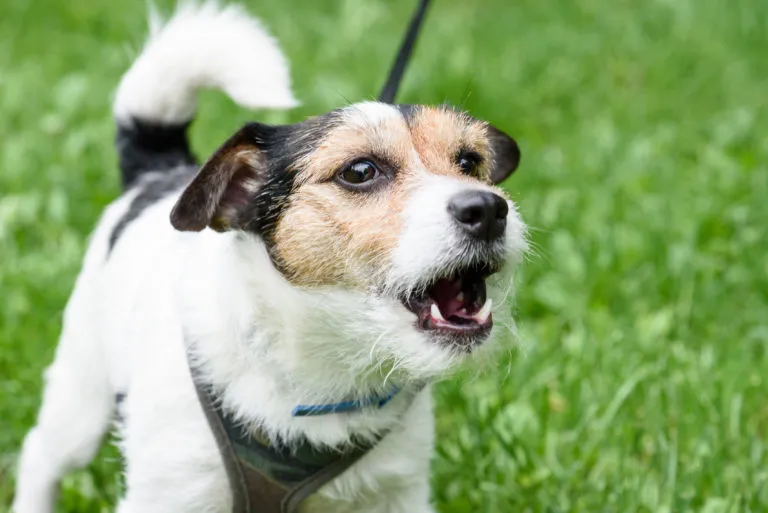
Many dogs bark because they feel insecure, for example when they are on a walk.
How Can I Get My Dog to Stop Barking?
If you want to train your dog to stop barking, you must first understand the reason for the unwanted behaviour. Observe and analyse carefully the situations in which your four-legged friend barks. In most cases, the causes can already be deduced from these situations.
If your dog barks at other people when they approach you, this usually means they want to protect and defend you. If you leave the house and drive off without them, barking can mean either: “I’m bored!” or “I’m alone without my pack – I’m scared!”
What Can I Do if My Dog Barks at Everyone? Keep Your Dog Busy!
Does your dog have a low barking threshold because they’re often bored? Then it’s time to provide proper exercise and stimulation. Even companion dogs want to be challenged both physically and mentally: long walks, small retrieval games, scenting out a dog treat and learning little tricks together all add variety to everyday dog life.
If your dog is a former working dog at heart, they are often a real workaholic with plenty of stamina and energy. Dog sports offer a much-needed outlet. Whether it’s agility, obedience, dog dancing or mantrailing – there’s something for every sporty four-legged friend.
Shared activities also strengthen your bond. Dogs that are physically and mentally stimulated are calmer inside. They’re more balanced and stop excessive barking.
Give Your Dog a Sense of Security
If your dog barks out of insecurity or fear, you should show them that you have everything under control. This may require patiently building a new relationship of trust together.
Convince your four-legged friend that you have the confidence and composure to handle situations yourself. This isn’t always easy and won’t work overnight.
However, the following examples are designed to give you some practical guidance to show your dog: “There’s no need to bark. My human has everything under control!”
5 tips: What Can You Do to Help Your Dog Stop Barking?
Tip 1: Coping with Loneliness
If your dog suffers from severe separation anxiety, it’s important to start with short training sessions. Practise leaving first: for example, leave the house for 15 seconds without any announcement (no searching for keys, no changing shoes). Come back in as if it were the most normal thing in the world. Put on your coat and shoes, jingle your keys – and then make yourself comfortable on the sofa.
Gradually increase the time you spend outside. Also important: before your four-legged friend has to stay alone, they should be well exercised. This way, you can help your dog unlearn barking step by step.
Scents as a Helping Hand
If your dog suffers from particularly severe separation anxiety, using dog pheromones can also be worthwhile. Pheromones can give your dog a sense of safety and comfort. Female dogs also release these natural messenger substances into the environment to calm their puppies.
These dog pheromones, which are not perceptible to humans or other animals, are available in various forms, such as collars, diffusers or sprays.
Tip 2: Training Your Dog to Stop Barking at the Front Door and Doorbell
When the doorbell rings and the dog starts barking loudly, many owners try to calm their dog with shouted commands like “No! Stop it!”
What the dog hears is: “My human gets worked up when it rings too, so I’m doing everything right.” Even seemingly soothing stroking signals: “Well done!” Before opening the door, you should therefore gently but firmly send your dog to a fixed spot in the background. Because you are the one handling the situation!
Barking is Ignored
Sitting calmly is rewarded, barking is ignored. Your visitors should also ignore a barking dog. Only when your dog stops barking – even if it’s just to catch their breath – should you praise them.
By rewarding positive behaviour and ignoring unwanted behaviour, you can influence how your dog acts.
Tip 3: For Relaxed Walks
To give your dog a sense of security on walks together, you should use a lead during anti-barking training. This is not a punishment, but an extension of your protective arm. Don’t let your dog walk ahead – you decide the pace and direction.
When you meet someone, continue walking calmly without tightening the lead or changing speed. This reassures your dog and shows them that barking isn’t necessary. Ignore the barking and instead reward your four-legged friend with food when they remain calm.
Pheromone Collars for Support
If your dog is very anxious or insecure, using a dog collar that releases dog pheromones can also be helpful. The calming scents can take the edge off your dog’s tension.
Tip: Good lead manners can also help reduce barking, because you decide where to go. Find out more about relaxed lead walking.
Tip 4: Build Security and Routines into Everyday Life
In general, almost all dogs crave security and structure. They need a confident handler they can rely on. You decide how the day unfolds – not your dog.
For example, start every morning walk with a short obedience session. Teach your dog the most important commands and praise them when they get it right straight away. Introduce fixed times for meals, walks or play together and show them that you’re taking the lead.
Here too, the key principle of dog training applies: ignore unwanted behaviour and reward positive behaviour with food or play.
Tip 5: Channel Natural Guard Dog Behaviour in a Controlled Way
Barking by natural guard dogs should not be completely suppressed. Your dog is carrying out a task that is deeply ingrained in them. Instead, guide the barking into controlled channels.
Show your dog that you’re a team: they alert – you secure the territory. How does that work?
When your dog barks, guide them slightly backwards and have them lie down there. Then you assess the “threat”. Go to the window or garden gate, take a proper look, and then calmly return to your dog. This shows you value their alertness while keeping control.
Training Your Dog to Stop Barking: Mistakes to Avoid
When trying to train a dog to stop barking, certain mistakes are often made that can make the process more difficult. To ensure progress in training, you should avoid the following:
Inconsistency: One of the biggest mistakes is reacting inconsistently to barking. If the dog is sometimes ignored for barking and at other times punished or rewarded, this can be confusing and may reinforce the behaviour.
Negative reinforcement: Many people tend to suppress barking with punishment, which often leads to increased stress and anxiety in the dog. This can make the problem worse, as the dog may bark even more out of fear or frustration.
Insufficient stimulation: Dogs that are not sufficiently exercised and mentally stimulated are more likely to bark out of boredom or excess energy. A common mistake is neglecting the dog’s need for activity and engagement.
Ignoring the cause: Often, attempts are made to stop the barking without identifying the underlying reason. Whether the dog barks out of fear, boredom, excitement or another cause needs to be recognised and addressed accordingly.
Lack of patience: Expecting a dog to stop barking immediately is unrealistic. It takes patience and consistent training methods to change behaviour in the long term.
An effective approach is to use positive reinforcement to reward calm behaviour and to identify and reduce the triggers for barking.
Professional Support: When Does a Dog Training Class Make Sense?
With consistent training, you can teach a puppy to stop barking with relatively little effort. The older the dog, the more patience you’ll need.
Don’t hesitate to seek help from experts who can offer tailored support for you and your dog. A visit to a dog training school, the vet or a dog behaviour therapist has proved very helpful for many on the path to a calmer life together.
Getting to the Root of the Cause: Training Your Dog to Stop Barking With a Dog Trainer
Expert advice from a dog trainer also makes sense if you’re unsure why your dog is barking. Especially on the lead, it’s often unclear: is the dog barking out of excitement, fear or aggression? Controlled social contact with other dogs under the supervision of an experienced trainer can help.
Training Dogs to Stop Barking: Not with an Anti-Bark Collar!
If you want to train a dog to stop barking, anti-bark collars may seem practical at first glance: when the dog barks, they immediately receive a punishing stimulus in the form of a spray. This is intended to startle them.
This method may indeed show short-term success with some dogs. However, such training aids are not suitable for teaching your dog to stop barking.
Fear is Intensified
So why is an anti-bark collar not a good idea? The problem is that it only addresses the symptom, not the underlying cause.
If your dog barks out of insecurity, the spray will make them even more fearful in an already anxiety-filled situation. They may stop barking, but feel panicked inside. If your dog barks because they’re under-stimulated, they’ll look for another outlet to release their frustration.
An anti-bark collar therefore does not align with dog-friendly training – which is why you won’t find one in the zooplus shop.
Conclusion: What Can You Do About a Barking Dog?
There is no “magic formula” to calm a barking dog. Instead, as an owner you should investigate the causes to identify the reason for the unwanted barking. Only then can you take suitable measures to train your dog to stop barking.
The effort is worth it: life with your beloved pet will be more harmonious – and your neighbours will thank you too. Excessive barking can, under certain circumstances, be considered a noise nuisance.
The zooplus forum was my entry into freelance writing: Here, interested cat lovers came together in 2011 to develop their own print magazine called "Pfotenhieb." In addition to my German studies, I was allowed to write some articles for the "Pfotenhieb". Today, as a happy dog owner, I devote myself mainly to animal and health topics.
Being particularly social animals, dogs love the company of their pack. Nevertheless, every adult dog should be capable of staying on its own for short periods of time. This will need to be trained early on in life, as a fully-grown dog that has never been left alone will struggle to adapt.
Shoes, cables, phones, felt-tip pens, sofas, carpets or waste bins – nothing seems to be safe from the destructiveness of some dogs. Within a very short space of time, wild dogs can turn a home and all its furnishings upside down. But why do some dogs have destructive tendencies and how can they move away from this behaviour?
Are you thinking about adopting a rescue dog from abroad? Maybe you’ve met a ‘Rommie’ rescue dog out on a walk and become curious about what the adoption process entails?