{"url":"https://www.zooplus.co.uk/magazine/dog/dog-health-and-care/stroke-in-dogs","title":"Stroke in Dogs: Symptoms and Causes","mag_id":402869,"is_single":true,"cat_name":"Dog","sub_cat_id":143,"sub_cat_name":"Dog Health and Care","cat_id":3410}
Dog owners often associate a stroke in dogs with the vestibular syndrome as if they were the same thing – but in fact, these are two different conditions. So, what exactly happens when a dog has a stroke, and what causes it? You can also find out here what to do in an emergency.
In veterinary medicine, a stroke (also called a “cerebrovascular accident”) refers to a sudden loss of brain function caused by an abrupt injury to parts of the brain.
This is triggered either by bleeding in the brain or by a blockage of a blood vessel due to a thrombus (blood clot), which cuts off the brain’s blood supply.
Although vets long believed that dogs could not suffer a stroke, new scientific findings suggest otherwise. It is now recognised that, like humans, dogs can also experience a stroke.
How Dangerous is a Stroke in Dogs?
Although strokes in dogs are generally milder than in humans, you should still take the condition seriously. In some cases, a stroke can lead to severe long-term effects (such as lameness) or even the death of the animal.
Which Dog Breeds are Most Commonly Affected?
In general, any dog can suffer a stroke. However, the risk is considered particularly high in older dogs and those with pre-existing conditions, especially heart and circulatory diseases, infections or tumours.
A stroke usually manifests as sudden neurological deficits. The exact symptoms depend on the part of the brain affected and the extent of the oxygen deprivation.
Typical Signs of a Stroke in Dogs
The most common symptoms of a stroke in dogs include:
Movement disorders: staggering or inability to move (paralysis)
Altered consciousness (e.g. unconsciousness)
Nystagmus: your dog’s eyes move rapidly from side to side
Seizures
In some cases, due to impaired balance, other symptoms such as vomiting may also occur.
First Aid: What to Do if Your Dog Has a Stroke
If you suspect your dog may have had a stroke, the first thing to do is stay calm. Lay your dog on a soft surface and keep them warm with a blanket.
When Should I See a Bet?
Call your vet immediately and do not delay, as this is a medical emergency. If you fail to act or wait too long, your dog’s health could suffer long-term damage.
If your dog shows signs of a stroke, act fast and contact your veterinarian without delay.
Diagnosis: How is a Stroke in Dogs Confirmed?
Based on the information you provide about the onset and progression of symptoms, your vet can only make a preliminary diagnosis. To confirm it and rule out other conditions with similar signs, they will then carry out various tests:
Imaging Techniques
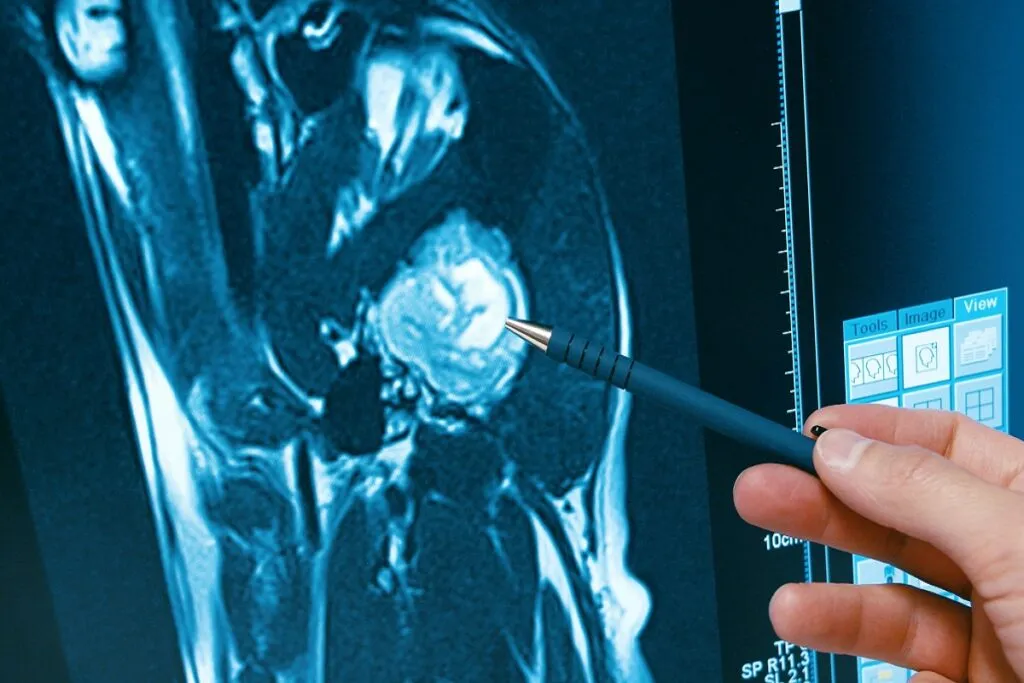
As the brain cannot be visualised using ultrasound or X-rays, a CT (computed tomography) or MRI (magnetic resonance imaging) scan is necessary to confirm a stroke in dogs. To ensure your dog stays still during the scan, these procedures are carried out under anaesthesia.
This also helps rule out other conditions such as brain tumours or brain metastases (secondary growths).
Lumbar Puncture
Using a spinal tap (lumbar puncture), your vet can collect cerebrospinal fluid (CSF) from your dog while they are still under anaesthetic. This helps to rule out possible conditions such as bacterial infections.
Blood Test
Blood test results can also reveal a lot about your dog’s overall health. They help your vet assess the function of other organs such as the heart or the kidneys and identify possible causes of a stroke in your dog.
Diagnosing a stroke in dogs requires a CT or MRI scan to accurately assess brain health.
Treatment: How is a Stroke in Dogs Managed?
As a stroke in dogs can have various triggers, it is important to identify the cause in order to treat it effectively.
Once the cause is known, your vet can provide targeted treatment. In some cases, however, this is not possible, as finding the cause can often be a lengthy process.
Note: Clot-dissolving medicines (“thrombolytics”) are established in human medicine but not in veterinary medicine.
Causes: What Triggers a Stroke in Dogs?
The trigger for a stroke is an interruption in the brain’s blood supply. As a result, your dog’s brain no longer receives enough oxygen and cannot remove waste products effectively.
This can lead either to impaired brain function (ischaemia) or to tissue destruction (infarction).
The causes of a stroke in dogs can therefore vary, which is why vets distinguish between two types: haemorrhagic and ischaemic stroke.
Haemorrhagic Stroke
A haemorrhagic stroke (“bleeding in the brain”) occurs when a blood vessel bursts and disrupts circulation. The bleeding can occur within the brain tissue itself (intraparenchymal) or between the brain and skull (subdural or subarachnoid).
Possible causes include:
Injury (e.g. as a result of a road traffic accident)
Damage caused by tumours or metastases (e.g. from a splenic tumour)
Clotting disorders (e.g. poisoning with rat poison, immune-mediated thrombocytopenia, congenital clotting disorders)
Ischaemic Stroke
In an ischaemic stroke, the blood vessels become blocked. This can happen if materials (e.g. blood clots, parasites, tumour fragments, fat) block the arteries (embolism). Alternatively, thrombi can attach to the artery wall and narrow the artery (thrombosis).
In many cases, however, no cause can be identified.
Recovery Prospects: Can a Dog Recover from a Stroke?
If no vital parts of the brain are affected and the cause can be treated specifically, most affected dogs recover within a few weeks.
The situation is different if the problem affects central brain functions. This can lead either to lifelong impairment or, in the worst case, to the death of your dog.
Time is of the Essence
This is why it is so important to recognise the signs of a stroke in your dog early and seek veterinary help promptly.
Prevention: Can a Stroke in Dogs be Prevented?
Strokes in dogs, as in humans, cannot always be prevented. However, ensure your dog is kept in a species-appropriate environment and fed a suitable diet to protect them from certain underlying conditions that could cause a stroke.
Regular check-ups with your vet will also help you maintain your dog’s good health.
Summary: Key Facts About Strokes in Dogs
Description:
A stroke is a sudden loss of brain function caused by an abrupt injury to parts of the brain.
Disease progression:
Acute
Symptoms:
Neurological deficits (blindness, movement disorders, lameness, unconsciousness, nystagmus, seizures)
Occurrence:
Any dog, but especially those with pre-existing conditions (heart and circulatory diseases, infections, tumours) as well as Cavalier King Charles Spaniels and Greyhounds
Causes:
Haemorrhagic (bleeding in the brain), ischaemic (circulatory disorder in the brain)
Treatment:
Treating the underlying cause
Prognosis:
Prognosis improves with early treatment and if no vital brain areas are affected
Risk of contagion:
No
Prevention:
Not directly
Important Note: The content provided for informational purposes only and is not intended to replace professional veterinary advice, diagnosis or treatment. If you have any questions or concerns about your pet's health, please always consult a licensed veterinarian.
At the Justus-Liebig-University of Giessen I was extensively trained as a veterinarian and was able to gain experience in various fields such as small animal, large animal and exotic animal medicine as well as pharmacology, pathology and food hygiene.
Since then, I have been working not only as a veterinary author, but also on my scientifically driven dissertation. My goal is to better protect animals from pathogenic bacterial organisms in the future.
Besides my veterinary knowledge, I also share my own experiences as a happy dog owner and can thus understand and enlighten fears and problems as well as other important questions about animal health.
When does a female dog’s first season begin? How often and for how long is a female dog in season? And what symptoms does a female dog in season show? Find out everything you need to know about these “hot days” and how you and your dog can get through the season calmly and stress-free in the following article.
16 February 2024 |Leishmaniasis is an infectious disease transmitted by sandflies and can often prove fatal for dogs. Find out how you can protect your dog and how to recognise and treat the disease should it emerge.
Neutering has traditionally been a standard veterinary practice, but is it universally recommended? What distinguishes neutering from sterilisation and what expenses should a dog owner anticipate? Here, you can discover all the essential information concerning the advantages and disadvantages of neutering your dog.