

11 min
2.6k
Medium Size Poodle
Friendly, intelligent, and exuberant. The Olde English Bulldogge, or OEB for short, brings all these traits together. It now has very little in common with the English Bulldog. Animal lovers set out to create the OEB as a healthier, more original breed. So why do many dog enthusiasts believe it has the edge?
© CallallooAlexis / stock.adobe.com
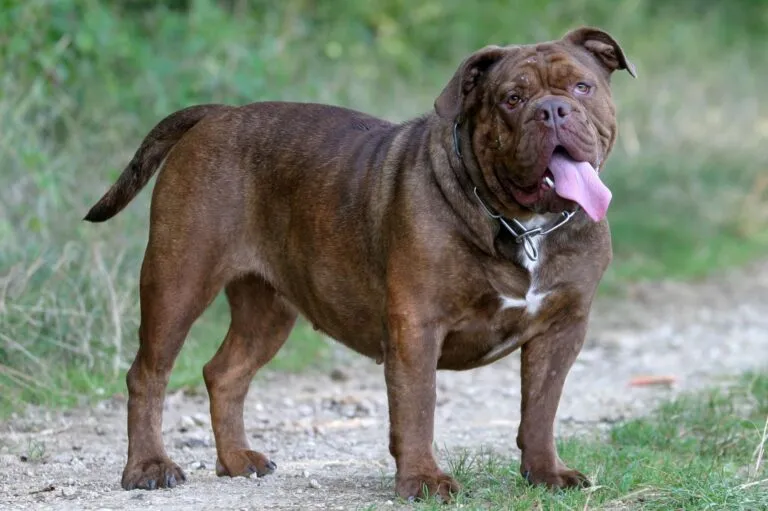
The Olde English Bulldogge is a bundle of energy and enjoys long, leisurely walks.
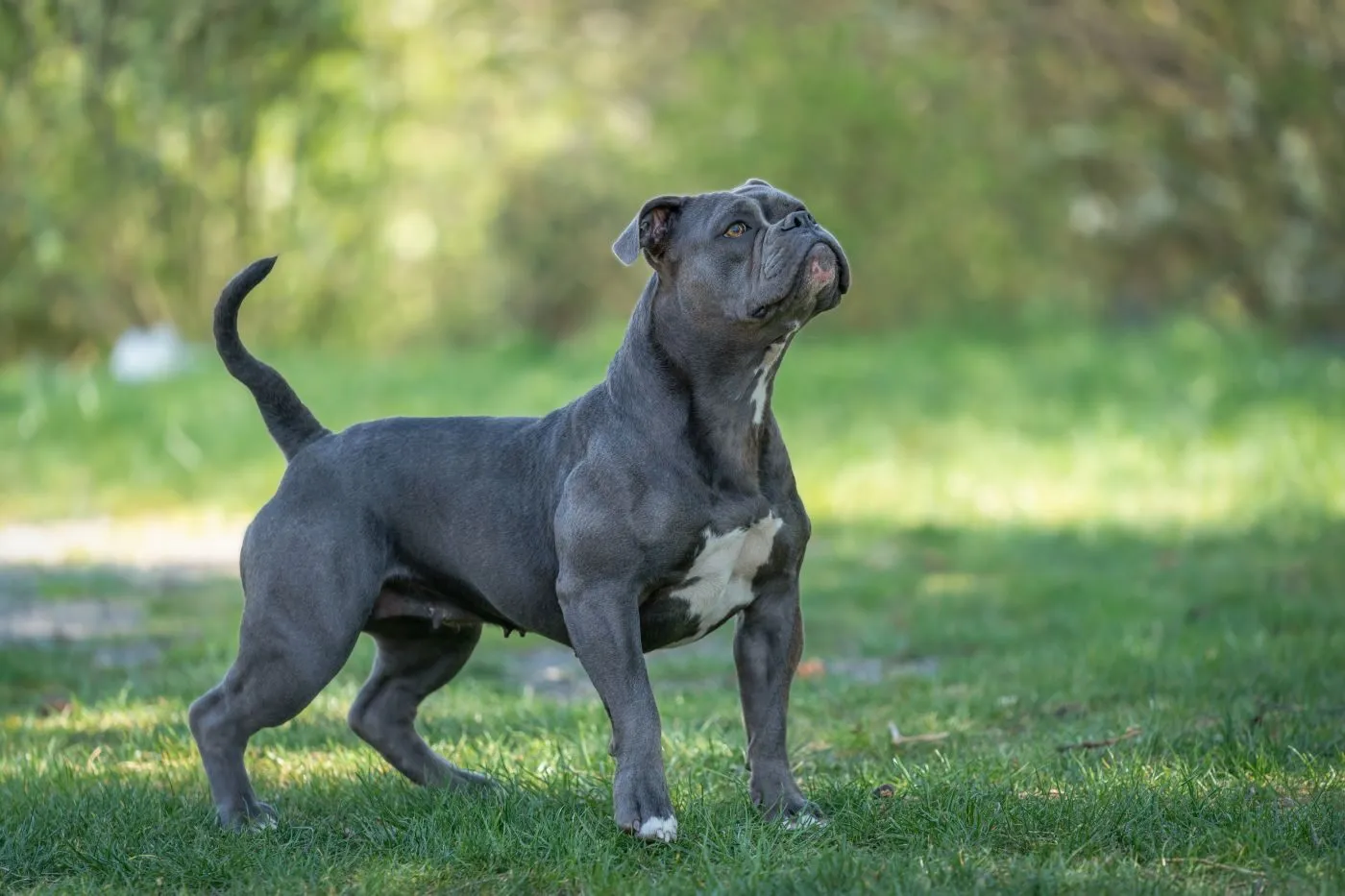
When you see an Olde English Bulldogge for the first time, one thing stands out straight away: it’s very stocky and muscular. The OEB shares these traits with its famous relative, the English Bulldog. However, there are numerous differences:
The Olde English Bulldogge also has a short, fine and smooth coat. All colours occur except black, lilac or blue. The Olde English Bulldogge’s nose is always black.
Olde English Bulldogges are cheerful and lively dogs that love doing things with their humans. They are also known as real characters with plenty of personality.
These intelligent dogs often have ideas of their own and pursue them with a certain passion and creativity. If you’re looking for a four-legged friend with a strong “will to please”, the Olde English Bulldogge may not be the right choice.
What does that mean exactly? Once the OEB has set its mind on something, it will try to see it through. Some might call that determination. At times, the Olde English Bulldogge will happily ignore a training attempt if it has a different view of the situation.
There’s usually a mischievous sparkle in its eyes, so bring a good sense of humour. This dog definitely has a mind of its own – and that’s part of its charm. That doesn’t mean the OEB is constantly defiant. It enjoys working with its owner, provided it has learned how.
This four-legged friend therefore needs clear guidance. Decide what matters most to you and be consistently loving in enforcing those rules.
The Olde English Bulldogge is a bundle of positive energy. It is open and friendly towards people. Even strangers are quickly welcomed into its heart.
And that energy should be taken quite literally: the OEB is a lively powerhouse. On walks, it likes to test the limits of the lead – and your fitness levels. During play or when meeting other dogs, the Olde English Bulldogge is very physical.
In general, it can behave towards other dogs in a rather boisterous manner. It’s often enthusiastic about fellow four-legged friends, but tends to show that excitement a little too exuberantly. The OEB doesn’t always have full control over its “momentum” either, so it may only hit the brakes once it’s already bumped into the other dog.
This can intimidate smaller dogs in particular. Conflicts may also arise with dogs of the same sex or if the OEB feels the need to defend its territory.
This dog is suited to life in the city as well as the countryside, as long as you provide enough exercise. It fits well with families or single people who enjoy spending lots of time with their dog. The lively OEB needs plenty of attention and activity.
Anyone without prior dog experience should definitely attend a dog training school with an Olde English Bulldogge, as training can present challenges for beginners.
This four-legged friend generally gets on well with children. However, you should never leave young children alone with the dog. If you live with cats, look for a breeder who also keeps cats, so the Bulldog has learned from an early age that they are part of the family.
The OEB is far more active than its relatives and enjoys plenty of movement. This dog loves to gallop, but usually only over short distances. It’s therefore not the ideal companion for jogging or cycling. However, it’s more than happy to join you on longer walks.
As this four-legged friend enjoys getting a firm grip, it loves tug games. The OEB still has a strong hunting instinct. Grabbing and holding on is therefore an important need for this lively dog. Take the time to practise these games using suitable dog toys. Make sure the games follow clear rules and that you can end the play calmly and in control at any time.
Dog sports such as agility or flyball are not among the favourite activities of most Bulldogs. However, they may develop a love of scent games. Try out what you both enjoy most.
The Olde English Bulldogge particularly enjoys:
Overall, Olde English Bulldogges are very healthy and robust dogs. That was the main aim behind their development.
Due to their strength and speed, the OEB can be prone to ligament injuries. Cruciate ligament tears are relatively common.
In addition, there are other conditions to which the OEB may be predisposed, most of them hereditary:
However, if you buy an Olde English Bulldogge from a responsible breeder, you shouldn’t need to worry too much. Before dogs are approved for breeding, they are tested for these conditions.
Additional checks include examinations of the heart, breathing and skin, osteochondrosis dissecans (a bone disease beneath the joint cartilage) and spondylosis (degenerative changes in the spine).
If a dog has a malformed tail, X-rays should be carried out to determine whether this leads to spinal deformities. In reputable clubs, mating two dogs with malformed tails is not permitted.
With good care, Olde English Bulldogges can reach the proud age of 14. On average, their life expectancy ranges from nine to 14 years.
When it comes to food, the OEB is uncomplicated. It’s best to follow our general tips on dog nutrition.
BARF feeding is also becoming increasingly popular and is suitable for the Olde English Bulldogge.
Bulldogs have been known as a breed since the Middle Ages. At that time, these stocky dogs took part, among other things, in contests against bulls. Their powerful bodies and short muzzles allowed them to latch onto the bulls. This earned them the name “bull-baiters”.
Later, Bulldogs were also set against other dogs. These bloody animal fights were banned in Great Britain in 1835. As a result, the breed lost its purpose almost overnight, and the “English Bulldog” nearly disappeared. However, some breeders continued to focus on the former fighting dog, which at heart is a very affectionate companion.
Unfortunately, especially in the 20th century, breeding became increasingly extreme: Overly large heads and narrow hips made natural birth difficult. As a result, up to 80% of English Bulldogs were delivered by caesarean section. For some animal lovers, this went too far. They longed for a more “natural” Bulldog. Thus, the Olde English Bulldogge was born.
Looking for an alternative to the Olde English Bulldogge? There are now “Leavitt Bulldog” breeders and “Vintage Bulldog” breeders who have separated from standard OEB breeders.
In addition, European clubs are working to avoid extreme breeding in English Bulldogs. The leading British Kennel Club, for example, introduced a new standard in 2009 that places the dogs’ health at its centre. The FCI adopted this standard in October 2010. However, there are still breeders who do not follow it.
Furthermore, a new hybrid breed has emerged in Switzerland from crossing the English Bulldog with the Olde English Bulldogge: the Continental Bulldog. This breed is recognised, for example, by the Swiss Cynological Society (SKG) and the German Kennel Club (VDH).
The aim of the Olde English Bulldogge was to return the overbred English Bulldog to its original appearance. In the view of many dog lovers, the English Bulldog is an adventurous dog trapped in a sluggish body.
Its extremely short nose makes breathing difficult. Short legs combined with a stocky body make movement challenging. The creator of the Olde English Bulldogge, US breeder David Leavitt, was also dissatisfied with the fertility of his English Bulldogs. His plan: back to the roots and away from extremes.
In 1971, Leavitt began his own breeding programme aimed at restoring the Bulldogs’ original traits. He used images of dogs from the early 19th century as a guide.
Leavitt ultimately selected the American Bulldog and the Bullmastiff to cross deliberately with the English Bulldog. He named the offspring Olde English Bulldogges, in reference to the “old” English Bulldog. For the American breeder, the focus was primarily on health, a less aggressive temperament and a more athletic appearance.
Until 1995, Leavitt bred Olde English Bulldogges and during that time convinced many dog lovers to join him.
 © thorstenstark / stock.adobe.com
Have you already fallen for the Olde English Bulldogge after reading this? Then here are a few tips to help you find the right addition to your family.
The OEB is one of the rarer breeds. In Germany, there are only around ten to twenty breeders who genuinely follow official breeding regulations. To find reputable offers, take your time and research thoroughly.
Be prepared for long journeys to meet both the breeder and the dog before making a decision.
Breed clubs can help you choose a breeder – for example, the Club for Olde English Bulldogges in Germany or the Olde Bulldogge Club Europe. Only buy a puppy from breeders who place great importance on comprehensive health checks.
You can find more tips on adopting dogs in our article “12 Questions to Ask Dog Breeders When Buying a Puppy”.
By the way, you can also find many Bulldogs in animal rescue centres looking for a loving new home. Perhaps your local rescue has a four-legged friend you’ll instantly fall for.
 © BildwerX Photography / stock.adobe.com
Listed dogs are breeds that are legally classified as dangerous. Their owners must therefore meet certain requirements or, in some cases, keeping them is completely prohibited. In some countries and regions, it is a controversially debated issue whether the Olde English Bulldogge is considered a listed breed. This includes related breeds such as the Dogue de Bordeaux or the Bullmastiff, which was used in developing the OEB.
The debate is further complicated by the fact that the OEB is not currently recognised by the Fédération Cynologique Internationale (FCI). In Germany, it is not regarded as an independent breed – unlike the English Bulldog, the FCI-recognised “original”.
Whether authorities classify the Olde English Bulldogge as dangerous varies from case to case. The OEB’s appearance may be decisive, for example if it resembles a Pitbull, or the breed of its ancestors. It’s therefore advisable to check with the relevant authorities in advance.
You should also receive official papers for your Olde English Bulldogge from a reputable club or breeder. These documents should help you prove, if necessary, that the OEB is not a listed breed. If you still encounter problems with registration, it may be worth consulting a lawyer who specialises in animal law.
The Olde English Bulldogge is a particularly exciting breed for dog lovers. This intelligent four-legged friend is not always easy to handle and comes with a fair streak of stubbornness. For that reason, it’s only partially suitable for beginners. However, once you welcome this energetic companion into your family, one thing is certain: with its open and positive nature, this thoroughly friendly dog will melt the heart of any animal lover.
| Special features: | The Olde English Bulldogge is a strong and resilient breed that wins over dog fans with its friendly character. |
| Character: | playful, strong-willed, boisterous |
| Size: | Males: 45–55 cm Females: 40–50 cm |
| Weight: | Males: 30–35 kg Females: 25–30 kg |
| Coat: | short, smooth coat all colours except black, lilac and blue |
| Coat care: | low maintenance |
| Exercise needs: | very active, enjoys tug games |
| Suitable for beginners: | recommended for experienced dog owners |
| Barking: | not prone to excessive barking |
| Life expectancy: | approx. 9–14 years |
| Common health issues: | robust breed but prone to ligament, elbow and hip problems |
| FCI group: | not recognised |
| Origin: | USA |

The zooplus editorial team consists of a dedicated team of experts with many years of experience in the field of animal husbandry: Luisa with her White Swiss Shepherd Elyos, Laura, Julio, and Florian. Together with a large network of animal experts, we work to make the zooplus magazine a trusted source of information for all animal owners and lovers. Our goal is to provide exciting animal knowledge and relevant information on the proper care of pets.
Fans of the Bearded Collie agree that those who aren't familiar with this dog breed simply have to get acquainted with it. And those who have experienced how a Bearded Collie bolts across meadows with its flowing fur, how it rolls around full of energy and joy and how it attentively and observantly takes into account its owners wishes become simply addicted to this original dog breed and its unique charm.
The Irish Wolfhound is one of the largest dogs in the world. Used for hunting wolves and bears in medieval Ireland, today it is kept exclusively as a family dog. Despite its imposing size, this sighthound is very gentle and affectionate. Unfortunately, the friendly giant is also quite prone to illness and has a comparatively short life expectancy. Is an Irish Wolfhound right for me, and what does keeping one involve? You can find everything you need to know in the following article.