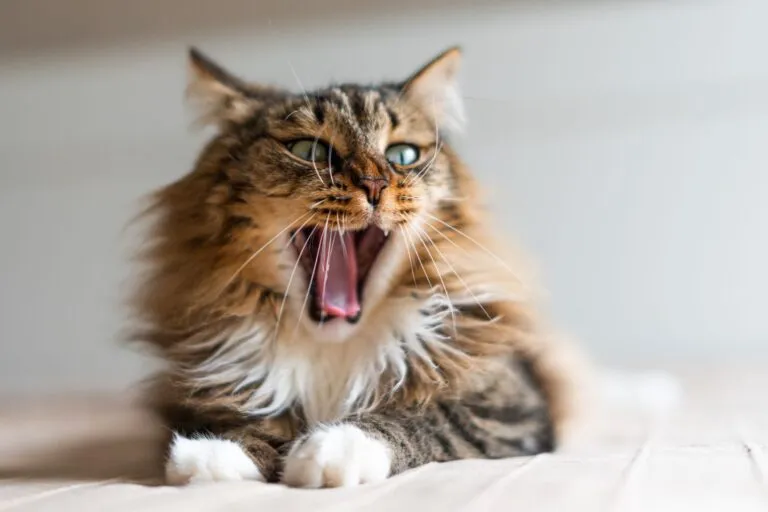
Does your cat have unpleasant-smelling breath? Bad breath in cats can have various causes. Often, problems with the teeth or gums are behind it. But metabolic or organ diseases can also lead to bad breath.
Does your cat have bad breath? Unpleasant breath can have various causes.
What Type of Bad Breath is Normal in Cats?
Immediately after eating all feline friends have slightly smelly breath. This should fade away again after a while.
It’s a different matter if your cat’s breath smells really unpleasant – and that over a longer period of time. In that case, you should definitely get to the bottom of the causes of your cat’s bad breath and book an appointment with your vet.
Why Does My Cat’s Breath Smell So Bad? Cause: Tartar
If your four-legged friend has foul-smelling breath, it’s often down to their teeth or gums.
One of the most common causes of bad breath in cats is tartar, recognisable by brownish-yellow deposits on the surface of the teeth.
Tartar may sound harmless at first, but these hard deposits can cause serious discomfort for your cat.
How Does Tartar Develop?
Through the combination of food residues stuck between the teeth, saliva and bacteria, a coating forms on the teeth. This coating, also known as plaque, is initially still soft.
However, due to the minerals in the saliva, the plaque gradually hardens. Hard tartar forms, which in turn can lead to painful gum inflammation in your cat. As a result, the teeth themselves may also become damaged.
How Can You Get Rid of Bad Breath in Cats? Removing Tartar
To prevent gum inflammation, heavy tartar should be removed regularly by a vet. However, this requires the cat to be put under a general anaesthetic.
Important to know: If your cat is eating normally, it doesn’t necessarily mean everything is fine. Cats will often continue to eat even if their mouth is sore. They are masters at hiding pain.
Cause: Gum Inflammation (Gingivitis)
Gum inflammation, also known as gingivitis, can also be accompanied by bad breath in cats. In most cases, the gum tissue along the edge of the teeth is red and swollen. Bleeding gums are also a possible symptom.
In addition to tartar, the following triggers can, for example, cause gingivitis:
- Injuries caused by foreign objects such as blades of grass
- Inflammation of the tooth-supporting structures (periodontitis)
- Infections caused by bacteria or viruses
- Tumours in the oral cavity
- Organ diseases (for example kidney failure in cats)
What Should You Do if Your Cat Has Bad Breath? Treating Gum Inflammation
One part of the treatment is the elimination of the cause of the inflammation: Foreign objects lodged in the gums are surgically removed, for example, and infections are treated with the appropriate medication.
In addition, oral discomfort can be relieved, for example, with pain relief for your cat, anti-inflammatory medication or special mouthwashes.
You can find detailed information about causes and treatment options in the article Gum inflammation (gingivitis) in cats here in the zooplus Magazine.
Cause: Damaged Teeth
Broken teeth, cavities or infected tooth roots also often cause bad breath in cats. Not uncommonly, the dental disease FORL is responsible for damaged teeth. Experts assume that around half of all cats are affected.
What Does FORL Mean?
FORL stands for “feline odontoclastic resorptive lesions”. Put simply, the teeth are decalcified from the inside by the body’s own cells, known as odontoclasts, and slowly break down.
The tricky thing about FORL is that because the teeth are attacked from the inside, the holes are usually not visible from the outside. Nevertheless, the cat still suffers from toothache.
Diagnosis and Treatment of FORL
In some cases, FORL is accompanied by gum inflammation. However, only an X-ray of the teeth under general anaesthetic provides real certainty. The damaged teeth must then be extracted by the vet.
Preventing Dental Problems and Avoiding Bad Breath in Cats
If your cat has FORL or tends to develop tartar, regular check-ups with the vet are essential. But you can also do quite a bit yourself to care for your cat’s teeth.
If your cat tolerates tooth brushing, you can use a special toothbrush for cats. A good alternative is dental care snacks as well as dental care products that are sprinkled over the food.
Does Wet Food Cause Bad Breath in Cats?
It may be that wet or very soft food is (partly) responsible for your cat’s bad breath. In this case, special dental dry food can help: It has particularly large kibble pieces. Your cat can’t simply swallow these whole. They have to bite and chew the pieces properly. This helps rub off plaque and reduce tartar build-up.
You can find suitable dental care products for your cat in the zooplus shop:
Sometimes the root of the problem behind your cat’s bad breath isn’t in the mouth at all, but elsewhere in the body. Metabolic diseases as well as conditions affecting the gastrointestinal tract, kidneys or liver can also cause bad breath in cats.
Diabetes
Sweet-smelling breath, similar to fruit vinegar, can indicate diabetes in cats. Other signs of diabetes include, for example, increased drinking and urination or noticeable weight loss.
Liver and Gastrointestinal Tract
Diseases of the gastrointestinal tract (for example worms) are often accompanied by fishy-smelling breath in cats. The same applies to liver disease.
Cats that do not eat properly over a longer period are particularly at risk of developing serious liver problems. This can lead to acute fatty liver disease. The medical term for this is “hepatic lipidosis”.
Serious condition: Acute fatty liver disease is a medical emergency that must be treated by a vet immediately!
Kidney Problems Can Cause Bad Breath in Cats
If your cat’s breath smells of urine, kidney disease may be the cause.
Older cats are disproportionately affected by what is known as chronic kidney failure (CKF). This is also referred to as chronic kidney disease (CKD). Experts assume that CKD is the most common cause of death in older cats.
What Should You Feed a Cat with Kidney Problems?
Although kidney failure is not curable, symptoms can be alleviated with a special diet and suitable medication.
Conclusion: Take Bad Breath in Cats Seriously
Bad breath in cats is often dismissed as a minor issue. After all, our feline friends don’t brush their own teeth, so unpleasant breath can seem quite natural.
However, foul-smelling breath is always a warning sign and a case for the vet: If the cause is problems with the teeth or gums, it means your cat is very likely in considerable pain.
You should also never take diabetes or diseases of the internal organs lightly.