

11 min
2.6k
Medium Size Poodle
The French shepherd dog, Berger Picard, is robust in every way: in its appearance, character, and health. As a family dog, however, it also reveals its gentle and charming side.
© CALLALLOO CANDCY / stock.adobe.com
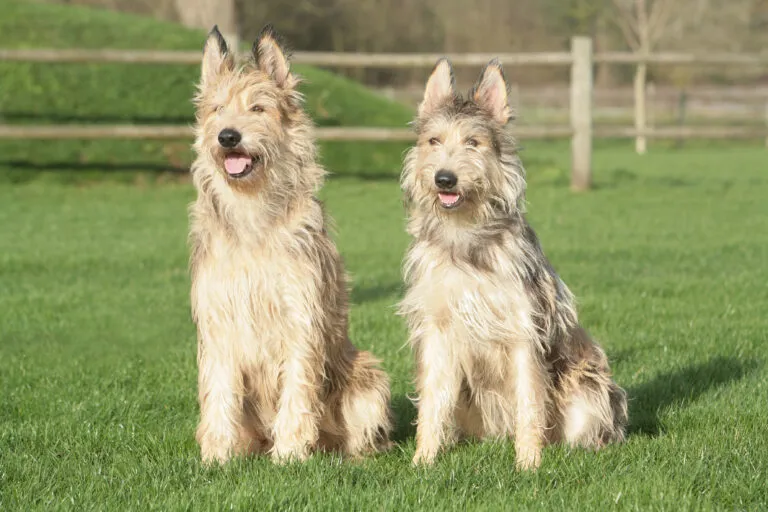
The upright ears and fluffy fur are typical of the Berger Picard.
Its origins as a herding dog, originally guarding its flock outdoors in northern France in blazing sunshine, thick fog, and rain, are reflected in the Berger Picard’s sturdy exterior. Its rustic coat, with rough, medium-length fur, feels coarse, and thanks to the fine and dense undercoat, offers this outdoorsy dog perfect protection in all weather conditions. Its lively and alert facial expression always appears cheerful. Distinctive features include its medium-sized, naturally upright ears. Unlike the Beauceron (Berger de Beauce) and the Briard (Berger de Brie), with which it shares the same origins, the Picard does not have double dewclaws.
The Berger Picard is quite versatile in colour. The base shades are usually grey or fawn, but the various nuances range from a darker grey-black to a lighter grey with a black sheen, and even bluish or reddish-grey tones. White markings are only permitted as small, light spots on the paws and chest. Large white areas are not allowed according to the breed standard.
With a shoulder height of up to 65 centimetres for males, and up to 60 centimetres for females, the Picard is considered a medium-sized dog. With an average weight of 23 to 32 kilograms, it is a sporty dog, known for its speed and agility.
 © Dogs / stock.adobe.com
This saying sums up the nature of the Berger de Picardie perfectly. Aside from its rough, goat-like coat, this French breed shows its “tough shell” especially towards strangers, whom it meets with suspicion and sometimes aloofness. This also applies to new environments or situations. However, it is never aggressive or snappy. Within the close family circle, its gentle side comes to the fore. Without being pushy, it loves spending time with its trusted humans and thoroughly enjoys playing and cuddling together. Especially with children, this sensitive dog proves to be a loving and reliable protector.
The training of a Berger Picard is demanding. Its suspicion and alertness towards strangers are as innate to this French herding dog as its independence, which is often mistaken for stubbornness. As an independent guardian of a large flock, these traits were not only useful but essential for the Berger Picard’s survival. In training of the Picard, which is now mainly kept as a family dog, this stubbornness can be more of a challenge.
It’s not true that this breed isn’t capable of learning – on the contrary, its intelligence, quick understanding, and lively temperament make it an enthusiastic participant. However, it sometimes questions the “why” behind an exercise. Blind obedience cannot be expected from a Berger Picard. With loving consistency, patience, perseverance, and enough empathy, this French herding dog can be guided in the right direction.
Properly trained and socialised, the sensitive and balanced Berger Picard becomes a reliable canine companion. Raising and training a Berger Picard requires a lot of patience, as well as a good mix of perseverance and calmness. Excessive strictness or overly high expectations regarding obedience will not work with the stubborn and sensitive Picard.
Its suspicion of strangers and unfamiliar things makes early socialisation and imprinting of the Picard all the more important. Introduce a young Picard step by step to new situations, such as visiting a city, meeting children, or a train journey. The more relaxed this phase of discovery is, the less suspicious the adult Picard will be of new things.
The Picard has high demands when it comes to its living conditions. Owners should enjoy being active and ideally have a house with a large private garden. The Berger is not suitable for a small city flat. With cats, this dog, which does not have a strong hunting instinct, can be well socialised – especially as a young dog.
The charming but stubborn Picard is not suitable for beginners. It takes a deep understanding of its character and a certain level of know-how to motivate it for tasks and commands. An owner with experience in dog training, who can devote time and loving consistency to their dog, is best suited for this breed.
As a former herding dog, which used to cover distances of 40 to 100 kilometres daily, the Picard also needs plenty of exercise and activity as a family dog. Energetic walks, jogging sessions or bike rides should be part of its owner’s daily routine. But exercise alone isn’t enough – the Picard also wants to use its mind. Puzzle toys, fetch games or attending a dog sports school are great options for this enduring and intelligent breed. However, keep in mind that the Picard has a mind of its own and may become stubborn with exercises it finds pointless.
Generally, grooming the Picard is easy thanks to its rough coat, which is simple to brush and doesn’t trap much dirt. It’s recommended to brush the Picard twice a week. Some Picards shed heavily, especially during the moulting season.
The small number of puppies means the Picard still has a relatively high risk of inbreeding, which strict breeding regulations and controls aim to reduce. Inbreeding can lead to health problems. The hereditary disease HD (hip dysplasia), which affects many medium to large dog breeds, is fortunately well managed in this French breed. If you’re interested in a Picard puppy, ask the breeder about their health precautions.
A Berger de Picardie typically lives to around 13 years of age.
As the breed is considered very healthy, has few intolerances, and is usually spared from obesity
thanks to its love of exercise, standard food (wet or dry food) is just as suitable as home-cooked meals
or the BARF method. Which type of diet you choose depends not only on your dog’s individual preferences, but also on your own. Which food fits best into your daily routine? How much time do you have for preparation? If you’ve found a food your four-legged friend enjoys and that suits them, you should stick with it. Frequent changes of food can be stressful for your dog’s digestion.
Among the group of old French herding dogs, which also includes the Beauceron and Briard, the Picard is probably the oldest breed. It’s believed to descend from Celtic dogs from the 9th century BC, although this theory can no longer be proven. Reliable information about its origins only exists from the 19th and 20th centuries. The cynologist Robert Fontaine was one of the first to take an interest in the rustic herding dogs from Picardie, the Paris Basin. His early breeding attempts were thwarted by the outbreak of the First World War in 1914.
Only after the war did Fontaine, with the help of influential supporters Paul Mégnin, director of the specialist magazine L’Eleveur, and breeder Tournemine, manage to create a first breed standard and raise awareness of this special breed. The Picard was officially recognised as another French herding breed in early 1925.
However, outside its region of origin, it remained largely unknown. All efforts to change this were abruptly ended by the outbreak of war once again. It is thanks to Picard owner Jean Cotte that the breed did not die out despite the Second World War: After the hardship of the war and occupation years, Cotte searched farms in Picardie for dogs matching the Berger de Picardie type. His crossbreeds named “Radjah de la Bohème” and “Wax de la Bohème” are now considered the founding ancestors of the Picardie breed.
Yes – to this day, the Berger de Picardie is a rare breed, with puppy numbers nowhere near those of its relatives, the Beauceron and Briard. Fortunately, dedicated breeders and enthusiasts have helped make the Picard known beyond the Paris Basin and have established breeding centres in other European countries.
Ludwig is a Picard! In German-speaking countries, the Berger de Picardie has become more well-known thanks to the Eberhofer crime film series, based on the books by Rita Falk. The Picard Joker, who passed away in 2021, played the lovable dog Ludwig in many episodes.
 © tmart_foto / stock.adobe.com
If you want to buy a Picard, contact a reputable breeder who breeds with pedigree certificates. You can find these, for example, through major umbrella organisations such as the VDH in Germany. Another option is clubs for the Berger de Picardie or French herding dog clubs, which also provide information about the breed. Sometimes these clubs also help rehome adult dogs looking for a new home.
| Special features:
| Along with the Beauceron and Briard, the rare Berger Picard is one of the old French herding dog breeds. |
| Character: | territorial, sensitive, loyal, alert |
| Shoulder height: | Males: 60-65 cm, Females: 55-60 cm |
| Weight: | 23-32 kg |
| Coat: | Rough, medium-length coat with dense undercoat in fawn, grey, and brindle colours. |
| Coat care:
| Weekly brushing recommended, more often during moulting. Sheds heavily. |
| Exercise: | Very active, needs plenty of exercise. |
| Suitable for beginners: | no |
| Barking: | alert, but not a barker |
| Life expectancy: | 13 years |
| Typical illnesses: | Hip dysplasia |
| FCI group: | Group 1, Section 1 (Shepherd dogs) |
| Origin: | France |

The zooplus editorial team consists of a dedicated team of experts with many years of experience in the field of animal husbandry: Luisa with her White Swiss Shepherd Elyos, Laura, Julio, and Florian. Together with a large network of animal experts, we work to make the zooplus magazine a trusted source of information for all animal owners and lovers. Our goal is to provide exciting animal knowledge and relevant information on the proper care of pets.
Fans of the Bearded Collie agree that those who aren't familiar with this dog breed simply have to get acquainted with it. And those who have experienced how a Bearded Collie bolts across meadows with its flowing fur, how it rolls around full of energy and joy and how it attentively and observantly takes into account its owners wishes become simply addicted to this original dog breed and its unique charm.
The Irish Wolfhound is one of the largest dogs in the world. Used for hunting wolves and bears in medieval Ireland, today it is kept exclusively as a family dog. Despite its imposing size, this sighthound is very gentle and affectionate. Unfortunately, the friendly giant is also quite prone to illness and has a comparatively short life expectancy. Is an Irish Wolfhound right for me, and what does keeping one involve? You can find everything you need to know in the following article.