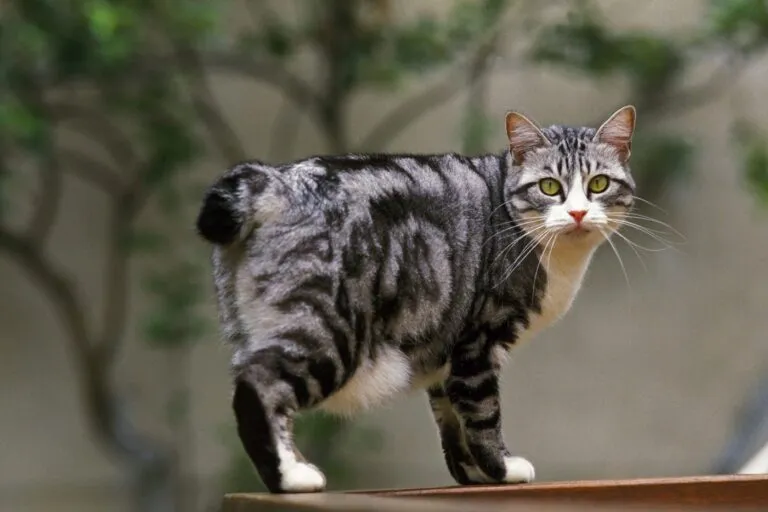
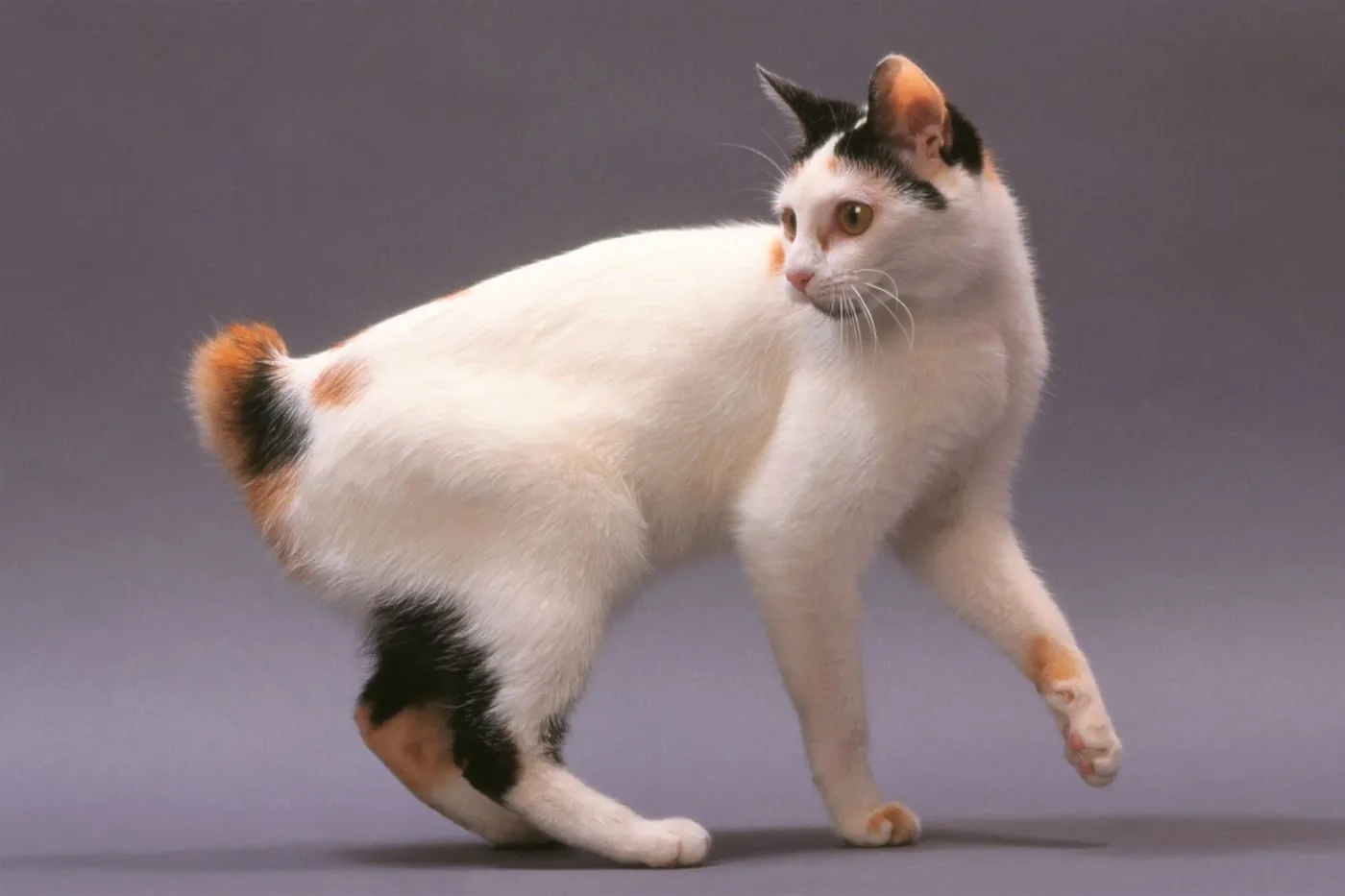
The short, plush tail of the Japanese Bobtail is its trademark. This cat breed is considered child-friendly, affectionate and playful. However, its short tail also makes it controversial: health problems cannot be entirely ruled out.
The most striking feature of this cat is its shortened tail. It is usually only five to eight centimetres long.
The “bobbed tail” that gives the Japanese Bobtail its name consists of one or more tail vertebrae. These vertebrae may be fused to varying degrees. The tail is curved or kinked.
The Japanese Bobtail is bred in both long-haired and short-haired varieties and is divided into Japanese Bobtail Longhair and Japanese Bobtail Shorthair. However, in both varieties the short tail is covered with dense, long fur.
Did you know?
The hair of its fluffy tail sticks out in all directions, resembling flower petals. This has earned the breed the nickname “Chrysanthemum Cat”.
What Colour Varieties Are There?
The silky, dense coat can come in many colours. According to the breed standard, all coat colours are permitted except lilac, chocolate and colourpoint.
The tri-coloured variety of this breed is particularly sought after. In its country of origin, Japan, it is called “Mike-neko”, meaning three-fur cat, and is regarded there as a good-luck charm.
The Japanese Bobtail’s eyes are almond-shaped and may be blue, green, golden or odd-coloured.
The tricolour Japanese Bobtail is regarded as a symbol of good luck in her native Japan.
Short Tail, Hopping Gait
Like other Oriental cat breeds, the Japanese Bobtail is slender and finely built. However, it has a slightly more muscular physique.
As the hind legs are longer than the front legs, its posture appears slightly arched. Its gait is somewhat hopping. As with other short-tailed or tailless breeds, the Bobtail lacks the long tail that helps with balance.
Welfare Concerns Surrounding the Japanese Bobtail
Short-tailed breeds are often criticised. The deliberate breeding of a shortened tail spine results in a short tail that cannot fulfil all the functions of a normally long cat’s tail.
Affected animals are often unable to walk, jump and climb properly because they lack the necessary “balancing pole”. Communication with other cats may also be impaired, as cats such as the Japanese Bobtail use their tails to express their mood.
Short-Tailedness Is a Cause for Concern
The trait of short-tailedness or taillessness in cats appears on the “list of affected traits in the expert report on the interpretation of the ban on extreme breeding”.
This list serves as guidance for interpreting Section 11b of the German Animal Welfare Act, which prohibits extreme breeding. It is intended to highlight breeders’ responsibility and encourage the breeding of healthy animals.
With regard to this breed, this means: the breed is at least questionable from an animal welfare perspective. However, breeding it is not generally prohibited. The cats may be bred legally and the Japanese Bobtail can be purchased in this country.
Demand: Breed Only with Healthy Animals
In any case, breeders of this breed should have their cats examined by a vet and breed only with healthy animals. This is called for, for example, by the Erna Graff Foundation for Animal Welfare.
Veterinarian Karina Schöll also underlines this recommendation in her dissertation:
“For the Japanese and Kurilian Bobtail, only an examination for increased sensitivity to pain in the tail area and further vertebral fusions prior to breeding approval is recommended. In addition, the animals should be permanently identified by microchip or tattoo and listed in stud books.” (Schöll, Extreme breeding traits in cats, p. 33)
Character: The Japanese Bobtail as a Family Cat
In Japan, this breed is called “Kazoku-neko”. Translated, this means “family cat”, which sums up its character rather well. It is considered extremely people-oriented, playful and affectionate.
If there are children in the household, like most cats it will need a short settling-in period. After that, however, it happily joins in family life and proves to be open and loving.
A Talkative Companion
The Japanese Bobtail meows relatively often. With a soft voice, it almost “chatters” and “sings”. It has a strong personality and demands plenty of attention from its owner.
Thanks to its curiosity and intelligence, the Japanese Bobtail is keen to learn little tricks such as fetching and giving a paw. Puzzle boards and other intelligence toys.
Keeping: Is This Breed Suitable for Indoor Living?
This breed does not have a particularly strong urge to roam, so keeping it indoors is generally possible. However, the Japanese Bobtail still needs plenty of climbing opportunities and quiet retreats to feel comfortable.
It greatly appreciates a netted balcony or a secure garden. As it is extremely people-oriented, owners should not leave a Japanese Bobtail alone for too long.
Good to know: the Japanese Bobtail is one of the few cat breeds that is not afraid of water. Many cats of this breed are genuinely fascinated by water and love playing with their drinking fountain.
Conditionally Compatible with Cats and Dogs
Due to its shortened tail, the Japanese Bobtail may have difficulties communicating with other cats. This can make living with other felines more challenging.
Nevertheless, a well-socialised Kazoku-neko should not be kept alone. It is therefore advisable to adopt at least two cats of this breed. It generally gets along well with dogs, although it tends to show little interest in them.
Nutrition & Care: An Uncomplicated Breed
As it is often a little more laid-back than other cats and does not move around as much, the Chrysanthemum-tailed cat has a relatively low energy requirement.
It should be fed high-quality cat food with a high meat content. Owners of a Japanese Bobtail should also ensure that their pet does not become overweight .
Grooming the Japanese Bobtail
The coat of this breed has no undercoat, which makes grooming particularly easy. Weekly brushing is usually sufficient.
For long-haired representatives or during the moulting season, you may need to reach for the brush more often. Many cats enjoy this “spa treatment” from their owner and are happy to be groomed.
Robust Health of the Japanese Bobtail
Although the Japanese Bobtail is one of the controversial short-tailed breeds, it appears to have more robust health than other cats with this trait. No hereditary diseases are known.
How Long Does a Japanese Bobtail Live?
With good care, the Japanese Bobtail lives on average around ten to 13 years.
Fewer Health Problems than the Manx
Unlike the tailless Manx cat, this breed appears to have fewer health problems resulting from its short tail. In the Manx, severe pain in the pelvic area occurs frequently. In addition, incontinence and brain malformations are widespread.
None of this has so far been observed to the same extent in the Japanese Bobtail. The reason is likely that its shortened tail is based on a different gene mutation than in the Manx. Unlike in the Manx, this mutation apparently does not affect the cat’s skeleton.
Avoid Extreme Breeding
However, as the breed is not very widespread, a final assessment of the Japanese Bobtail’s health is still pending. So far, there is no general recommendation to ban breeding of the Japanese Bobtail altogether.
Breeders are, however, urged to pay close attention to the health of their breeding cats in order to avoid extreme breeding.
Origin: From Japan to the Rest of the World
Unlike many other short-tailed cat breeds, the Japanese Bobtail has a long history.
Around 1,000 years ago, the natural gene mutation responsible for the short tail is said to have appeared in Asia. Later, the Japanese Bobtail was deliberately bred at the Japanese imperial court.
Short-Tailed Cats Used to Combat Pests
At that time, cats with shortened tails were highly sought after among the nobility. The animals were not only popular as gifts for crowned heads – they also served an important purpose.
Short-tailed cats were used as mousers in silkworm plantations, where the raw material for precious silk was produced. Cats with normally long tails were not suitable for this task, as they would damage the valuable cocoons.
As a result, cats with docked tails were sent into the plantations to protect the silkworms from rodents and birds. Once it was discovered that short-tailed cats could be bred selectively, the Japanese Bobtail eventually took on this role.
The Japanese Bobtail and Its Life as a Street Cat
In the 17th century, an official decree in Japan ordered that short-tailed cats be released so that as many cats as possible could rid the plantations of pests.
As a result, the Japanese Bobtail became a street cat and reproduced uncontrollably. The breed may owe its robust health to this fact.
Official Recognition of the Japanese Bobtail
In the 1960s, American soldiers stationed in Japan discovered these unusual cats. The first specimens reached the USA at the end of the 1960s and from there eventually spread to the rest of the world.
The American organisation Cat Fanciers’ Association (CFA) officially recognised the Japanese Bobtail as a distinct breed in 1965. In 1990, it was also recognised by the Fédération Internationale Féline (FIFe).
The Japanese Bobtail in Japanese Culture
There is a legend about the origin of the Japanese Bobtail. One day, a cat slept too close to a fire and its tail caught alight. The animal ran through the streets with its tail burning, setting the surrounding houses on fire. After the panicked four-legged creature had burned down an entire settlement, the Japanese emperor decreed that all cats’ tails should be shortened.
Today, of course, we know that the chrysanthemum-shaped fluffy short tail of the Japanese Bobtail is based on a gene mutation – a quirk of nature. In Japan, this breed remains very popular to this day. Tri-coloured specimens in particular are regarded as good-luck charms.
Inspiration for the Waving Cat and Hello Kitty
The well-known waving cat, called Maneki-neko in Japanese, which greets customers with a raised paw in shops and restaurants, is modelled on the Japanese Bobtail. Hello Kitty, the famous cartoon cat created by the Japanese company Sanrio, is also designed after the Japanese Bobtail.
Purchase: Should You Buy a Japanese Bobtail?
Based on everything known so far, the Japanese Bobtail appears to be more robust than other short-tailed breeds such as the Manx or the Cymric. Its bobbed tail apparently does not cause pain, as the underlying gene mutation does not alter the cat’s skeleton.
Nevertheless, short-tailed cats such as this breed may experience problems, for example in their movement or when interacting with other cats. For this reason, responsible pet lovers should think carefully about whether they really want to buy a Japanese Bobtail.
Japanese Bobtail from a Rescue Centre
Anyone who has fallen in love with this charming, affectionate breed should enquire at animal shelters and rescue organisations. Pedigree cats such as the Japanese Bobtail are also surrendered time and again, for example due to a house move or illness.
However, the Japanese Bobtail is not very widespread in this country. Prospective cat owners should therefore be prepared to be patient in their search for their dream cat.
A Japanese Bobtail from a Reputable Breeder
If you are set on a kitten from a breeder, cat lovers need to be particularly vigilant. To avoid health problems and the associated high vet bills, you should only buy a Japanese Bobtail from a reputable breeder.
They may only use one hundred per cent healthy animals for breeding. The kitten offered for sale must have all the necessary papers, including the EU pet passport and a detailed pedigree certificate.
This article was translated using Artificial Intelligence from the original German zooplus Magazine. While the original content was authored by industry experts and reviewed by our editorial team, this automated translation has not been human-edited and is provided for informational purposes.
"A life without a pug is possible, but pointless," Loriot once said. I would unreservedly agree and add: "A life without horse, cat and rabbit as well!" My heart beats for all animals big and small and I have the great fortune to be able to write about my passion as a freelance author. With my articles I would like to raise awareness for animal welfare and give useful tips to animal lovers.
The Maine Coon has become one of the most popular cat breeds in the world. This is probably due to its majestic appearance, robust nature and great character.
Large eyes and attentively upright ears instantly tell you a great deal about this charming breed of cat: Abyssinians are inquisitive and affectionate towards people.
With its long, dense fur, rounded ears, and intense stare, the Pallas Cat, or Manul, looks rather fluffy, yet somewhat dangerous. However, don't be fooled by its appearance—this is no petting zoo resident. The Manul is a wild animal and considered untameable.