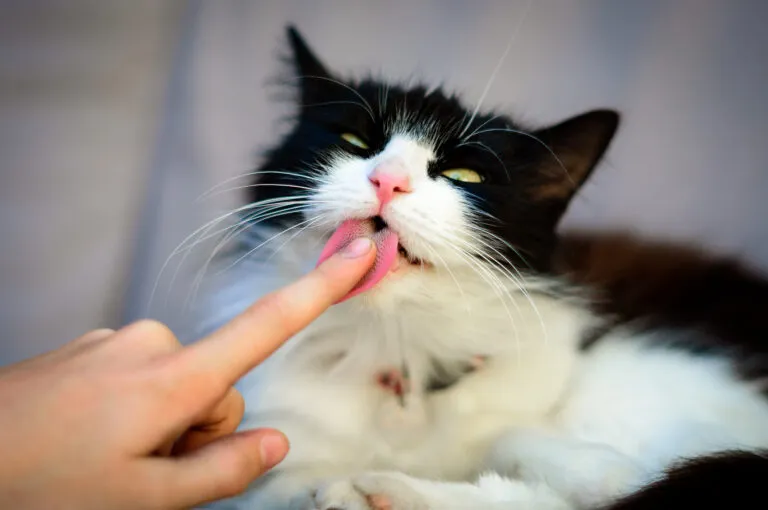
If you know two cats that are particularly fond of each other, you might, with a bit of luck, catch them grooming one another. They’ll lovingly lick each other’s coats. However, many cat owners ask, “Why does my cat lick me?”:
Cats’ licking can have many different meanings.
Why Do Cats Lick Each Other?
To understand why your cat licks you, it helps to look at the social relationships between cats. This makes it easier to see the role the tongue plays in feline social interactions.
The reasons why cats lick each other are:
- Grooming: Even young kittens enjoy the damp grooming they receive from their mother.
- Strengthening bonds: Linked to those kittenhood memories, grooming between adult cats is also a sign of affection and mutual trust.
- Taking in coat scents: By licking, a cat can better pick up the scents of its companion.
- Changing coat scents: The cat covers unfamiliar smells on its companion with its own scent molecules – for example, after the other cat has returned from a visit to the vet.
My Cat Licks Me: What Does It Mean?
When interacting with people, cats use the same behaviours they know from socialising with other cats. This leads to the following explanations for why your cat enjoys licking you:
Showing Affection with Their Tongue
The nicest and most meaningful reason your cat licks you is that it wants to show its deep affection. If you stroke your cat and it responds by purring and licking your hand, you can count yourself lucky. Your cat likes you and enjoys your time together.
But don’t be upset if your cat never licks your hand. Cats do this far less often than dogs. In the most literal sense, licking their favourite people is simply a matter of taste.
Licking to Mark Territory
Affection is closely linked to the next reason for this enthusiastic use of the tongue. Because your cat is so fond of you, it wants to mark you accordingly: “This human belongs to me!”
Animals have a much keener sense of smell than we do. What you won’t notice when your cat licks your skin is that it leaves behind tiny scent particles. These signal to other cats or dogs that you belong to your cat’s territory. Licking therefore expresses a claim of ownership.
A similar thing happens if you’ve stroked another cat or a dog before seeing your own cat. Your cat can smell the potential rival. By licking you, it not only removes their scent molecules but also covers them with its own.
Your Cat Licks Sweat from Your Skin
Are you lying on a sun lounger at 30 degrees Celsius while your cat licks your hand? It may simply enjoy the taste of your sweat. The slightly salty flavour appeals to many animals.
If you’ve eaten something tasty beforehand, it’s quite possible that your cat can smell it on your hands. No wonder it doesn’t want to miss out.
Licking to Relieve Stress
It’s also worth considering that your cat may lick more often as a way of coping with stress. This could be triggered, for example, by a house move or the arrival of another animal in the home.
What Should I Do if My Cat Licks Me?
If your cat licks you out of affection, you might want to return the favour. Stroke it with your free hand. Many cats also enjoy being groomed with a soft brush or a grooming glove.
If your cat is one of them, treat it to a few extra brush strokes. This will help strengthen your bond.
Why Does My Cat Lick and Then Bite Me?
Alongside licking, biting is a normal behaviour cats use when grooming. They may, for instance, bite to remove stubborn tangles or dirt from their coat. So it’s normal for your cat to give you an occasional nibble after licking – as long as it stays within limits and doesn’t really hurt.
If your cat genuinely hurts you, it’s important to stop the behaviour and make it clear that you don’t want this.
You can find out more about this topic here: Cat bite
Why Does My Cat Lick Me at Night?
Cats are generally more active at night than during the day. It’s therefore perfectly normal for them to groom and clean their coat at night. If your cat has formed a close bond with you, it may want to groom you during the night as well.
Can Cats Transmit Diseases Through Licking?
As a general rule, it’s best to follow a few hygiene measures when handling animals such as cats. It’s well known that cats can pass certain infectious agents on to humans.
If your cat has licked your hands, you should wash them afterwards. It can be more challenging if you have young children at home – their hands can end up in their mouths before you know it.
Transmission of Parasites
Regardless of licking, the following applies: if you have an outdoor cat and young children in the same household, you should regularly worm your cat.
Transmission of Bacteria
If cat saliva comes into contact with small wounds, in very rare cases it can lead to infection with the bacterium Bartonella henselae, causing “cat scratch disease”.
However, as the name suggests, this is mainly transmitted through scratches. The risk of a cat passing diseases to humans through licking is low. For hygiene reasons, though, you should avoid letting your cat lick your face.
This article was translated using Artificial Intelligence from the original German zooplus Magazine. While the original content was authored by industry experts and reviewed by our editorial team, this automated translation has not been human-edited and is provided for informational purposes.