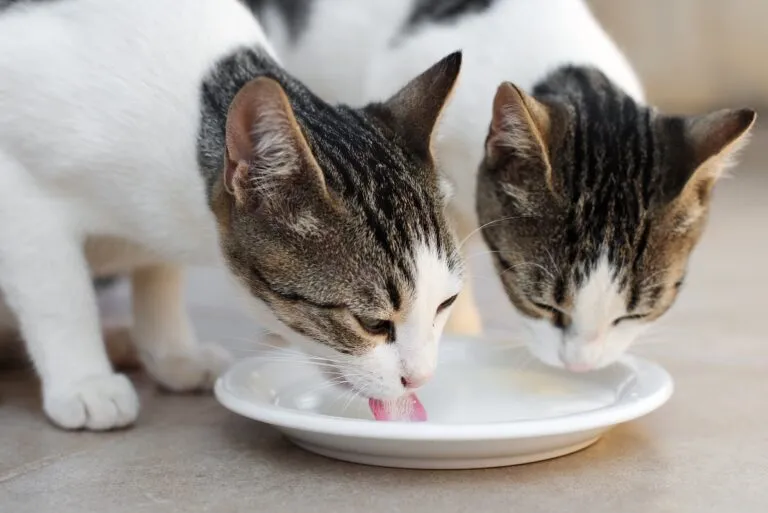
Many cats love milk, and for a long time the question “Can cats drink milk?” was answered with “Yes”. After all, that’s what we’re shown in countless children’s books, as well as in films and advertising. But is it really healthy for cats to drink milk regularly?
For a long time, it was considered perfectly normal to give cats milk – yet it can cause serious digestive problems.
Myth or Truth: Is Milk Really Good for Cats?
When nursing, small kittens drink their mother’s milk. During this stage of life, they produce kittens a special enzyme called lactase. This enzyme enables kittens to break down and digest the milk sugar (lactose) in milk.
As they continue their growth, young kittens gradually switch to solid food and therefore produce less and less lactase. The result: adult cats can no longer digest milk as well.
Lactose Content: The Difference between Milk, Cat Milk, and More
Milk isn’t just milk. That’s why, when asking “Can cats drink milk?”, it’s important to look at the source and exact composition of the different types of milk:
Can Cats Drink Cow’s Milk?
Pasteurised and homogenised cow’s milk contains a high proportion of lactose (50 grams per kilogram), which makes it unsuitable for adult cats.
Can Cats Drink Goat’s Milk?
No, cats should not drink regular goat’s milk, as like standard cow’s milk it is difficult for adult cats to digest and can lead to digestive issues such as flatulence and diarrhoea. Although goat’s milk contains less lactose than cow’s milk, which may make it more tolerable for some cats, it is still very high in fat and calories.
Can Cats Drink Lactose-Free Milk?
Yes, cats can drink lactose-free milk in small amounts, as the milk sugar has already been broken down and is therefore easier to tolerate than regular milk. However, it should only be offered as an occasional treat, as it still contains plenty of calories, which can lead to weight gain.
Can Cats Drink Condensed Milk?
No, cats should not drink condensed milk. Condensed milk has a lower water content and is therefore thicker than regular milk. However, the same amount of condensed milk also contains more fat, lactose (100 grams per kilogram) and calories than non-condensed milk.
Is Cat Milk Good for Cats?
In contrast to cow’s milk, there is also special cat milk that is low in lactose (not lactose-free). This milk, specially produced for cats, is available in many pet shops and is generally easier for cats to digest than cow’s milk.
For this reason, cat owners often turn to cat milk even for adult cats – usually as a well-meant treat between proper meals. However, cat milk should only occasionally feature on the menu and does not replace a complete meal or your cat’s water intake!
Health Consequences: What Can Happen if Cats Drink Milk?
Milk is not poisonous to cats, but it can lead to health problems. The severity of the reaction depends on individual factors, as well as on the quantity and type of milk consumed.
Digestive Problems
Since adult cats cannot enzymatically break down milk sugar and lactose has a laxative effect, digestive problems are the most common health consequence when cats drink milk. In addition to flatulence and abdominal pain , these mainly include diarrhoea and constipation.
Weight Gain
Although milk contains important nutrients, adult cats do not naturally depend on drinking milk. On the contrary, milk also contains a lot of calories.
Particularly for more sedentary indoor cats and senior cats with lower energy needs, any type of milk can quickly lead to weight gain.
Conclusion: Water is Better than Milk
Since your adult cat cannot tolerate lactose for physiological reasons, you should generally avoid giving cow’s milk or condensed milk. If you do, it can seriously upset your cat’s digestion.
How Much Milk Can Cats Drink?
For health reasons, it is advisable not to give cats conventional milk at all.
Even special cat milk or lactose-free milk diluted with water should only be offered in small amounts and in moderation , for example as a special reward after clicker training.
The general recommendation is: give your cat no more than two grams of lactose per kilogram of body weight.
Encouraging Cats to Drink Water
Cats are particularly prone to kidney problems such as kidney insufficiency or bacterial urinary tract infections. Such patients should drink plenty of fluids, but they often don’t like to. That’s why many cat owners turn to cat milk in these cases, as it is tastier than water.
However, as milk contains too many calories, it’s better to encourage your cat to drink water instead. To help your cat drink more in future and to prevent dehydration , you can try the following tips:
- Get your cat a drinking fountain (cat fountain)
- Place several water bowls in different shapes and at varying heights around your home
- Regularly draw your cat’s attention to the water bowl using gestures
This article was translated using Artificial Intelligence from the original German zooplus Magazine. While the original content was authored by industry experts and reviewed by our editorial team, this automated translation has not been human-edited and is provided for informational purposes.