{"url":"https://www.zooplus.co.uk/magazine/dog/dog-travel-and-transport/flying-with-your-dog","title":"Flying with Your Dog ","mag_id":389770,"is_single":true,"cat_name":"Dog","sub_cat_id":147,"sub_cat_name":"Dog Travel and Transport","cat_id":3410}
Whether you’re relocating overseas or heading off on an extended holiday in a faraway country, sometimes flying with your dog simply can’t be avoided. A dog’s ability to travel with you by air, and the available options for doing so, depend primarily on the dog’s size and the airline’s regulations. In this article, you’ll find out what else you need to consider when flying with your dog and how to prepare them for the journey.
Flying is always stressful for dogs – just like getting used to a new environment and an unfamiliar climate. That’s why you shouldn’t take this risk lightly, and always consider whether it’s truly necessary. However, with proper preparation, you can make the flight much more comfortable for your dog.
Good health is essential
A flight is only suitable for dogs that are generally healthy and have no age-related limitations. That’s why it’s important to speak to your vet beforehand to check whether air travel is even an option for your dog. Brachycephalic dogs with narrow airways are also usually subject to special regulations.
You should also make sure to follow the entry requirements of your destination country. For example, does your dog need a specific vaccination or a health certificate?
Do dogs struggle with equalising pressure?
During take-off and landing, most dogs experience a strong pressure sensation in their ears. Unlike humans, dogs can’t relieve this pressure themselves.
You should be aware that these situations can be very stressful for your dog. So, it’s worth considering whether travelling by car might be a better option for both you and your dog than flying.
Not every dog is allowed on a plane
Aside from dogs whose physical condition makes them unsuitable for air travel, there are also breeds that many airlines ban outright.
This mainly includes dog breeds that airlines have classified as dangerous. As a result, so-called “fighting dogs” or listed breeds are prohibited on most flights.
Flying with your dog: What do I need to know?
Before you set off on a flight with your dog, there are a few important things you should keep in mind:
your dog’s fitness and health
gradual preparation through targeted training
choosing a suitable travel crate or carrier
choosing the right airline
checking entry requirements for your destination country
Check with the airline well in advance to find out under what conditions you can take your dog on the plane, and also consult your vet and dog trainer for any preparations needed before the flight.
General requirements for travelling by air with a dog
For your dog to be allowed on a plane, they must:
be fitted with a microchip
have a valid EU pet passport
and be able to provide proof of a current rabies vaccination.
You should also plan your trip well in advance and check the specific travel requirements for your chosen airline. Find out whether you can take your dog in the cabin or if they must travel in the hold.
Cabin or cargo hold: When can a dog travel in the cabin?
Whether you can take your dog into the cabin usually depends on your dog’s size, the airline, and sometimes even the time of year. Unfortunately, there are no universal rules that apply to all airlines.
Many airlines do not transport animals during the hot summer months, while others never allow pets in the cabin at all, or only permit a limited number on board.
Can you take a dog as hand luggage?
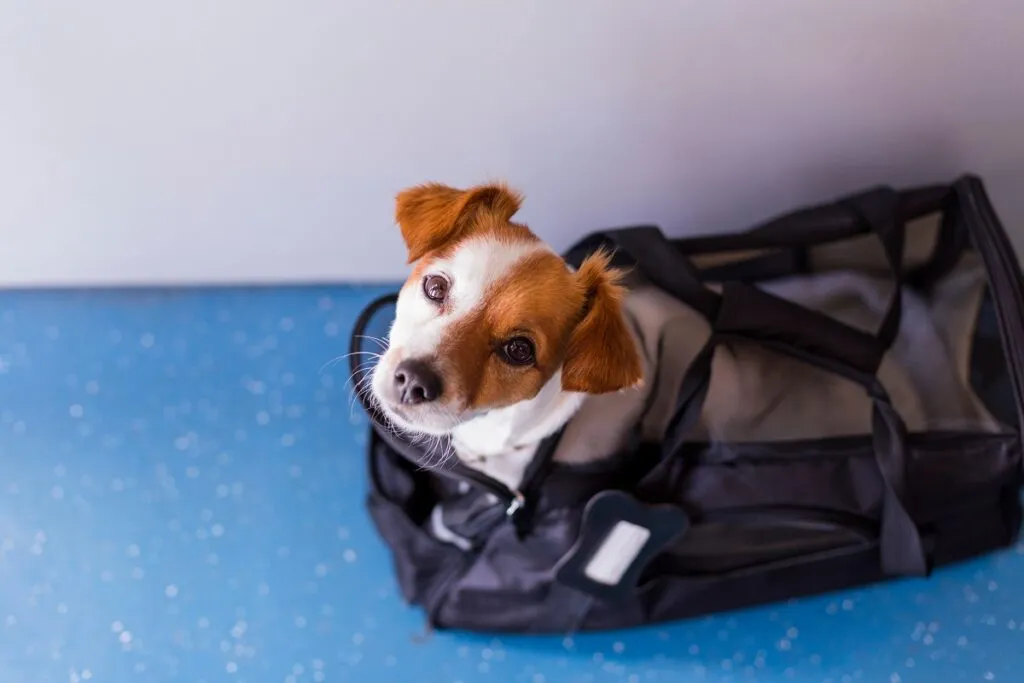
Small dog breeds are often considered hand luggage and, with many airlines, can travel in the cabin in a carrier up to a certain weight limit. Please note, however, that your small dog must remain in an appropriate carrier, kept in the footwell at all times. In addition, their head must stay inside the carrier, they mustn’t peek out.
Which airlines allow dogs in the cabin?
Some carriers, such as Lufthansa and Eurowings, let you fly with your dog in the cabin. However, it’s best to check the specific guidelines and rules of each airline in advance, as these can vary in terms of accepted animal types, size limits, fees, and required documentation.
Can you fly in the cabin with a large dog?
Large dogs, unfortunately, usually have to travel as special luggage during flights – in a transport crate in the cargo hold.
How much does it cost to fly with a dog?
How much a plane ticket for your dog costs naturally depends on several factors, including:
Airline
Flight zone
Your dog’s size and weight
Breed
Travel option (cabin baggage or checked as oversized luggage)
However, you should expect to pay at least €30 and up to over €300 per flight for your dog.
These dogs fly for free
Owners of assistance dogs, such as guide dogs, enjoy a big advantage. Their specially trained dogs are usually allowed to travel free of charge and sit in the cabin right by their owner.
Small dogs are generally allowed to travel in the cabin as hand luggage with some airlines.
Which travel crate is best for flying with your dog?
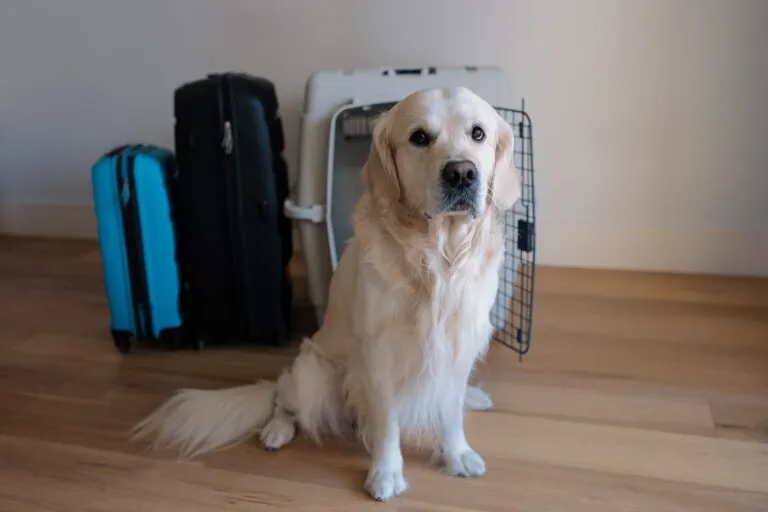
A travel crate is an absolute must for any flight with your dog. It needs to be escape-proof and waterproof – so wicker baskets are not suitable. Sturdy plastic crates or pet travel bags are usually the better option, depending on the airline’s requirements. However, these should not exceed the typical hand luggage allowance of 56 x 45 x 25 cm.
Special transport crates for the cargo hold
Dogs that exceed the permitted total weight must travel in the air-conditioned cargo hold. Here, there are specially designed dog transport crates for air travel. This option does have its advantages: although you can’t keep an eye on your dog, the larger crates offer more room to move around. Many also come with a fitting for water bottles, so your dog can have a drink during the flight.
Additional requirements for your dog’s travel crate when flying
Make sure the travel crate…
is spacious enough for your dog to comfortably turn around and lie down inside.
has plenty of openings to ensure good airflow and ventilation.
is comfortably padded.
includes, if needed, a holder for a water bottle or bowl.
is ideally lined with an absorbent material (especially for longer flights).
You can find suitable pet carriers in the zooplus Online shop.
Preparation: Making air travel with your dog stress-free
Flying can be stressful not only for many people, but for dogs as well. So, in addition to checking the general requirements for air travel, you should also think about how to keep your dog comfortable and relaxed throughout the entire flight, and how to keep them occupied.
Tips for stress-free flying with your dog
To help prepare your dog for air travel and make the flight as comfortable as possible for them, follow these tips:
Get your dog used to their travel carrier step by step, and practise longer stays inside it. Ideally, start a few weeks before the flight.
Your dog should ideally already be accustomed to being left alone for short periods.
Line your dog’s crate with a T-shirt you have worn.
Give your dog a chew-safe toy for the journey to keep them occupied – one they can’t swallow.
Bach flower remedies can also help to ease stress. Ask your vet for advice on this.
Make sure your dog has plenty of opportunities to relieve themselves before travelling.
Let them burn off excess energy beforehand – for example, with a long walk.
Avoid giving your dog anything to drink shortly before the flight.
Try to stay calm yourself – your anxiety can rub off on your dog. Speak to them soothingly, offer reassurance, and give them a gentle stroke.
Flying with your dog: Why sedatives aren’t a good idea
Sadly, sedatives often just stop your dog from showing signs of stress on the outside, while they’re still feeling it on the inside. These days, vets usually advise against using sedatives when flying with your dog. That’s why early training and thorough preparation are so important to help your dog travel safely from A to B.
At the Justus-Liebig-University of Giessen I was extensively trained as a veterinarian and was able to gain experience in various fields such as small animal, large animal and exotic animal medicine as well as pharmacology, pathology and food hygiene.
Since then, I have been working not only as a veterinary author, but also on my scientifically driven dissertation. My goal is to better protect animals from pathogenic bacterial organisms in the future.
Besides my veterinary knowledge, I also share my own experiences as a happy dog owner and can thus understand and enlighten fears and problems as well as other important questions about animal health.
Whether it’s shorter hikes close to home, day trips at the weekend or a full hiking holiday with your dog: hiking is a paw-sitively great hobby for human–animal teams! We’ve put together everything you need to know about preparing for a hike with your four-legged friend, the equipment you’ll need and what to keep in mind when hiking with a dog.
Dog lovers like to take their best four-legged friend everywhere they go. But what if you want to be travelling with your dog? Is it a good idea to take your dog on a plane? Or should dog owners tackle longer journeys by car or by plane instead?
Many people know it all too well: after only a short time in a moving vehicle or on a rocking boat, symptoms of travel sickness appear. Unfortunately,often ourfour-legged friends can also affected by travel sickness. Read thefollowing article to find out everythingyou need to knowabout travel sicknessin dogs and what you can do to help relieve travel nausea in dogs.