{"url":"https://www.zooplus.co.uk/magazine/dog/dog-adoption/dog-allergies-in-humans","title":"Dog Allergies in Humans","mag_id":364944,"is_single":true,"cat_name":"Dog","sub_cat_id":144,"sub_cat_name":"Dog Adoption and Ownership","cat_id":3410}
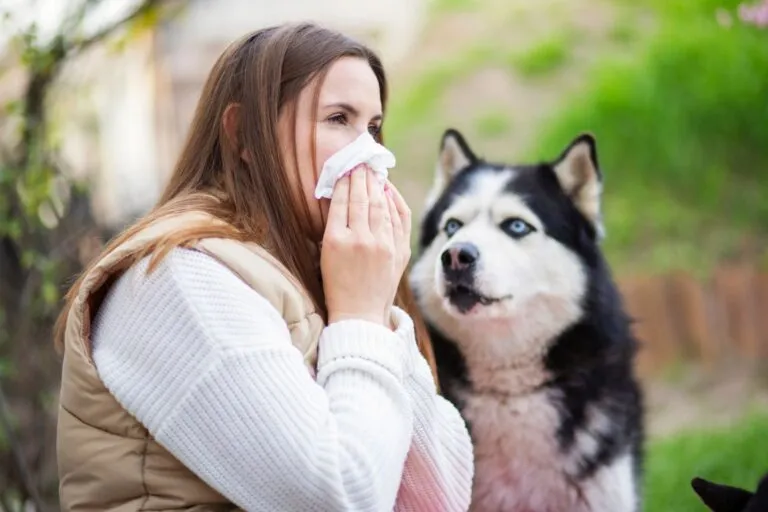
Do you experience itching or breathing difficulties after being around dogs? Then you might have developed an allergy to dogs. This article will explain how to determine if you have a dog allergy, whether it's dangerous, and how you can alleviate your symptoms.
When your immune system reacts to certain proteins originating from dogs, you have a dog allergy. Many people suspect that dog hair is the trigger for a dog allergy.
However, the human body doesn’t actually react to the hair of our feline friends, but rather to specific allergens. For this reason, “human dog hair allergy” is technically incorrect. Still, dog allergies certainly do exist.
How Dangerous is a Dog Allergy in Humans?
A dog allergy often appears milder than other allergies, such as an allergy to insect venom. Nevertheless, some patients may experience significant symptoms.
In extreme cases, an anaphylactic shock can happen. If not treated, this most severe form of allergic reaction can be life-threatening.
How Common is Dog Allergy in Humans?
A 2013 study conducted by the Department of Epidemiology and Health Monitoring at the Robert Koch Institute in Berlin investigated how common dog allergy is among the German population.
Researchers found that approximately seven percent of adults are sensitive to dog dander. However, only about a third of those affected show allergic reactions.
Good to know: A dog allergy occurs considerably less frequently than an allergy to house dust mites.
Symptoms: How Do You Know If You Have a Dog Allergy?
Dog allergy symptoms often resemble those of hay fever. Patients with a mild dog allergy typically exhibit:
Frequent sneezing and runny nose
Itching and redness of the eyes
Fatigue
Take Immediate Action for Anaphylactic Shock
In some cases, more severe symptoms of a dog allergy may occur. Symptoms of a life-threatening anaphylactic shock include itchy, reddened skin and difficulty breathing.
In this instance, it’s crucial to take immediate action by administering emergency medication and calling emergency services or getting someone to call an ambulance for you.
When Should I See a Doctor for a Dog Allergy?
If you suffer from allergic symptoms that increasingly restrict you, it’s essential to have them examined by a doctor. Untreated allergies can worsen over time.
Tip: Keep an Allergy Diary
To aid your doctor in diagnosing, you can keep an allergy journal over several days or weeks. Record daily when and if problems occur. Note down if and what medication you have taken.
Diagnosis: Can You Get Tested for a Dog Allergy?
If you suspect you have a dog allergy, you can get tested by your GP or a specialised allergist.
The doctor will ask about your medical history and conduct a physical examination before testing you for a dog allergy with various diagnostic tools.
Note: Home testing kits for dog allergies also promise a diagnosis. However, allergists advise against relying solely on these tests.
Skin Test
There are two ways to detect a dog allergy in humans via skin tests:
Prick Test for Dog Allergy: This test is one of the most common for confirming an allergy. Your doctor will drop various allergens on your forearm, which is marked with squares, and lightly prick the skin. If a square reddens within about 20 minutes, you are allergic to that allergen.
Intradermal Test: This test works on the same principle as the prick test, but the allergist injects the allergens directly under your skin.
Blood Test (RAST Test)
Another way to confirm a dog allergy suspicion is through a blood test. In the so-called RAST test, the doctor will draw blood from you, which will then be tested for the presence of specific antibodies.
Provocation Test
With the provocation test, the doctor applies the allergens directly to the nasal mucosa. This test is now rarely performed, as it can potentially trigger severe allergic reactions.
Treatment: What Can You Do About a Dog Allergy?
The simplest way to alleviate dog allergy symptoms is to minimize contact with dogs. However, if you already have a dog in your household, that’s easier said than done.
In this case, ensure the dog doesn’t lick your face, and wash your hands regularly. You can also use the following treatment options to relieve potential symptoms.
Medications Against Dog Allergy
You can get antihistamines or cortisone from your doctor in the form of eye drops, ointments, or tablets for dog allergy. For shortness of breath, you can also be prescribed an inhalation spray with beta-2 sympathomimetics.
Caution: While these remedies may reduce your symptoms, they do not cure the allergy.
Desensitisation for Dog Allergy
If the symptoms are too severe despite dog allergy medications, you can undergo desensitisation. Your doctor will administer the allergen in increasing doses over a period of several months or even years.
The allergen is given either in the form of drops under the tongue or as an injection into the skin. This gradually leads to your immune system no longer regarding the allergens as foreign and tolerates them.
Causes: What Exactly Triggers a Dog Allergy?
If your immune system reacts excessively to dog allergens, you have a dog allergy. These allergens are found not just in skin and hair, but also in saliva and excrement of dogs.
If dander and saliva spread in your home, you may continually show symptoms – not just when you have direct contact with your dog.
Which Allergens are to Blame for a Dog Allergy in Humans?
Various allergens can lead to a dog allergy in humans. The most common of these is the so-called Can f 1.
What Type of Allergy is Dog Allergy?
A dog allergy is usually a type 1 allergy, the so-called immediate type. When you first come into contact with dogs and the causative allergens, your body considers these allergens foreign.
If you are exposed to the substances again, your immune system overreacts by producing antibodies against the allergens and releasing histamine. This process causes your mucous membranes to swell and blood vessels to dilate.
Prognosis: Can a Dog Allergy Disappear?
Dog lovers with allergies have to be strong: a dog allergy does not disappear by itself. However, you can take steps to alleviate the symptoms through various treatment options.
The prognosis is often good after desensitisation. Consult your GP for advice in this regard.
Dog hair isn’t the trigger for a dog allergy, but it does help to spread the allergens that cause it.
Prevention: Can You Prevent a Dog Allergy?
Allergies can appear at any time in life, making it virtually impossible to effectively prevent their onset. The focus should be on how you manage an existing allergy.
Can You Keep a Dog Despite Having a Dog Allergy?
Some dog breeds are more prone to developing allergens than others. Therefore, in certain cases, it’s possible for people with allergies to keep dogs – provided you choose a breed that releases fewer allergens. However, you should thoroughly test whether cohabitation is really possible in advance.
To find out which breeds are considered “allergen-friendly,” read our article Dogs for Allergic People.
If you have contact with dogs despite a dog allergy, you should regularly ventilate your home and pay close attention to hand hygiene. Moreover, remove allergens as often as possible by vacuuming and mopping floors, carpets, upholstery, and other surfaces.
Here are some purchase proposals curated by the zooplus editorial team
The products featured have been carefully selected by our editorial staff and are available at the zooplus online pet shop. The selection does not constitute advertising for the mentioned brands.
At the Justus-Liebig-University of Giessen I was extensively trained as a veterinarian and was able to gain experience in various fields such as small animal, large animal and exotic animal medicine as well as pharmacology, pathology and food hygiene.
Since then, I have been working not only as a veterinary author, but also on my scientifically driven dissertation. My goal is to better protect animals from pathogenic bacterial organisms in the future.
Besides my veterinary knowledge, I also share my own experiences as a happy dog owner and can thus understand and enlighten fears and problems as well as other important questions about animal health.
“How do I recognise that my beloved dog is happy?”. “How do I know that I am doing everything right with my dog and that it is completely happy with its life with me?”. Many dog owners ask themselves these questions.
The corona pandemic has changed the day-to-day life of millions of people all over the world. Dog owners who go into quarantine in order to not spread the virus further are asking themselves: how can I take care of my dog during the quarantine? For now the UK is in lockdown which entails more relaxed measures than a quarantine.
Are you thinking about adopting a rescue dog from abroad? Maybe you’ve met a ‘Rommie’ rescue dog out on a walk and become curious about what the adoption process entails?