As recently as the 19th century, the European wildcat was considered almost extinct. Following extensive conservation measures, the population has now recovered. These shy cats are wild animals and are not suitable to be kept as pets.
Reclusive wild forest cat; native to Europe, endangered and strictly protected.
Shoulder height:
46–58 cm
Weight:
Up to 4 kg for females, up to 7.5 kg for males
Average life expectancy:
7–10 years, 15 years in human care
Character:
shy, solitary
Coat:
short, dense, bushy
Coat colours:
tabby with shades of grey, cream, brown and reddish tones
Training requirements:
cannot be domesticated
Origin:
Europe
Appearance of the European Wildcat
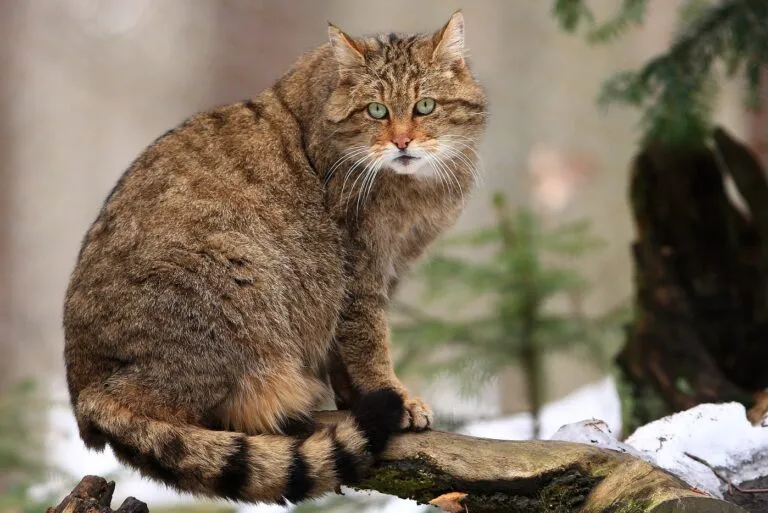
The European wildcat looks remarkably similar to the domestic cat. Its skull size, weight and tail length are comparable to those of its domesticated counterpart. However, there are also differences: wild forest cats have a stockier build and a very bushy tail which, unlike that of a domestic cat, ends bluntly rather than tapering to a point. When threatened, the fur on the tail stands on end, creating a very impressive display.
Hidden from Its Prey
The European wildcat hunts in the undergrowth and therefore needs excellent camouflage. Its always-tabby coat comes in subtle colours ranging from cream-brown and reddish-grey to silvery tones. Along its back runs a distinctive black stripe that extends to the base of the tail.
The voluminous tail is typically ringed and has three to five black bands. An important identifying feature: the tip of the European wildcat’s tail is always black, and there is always a light-coloured patch beneath the chin.
Feral domestic cat?
Even though they look very similar to our familiar pet cats, European wildcats are not feral domestic cats but a separate, non-domesticated species.
Compact Body with a Bushy Tail
Male European wildcats grow to between 55 and 65 centimetres in length, with an additional tail measuring around 30 centimetres long. Weighing between 3.8 and 7.5 kilograms, they can appear quite powerful. Female cats, on the other hand, are more slender, measuring 47 to 57 centimetres in length and weighing an average of 4 kilograms.
European wildcats live for around seven to ten years in the wild. In wildlife enclosures or zoos, they can even reach 15 years of age.
After being almost wiped out, the European wildcat population has now recovered.
Habitat: Vast, Remote Forests of Europe
European wildcats prefer extensive mixed or deciduous forests with little human disturbance. They can be found in Scotland, Spain, Portugal and the Balkans, for example. They also occur in Germany, although their habitat there is becoming increasingly limited. At present, thanks in part to numerous conservation programmes, around 8,000 animals are estimated to be living in Germany once again.
These wild cats live in forests and along forest edges. They seek shelter among the trees, but when all is quiet, they also venture into open countryside between hedgerows near woodland.
Not a Pet
As the name suggests, the European wildcat is a wild animal. It is completely unsuitable for domestic life. Even European wildcats that are hand-reared by humans remain wild and cannot be trained into tame pets.
Mating with free-roaming domestic cats is generally possible due to their close relationship, but studies in Germany have shown that this almost never happens. Wildcats seem to keep their distance from domesticated relatives and stay among their own kind.
Behaviour: Shy “Ghosts of the Forest”
In the wild, wildcats are difficult to spot because they have very keen senses, notice humans early on and generally avoid encounters. As a result, walkers almost never come across them by chance. Observing these wild animals requires a great deal of patience or wildlife cameras. These shy animals tolerate cameras and do not react by fleeing.
Intelligent wildcats: The brain of the European wildcat is larger than that of the domestic cat. Biologists therefore assume that its intelligence and cognitive abilities are correspondingly high.
Efficient Predators
Just like our domestic cats, European wildcats are ambush hunters, stealthily creeping up on their prey unnoticed before killing it with a sudden leap. They usually dispatch their prey with a bite to the neck.
Their sharp predator’s teeth and eighteen long, razor-sharp claws make these wild cats remarkably defensive for their size. Their acute senses also provide all the information they need for hunting. This makes them a perfect example of a successful predator.
How Large Is a European Wildcat’s Territory?
The size of a cat’s territory depends on the availability of prey. In areas with an optimal and plentiful food supply, 2 to 3 square kilometres are enough for a wildcat to feed itself and any potential offspring.
In areas with little prey, however, the territory can quickly expand to more than 10 square kilometres. This means the animals must expend significantly more effort and travel greater distances in order to hunt successfully.
Male cats generally hunt in larger territories than females. This is mainly linked to claiming areas against rivals of the same species. European wildcats are solitary animals and roam their territory alone.
Diet: What Does a European Wildcat Eat?
The European wildcat’s diet varies depending on what is available in the region. Most commonly, they eat various mice and rats. On the continent, they occasionally also feed on lizards, birds, frogs or insects.
In Scotland, however, the wildcat feeds mainly on rabbits. Wildcats only resort to carrion, roe deer fawns and wild boar piglets in emergencies. As strict carnivores, they do not eat plants.
Reproduction: How Do European Wildcats Breed?
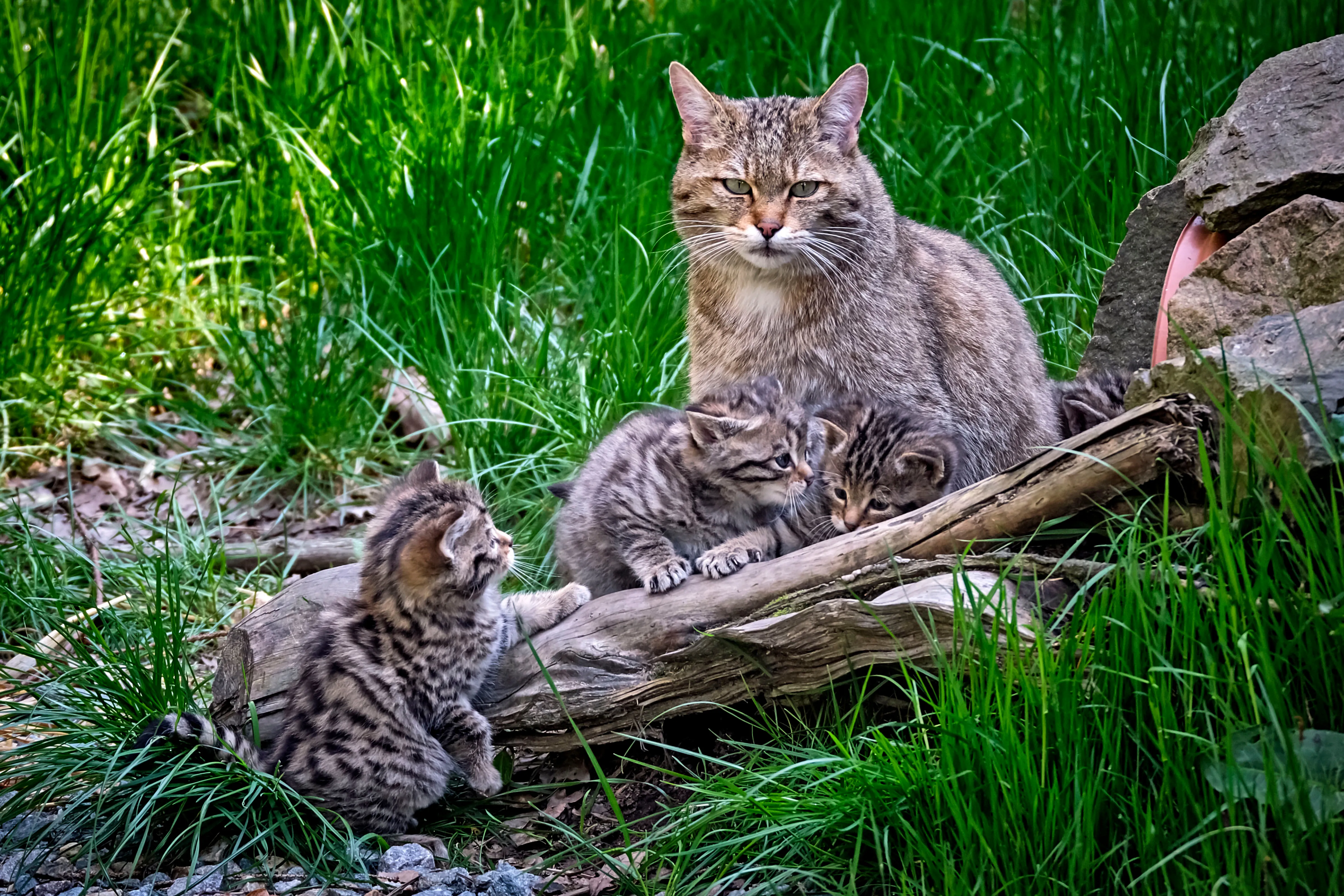
The wildcat’s mating season begins in January and reaches its peak in the second half of February. After a gestation period of 63 to 69 days, the female gives birth to two to four kittens, which are fully nursed by their mother during the first few weeks. Later, she brings them mice and other prey. During the summer months, the mother teaches her young how to hunt independently.
Most European wildcat litters are born in April. If many kittens die at birth, a second litter may be born in autumn in rare cases.
Threat Status: Is the European Wildcat Endangered?
There was a time when the European wildcat faced a bleak future. By the end of the 19th century, it was considered extinct across large parts of Europe – a consequence of uncontrolled hunting. Today, the situation looks better: year-round legal protection from hunting, conservation measures and the consistent rebuilding of the population have helped stabilise numbers.
Today, its greatest enemy is the increasing expansion of human land use. Ever-expanding settlements are destroying the cat’s natural habitat and pushing this shy animal back into the country’s quiet, untouched forests. Across Europe, the European wildcat remains a strictly protected species. In Germany, it is considered endangered and is listed on the “Red List”.
Conclusion: A Wild Animal Through and Through
The European wildcat is not a pet, but a genuine wild animal. It cannot be tamed and is protected in Germany by various laws. Keeping or purchasing one is not possible for private individuals. In the wild, these fascinating and extremely shy creatures are rarely encountered. Anyone wishing to catch a glimpse of a European wildcat should visit a wildlife park.
This article was translated using Artificial Intelligence from the original German zooplus Magazine. While the original content was authored by industry experts and reviewed by our editorial team, this automated translation has not been human-edited and is provided for informational purposes.
zooplus Editorial Team
The zooplus editorial team consists of a dedicated team of experts with many years of experience in the field of animal husbandry: Luisa with her White Swiss Shepherd Elyos, Laura, Julio, and Florian. Together with a large network of animal experts, we work to make the zooplus magazine a trusted source of information for all animal owners and lovers. Our goal is to provide exciting animal knowledge and relevant information on the proper care of pets.
The Maine Coon has become one of the most popular cat breeds in the world. This is probably due to its majestic appearance, robust nature and great character.
Large eyes and attentively upright ears instantly tell you a great deal about this charming breed of cat: Abyssinians are inquisitive and affectionate towards people.
With its long, dense fur, rounded ears, and intense stare, the Pallas Cat, or Manul, looks rather fluffy, yet somewhat dangerous. However, don't be fooled by its appearance—this is no petting zoo resident. The Manul is a wild animal and considered untameable.